
Neuroscientist • Parkinson’s Researcher
Mental overload in Parkinson’s disease is more common than many people realize, yet it’s rarely talked about. If you often feel mentally drained after conversations, overwhelmed in busy places, or find it harder to concentrate as the day goes on, you’re not alone. In this article, you’ll learn why mental overload happens in Parkinson’s disease, the common triggers to watch for, and 7 practical, research-based strategies to help protect your mental energy and make everyday life feel more manageable.

Have you ever reached a point where your brain simply says, “That’s enough”?
Maybe you’ve been answering questions, making decisions, following conversations, or trying to concentrate — and suddenly everything feels like too much. Even simple tasks can become overwhelming, and all you want is a few moments of peace and quiet.
For many people living with Parkinson’s disease, this experience is surprisingly common. It’s often called mental overload — a state where the brain has used up much of its mental energy and struggles to process any more information. Although it’s rarely discussed, mental overload can affect your focus, decision-making, mood, and ability to get through everyday activities.
In this article, we’ll explore why mental overload happens in Parkinson’s disease, how to recognize the warning signs, and, most importantly, practical research-based strategies that can help you protect your mental energy throughout the day.
Disclaimer: The information shared here should not be taken as medical advice. The opinions presented here are not intended to treat any health conditions. For your specific medical problem, consult with your healthcare provider.
What is mental overload in Parkinson’s disease?
Mental overload is the feeling that your brain has simply reached its limit. It can happen after concentrating for a while, making several decisions, following conversations, or coping with a busy or noisy environment. At that point, even tasks that normally feel manageable may suddenly seem difficult.
Unlike ordinary tiredness, mental overload is not just about needing more sleep. And unlike dementia, it does not necessarily mean you are losing your memory or intelligence. Instead, it reflects how much extra effort your brain is using to process everyday information.
Many Parkinson’s patients describe it as:
- “My brain feels full.”
- “I can’t think straight anymore.”
- “Everything suddenly feels too much.”
- “I just need some quiet.”
- “I know what I want to do, but my brain won’t cooperate.”
These experiences are more common than many people realize. Parkinson’s affects not only movement but also the brain networks responsible for attention, planning, decision-making, and filtering distractions. As these networks work harder to perform everyday tasks, mental energy can run out more quickly, leaving you feeling mentally exhausted long before your body is tired.
Mental overload is often manageable. Once you understand why it happens and learn to recognize the early warning signs, you can take simple steps to protect your mental energy and reduce its impact on daily life.
Why does Parkinson’s disease cause mental overload?
Parkinson’s disease is often thought of as a movement disorder, but dopamine does much more than help you move. It also plays an important role in how your brain focuses, plans, switches between tasks, filters distractions, and processes information.
As dopamine-producing brain cells are gradually lost, these mental processes become less efficient. Everyday activities that once happened almost automatically — such as following a conversation, making decisions, or remembering several pieces of information at once — begin to require much more conscious effort.
Think of it like walking across a flat road versus climbing a hill. You may reach the same destination, but climbing uphill takes far more energy. In a similar way, the Parkinson’s brain often has to work much harder to complete everyday thinking tasks that once felt effortless.
Over the course of a day, this extra effort can gradually drain your brain’s “mental energy.” As that energy runs low, concentrating becomes more difficult, distractions become harder to ignore, and even simple decisions may start to feel overwhelming. This is why many people with Parkinson’s notice that their thinking becomes slower or more tiring as the day goes on, particularly after busy, noisy, or mentally demanding activities.
Mental overload is therefore not a sign of laziness or a lack of motivation. It is often the result of a brain that is working harder than usual to keep up with the demands of everyday life.
The illustration below shows why many people with Parkinson’s disease feel mentally exhausted by the end of the day, even after what seems like a normal day.
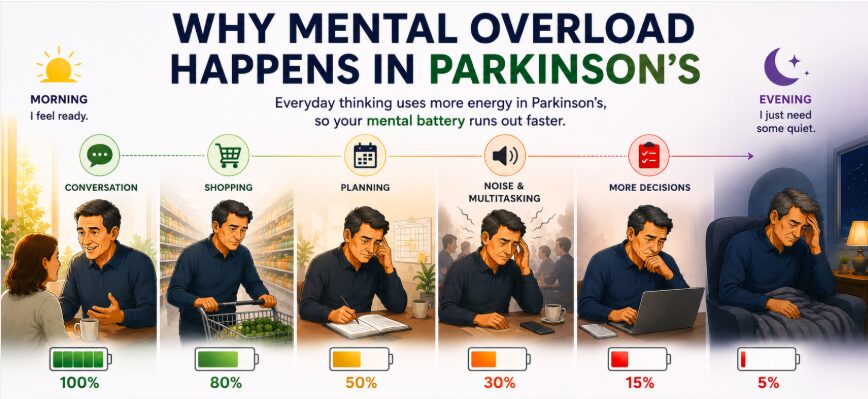
It’s not that your brain is unable to do these everyday tasks — it simply has to use more mental energy to complete them, causing your “mental battery” to run down faster.
Signs you’re experiencing mental overload
Mental overload doesn’t usually happen all at once. Instead, it often builds up gradually throughout the day as your brain uses more and more mental energy. Learning to recognize the early warning signs can help you take a break before you reach the point of complete exhaustion.
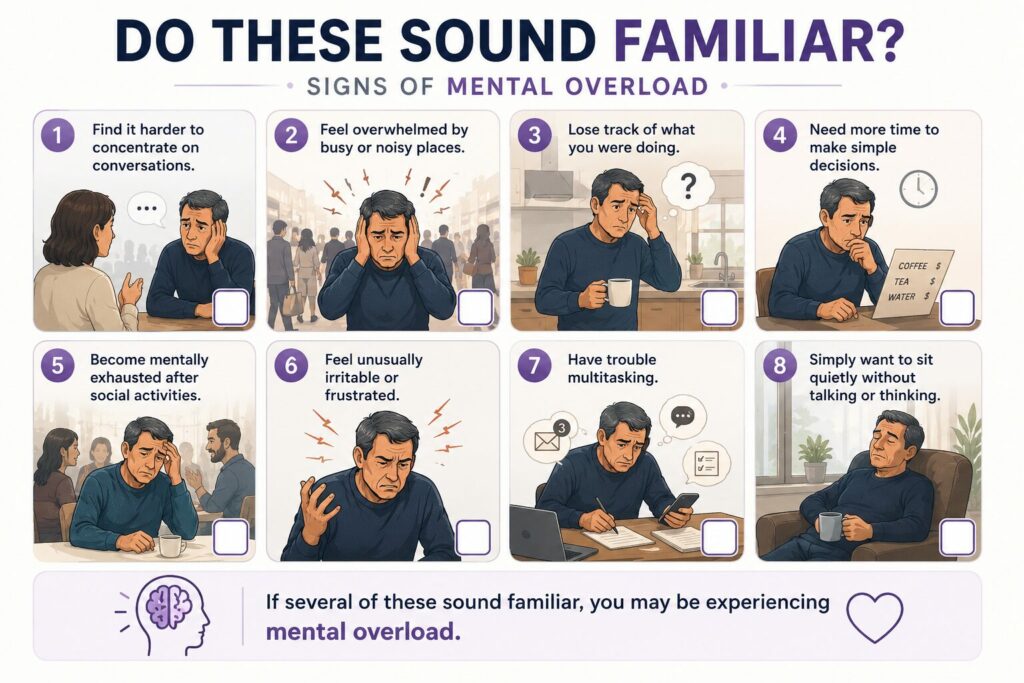
You may be experiencing mental overload if you notice that you:
- Find it harder to concentrate on conversations.
- Feel overwhelmed by busy or noisy places.
- Lose track of what you were doing.
- Need more time to make simple decisions.
- Become mentally exhausted after social activities.
- Feel unusually irritable or frustrated.
- Have trouble multitasking.
- Simply want to sit quietly without talking or thinking.
Not everyone experiences mental overload in the same way. Some Parkinson’s patients notice difficulty concentrating, while others become easily overwhelmed by noise, crowds, or having too many things happening at once. Paying attention to these early warning signs can help you protect your mental energy before you become completely drained.
What can trigger mental overload?
Mental overload doesn’t happen randomly. Many Parkinson’s patients notice that certain situations, environments, or symptoms make it more likely. While everyone’s experience is different, recognizing your personal triggers can help you plan your day and protect your mental energy.
Some of the most common triggers include:
Busy or noisy environments
Crowded shops, restaurants, family gatherings, or places with constant background noise require your brain to process many sights and sounds at the same time. This can quickly become exhausting.
Multitasking
Trying to do several things at once — such as talking while cooking, answering messages while watching television, or managing multiple errands — places extra demands on the brain. Focusing on one task at a time is often much easier.
Poor sleep
A restless night can leave your brain with less mental energy before the day has even begun. Many people find that mental overload develops much sooner after inadequate sleep.
Medication wearing off
During an OFF period, thinking, concentrating, and making decisions may require even more effort, increasing the risk of mental overload.
Pain, stress, and anxiety
Living with ongoing pain or emotional stress can consume valuable mental resources, making it harder to cope with everyday activities.
Too many decisions
Planning appointments, organizing medications, paying bills, or making several choices in a short period of time can gradually drain your mental energy.
Long social interactions
Conversations and social events can be enjoyable, but they also require sustained attention, listening, responding, and filtering distractions. For some people, this becomes mentally exhausting after a while.
A helpful reminder
You may not be able to avoid every trigger, but you can often reduce their impact. The first step is simply noticing when mental overload tends to happen. Over time, many people begin to see patterns — for example, feeling more mentally drained after poor sleep, during OFF periods, or after spending time in busy environments
7 Research-based ways to reduce mental overload in Parkinson’s disease
Mental overload isn’t something you simply have to “push through.” Because Parkinson’s disease changes the way the brain processes information, protecting your mental energy can be just as important as managing your physical symptoms. Small adjustments throughout the day can make everyday tasks feel much more manageable.
1. Plan your day around your best “ON” time
Mental clarity often changes throughout the day in Parkinson’s disease. Many people find they think more clearly when their medication is working well and struggle more during OFF periods.
If possible, schedule activities that require concentration — such as paying bills, attending appointments, making important decisions, or shopping — during your best “ON” time. Save simpler activities for times when your brain feels more tired.
Practical tip: Ask yourself, “When does my mind usually feel its clearest?” Try to protect that time for your most important tasks.
2. Give your brain permission to do one thing at a time
Parkinson’s disease can make switching between tasks much harder because your brain has to work harder to process information.
Instead of cooking while talking on the phone, checking messages, and watching television, focus on one activity before moving to the next.
Doing one thing well often requires less mental energy than trying to do several things at once.
Remember: Slowing down isn’t giving up — it’s using your energy more wisely.
3. Reduce noise and other unnecessary distractions
For many people with Parkinson’s disease , noisy environments can quickly become overwhelming because the brain has to work harder to filter background sounds.
Whenever possible:
- Turn off the television during conversations.
- Choose quieter cafés or restaurants.
- Step outside for a few minutes if a room becomes too busy.
- Ask family members to speak one at a time.
Reducing distractions allows your brain to focus on what matters most
4. Take a mental break before you need one
Many Parkinson’s patients wait until they feel completely exhausted before stopping.
Instead, try taking a short “brain break” every hour or two, especially after activities that require concentration or social interaction.
Sit somewhere quiet, close your eyes, enjoy a cup of tea, or simply spend a few minutes without conversation, television, or your phone.
A short pause now may help prevent mental overload later in the day.
5. Break large tasks into small, achievable steps
Mental overload often begins when a task feels too big.
Instead of thinking:
“I need to organize the whole house.”
Think:
“I’ll organize one drawer.”
Instead of planning the entire week, plan just this morning.
Small successes reduce mental stress and make it easier to keep going.
6. Look after the things that drain your mental energy
Mental overload is often worse after:
- Poor sleep
- Pain
- Anxiety or stress
- Long OFF periods
- Busy social events
You may not be able to avoid these completely, but recognizing them can help you prepare.
For example, if you know you’ll attend a family gathering, plan some quiet recovery time afterwards instead of scheduling more activities.
Protecting your mental energy is just as important as protecting your physical energy.
7. Track your mental energy to discover your own patterns
Mental overload rarely happens without a reason.
You may notice that it appears after a poor night’s sleep, before your next medication dose, after spending time in crowded places, or on days when your pain is worse.
Keeping a simple record of your symptoms can help you identify these patterns over time.
If you’re using the Parkinson’s Daily Diary, take less than a minute each day to record your mental energy alongside your medication timing, sleep, pain, and other symptoms. After a few weeks, you may begin to notice patterns that aren’t obvious from memory alone. These insights can help you plan your day more effectively and have more productive conversations with your healthcare team.
Final thought
Mental overload doesn’t mean you’re becoming lazy, losing your intelligence, or “not trying hard enough.” It often means your brain has been working harder than most people realize. By learning to protect your mental energy — and by giving yourself permission to rest when you need it — you can often reduce the impact of mental overload and make everyday life feel more manageable.
When should you talk to your doctor about mental overload?
Experiencing mental overload from time to time is common in Parkinson’s disease, especially after a busy day or during periods of stress. However, if it begins to interfere with your daily life or suddenly becomes much worse, it’s worth discussing with your healthcare team.
Mental overload isn’t always caused by Parkinson’s disease alone. Sometimes it can be made worse by problems that can be identified and treated.
You should consider speaking with your doctor if you notice that:
- Mental exhaustion is becoming more frequent or more severe.
- Your thinking has changed suddenly over days or weeks.
- You’re struggling to manage everyday activities that were previously manageable.
- Mental overload is affecting your work, relationships, or independence.
- Your symptoms seem to become much worse during OFF periods or after medication changes.
- You are also experiencing persistent low mood, anxiety, poor sleep, or significant pain.
Your doctor may review several factors that could be contributing, including:
- Whether your Parkinson’s medication timing needs adjusting.
- Sleep problems such as insomnia or REM sleep behavior disorder.
- Anxiety or depression, which commonly occur alongside Parkinson’s disease.
- Pain or other symptoms that increase mental fatigue.
- Changes in memory or thinking that deserve further assessment.
Remember, bringing up mental overload during an appointment is not complaining — it’s an important part of understanding how Parkinson’s disease is affecting your daily life. The more clearly you can describe when it happens, what seems to trigger it, and how it affects your routine, the easier it is for your healthcare team to identify possible solutions.
A small tip before your next appointment
Rather than simply saying,
“I’m mentally exhausted.”
Try giving specific examples, such as:
- “I become overwhelmed after shopping.”
- “I can’t concentrate once my medication starts wearing off.”
- “I need complete silence after family gatherings.”
- “Making simple decisions becomes much harder in the afternoon.”
These real-life examples often provide more useful information than describing the symptom alone.
Key takeaways
- Mental overload is a common but often overlooked symptom of Parkinson’s disease. It happens because the brain has to work harder to process everyday information, not because you’re “losing your mind.”
- Mental overload is different from ordinary tiredness. It can make conversations, decision-making, multitasking, and busy environments feel overwhelming.
- Common triggers include OFF periods, poor sleep, pain, stress, anxiety, noisy environments, and trying to do too many things at once.
- Small daily strategies can make a difference. Planning important tasks during your best “ON” times, focusing on one task at a time, taking regular mental breaks, and reducing distractions can help protect your mental energy.
- Tracking your symptoms can help you identify patterns. Understanding when mental overload occurs can help you adjust your routine and provide valuable information to discuss with your healthcare team.
- If mental overload suddenly worsens or begins interfering with your daily life, speak with your doctor. There may be treatable factors, such as medication timing, sleep problems, anxiety, depression, or pain, contributing to your symptoms.
Final thoughts
Mental overload is one of the invisible symptoms of Parkinson’s disease. Unlike a tremor or changes in walking, other people can’t always see it. Yet for many patients, it can be just as challenging — making conversations harder to follow, decisions more exhausting, and everyday activities feel overwhelming.
The important thing to remember is that mental overload doesn’t mean you’re becoming lazy, losing your intelligence, or “not trying hard enough.” It reflects the extra effort your brain is making to manage Parkinson’s disease every single day.
Although you may not be able to eliminate mental overload completely, there are many ways to reduce its impact. Learning to recognize your personal triggers, planning demanding tasks during your best “ON” times, taking regular mental breaks, and looking after your sleep and overall well-being can all help you make better use of your mental energy.
Most importantly, be kind to yourself. Some days will be easier than others, and that’s a normal part of living with Parkinson’s disease. Instead of measuring your day by how much you accomplished, remember that managing your symptoms and protecting your energy are achievements in themselves.
Small changes may not seem significant at first, but over time they can help you feel more in control, reduce frustration, and make everyday life more manageable.
Get Your Free Parkinson’s Medication Management Diary
Download your free printable diary to easily track your medications, symptoms, and doses.