
Neuroscientist • Parkinson’s Researcher
Why does Parkinson’s disease cause pain? It’s a question many people ask after experiencing aching muscles, painful cramps, or burning sensations that they never expected. Parkinson’s disease pain is often manageable once you understand what’s causing it.
In this guide, you’ll learn why Parkinson’s causes pain, the five main types of Parkinson’s pain, and the evidence-based strategies that can help you find relief.

“My shoulder hurts all the time.”
“Why do my legs ache so much?”
“Nobody told me Parkinson’s disease could be painful.”
If you’ve asked yourself any of these questions, you’re not alone.
Although Parkinson’s disease is often associated with tremor, stiffness, and slow movement, pain is one of its most common and most overlooked symptoms. It can affect the shoulders, neck, back, hips, legs, or feet, and for many people, it has a greater impact on daily life than the movement symptoms themselves.
The good news is that Parkinson’s disease pain is often treatable. The first step is understanding why it happens. In many cases, the pain is not caused by an injury but by changes in the brain, muscle stiffness, abnormal muscle contractions, or even the timing of Parkinson’s medication.
In this article, you’ll learn:
- Why Parkinson’s disease can cause pain
- The five main types of Parkinson’s disease pain and how to recognize them
- What treatments and self-care strategies are supported by research
- When it’s important to speak with your doctor
- How tracking your pain can help improve your treatment
Disclaimer: The information shared here should not be taken as medical advice. The opinions presented here are not intended to treat any health conditions. For your specific medical problem, consult with your healthcare provider.
Can Parkinson’s disease cause pain?
Yes. Pain is a common symptom of Parkinson’s disease, although many people are surprised to learn this. While Parkinson’s disease is best known for causing tremor, stiffness, and slow movement, pain can affect more than half of people living with the condition, and for some, it can even appear before a diagnosis is made.
Parkinson’s disease pain can feel very different from person to person. Some people experience aching muscles or stiff shoulders, while others describe burning, cramping, sharp, or electric shock-like pain. It may come and go throughout the day, often changing as Parkinson’s medications wear off and begin working again.
One reason Parkinson’s disease pain is often misunderstood is that it doesn’t always have an obvious cause. You might have shoulder pain without an injury, leg pain without arthritis, or painful muscle cramps that seem to appear out of nowhere. This can be frustrating and sometimes lead people to think that the pain is unrelated to Parkinson’s.
The reality is that Parkinson’s disease can affect the body’s pain pathways in several different ways. Changes in dopamine levels, muscle stiffness, abnormal muscle contractions, changes in posture, and altered pain processing in the brain can all contribute to pain. Understanding the underlying cause is important because different types of Parkinson’s disease pain often require different treatments.
The encouraging news is that many people experience significant improvement once the specific cause of their pain is identified. This may involve adjusting Parkinson’s disease medication, improving movement, starting physiotherapy, or using other targeted treatments recommended by their healthcare team.
But why does Parkinson’s disease cause pain in the first place? Let’s take a simple look at what’s happening inside the body.
Why does Parkinson’s disease cause pain?
Parkinson’s disease is caused by the gradual loss of brain cells that produce dopamine, a chemical messenger that helps control smooth, coordinated movement. As dopamine levels fall, the brain has more difficulty sending clear signals to the muscles.
As a result, muscles may stay tight instead of relaxing normally. This can lead to stiffness (rigidity), painful muscle cramps (dystonia), changes in posture, and reduced movement. Over time, these changes place extra strain on muscles, joints, and tendons, making everyday activities more uncomfortable.
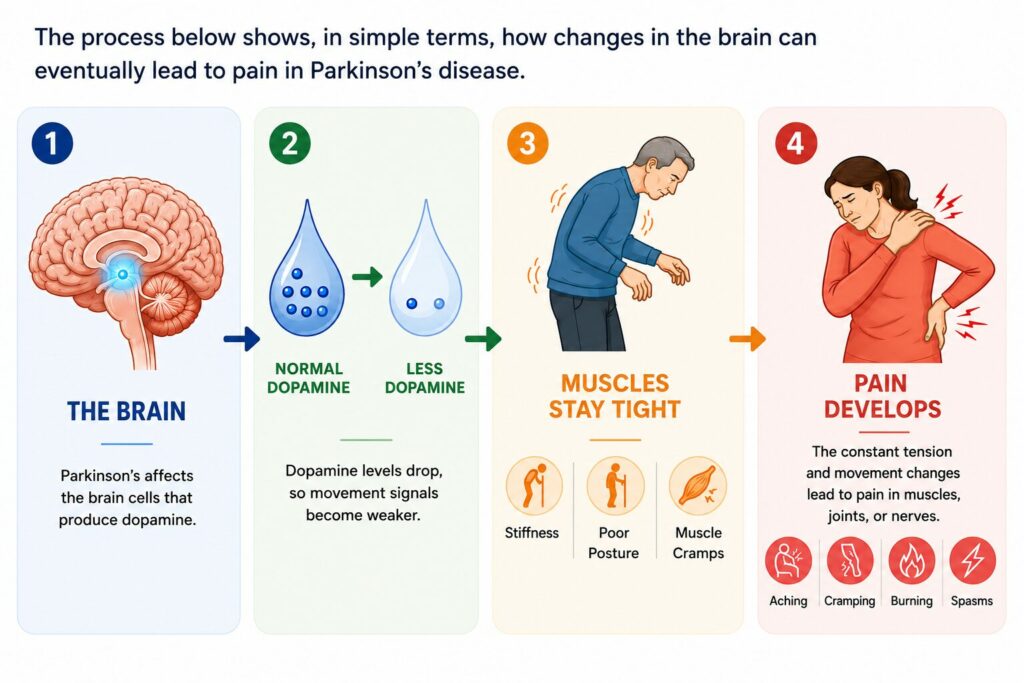
As the infographic shows, reduced dopamine doesn’t just affect movement—it can also lead to muscle stiffness, painful muscle cramps (dystonia), changes in posture, and reduced mobility. Over time, these changes place extra strain on muscles, joints, and tendons, making everyday activities more uncomfortable.
But that’s only part of the story.
Researchers now know that Parkinson’s disease can also affect how the brain processes pain itself. In other words, the brain may become more sensitive to pain signals, meaning discomfort can feel stronger or last longer than it otherwise would.
This is why two people with similar movement symptoms can experience very different levels of pain. It also explains why pain sometimes appears before obvious movement symptoms or without any injury at all.
The good news is that understanding what is causing your pain is the first step toward finding the most effective treatment. Different types of Parkinson’s disease pain often respond to different approaches, which is why identifying the source of the pain is so important.
So, what type of Parkinson’s disease pain are you experiencing? Let’s look at the five main types of Parkinson’s disease pain and how to recognise them.
The 5 main types of Parkinson’s disease Pain
Not all pain in Parkinson’s disease feels the same. Some people experience aching muscles, while others have painful cramps, burning sensations, or pain that seems to have no obvious cause.
Understanding which type of pain you’re experiencing can help you and your healthcare team choose the most effective treatment.
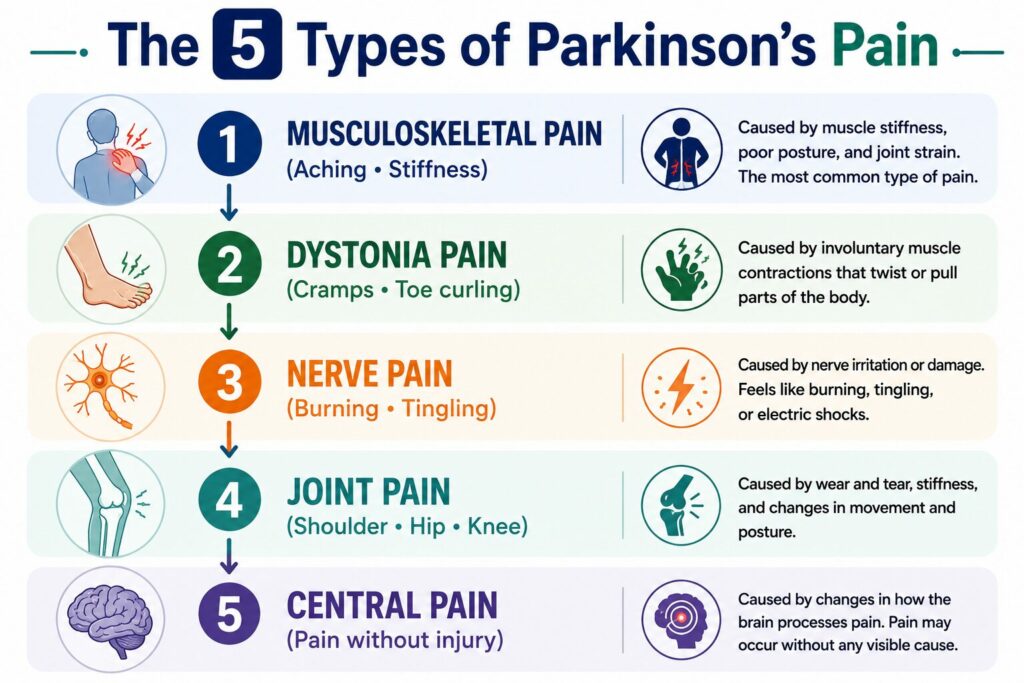
1. Musculoskeletal pain (the most common type)
This is the most common type of pain in Parkinson’s disease. It happens because muscles remain stiff, posture changes over time, and joints are placed under extra strain.
It often feels like:
- Aching muscles
- Stiff shoulders or neck
- Lower back pain
- Hip discomfort
- Muscle soreness
What may help:
- Adjusting Parkinson’s disease medication
- Regular movement and stretching
- Physiotherapy
- Heat therapy
2. Dystonia pain
Dystonia is caused by involuntary muscle contractions that force part of the body into an abnormal position. It can be extremely painful and often occurs when Parkinson’s disease medication is wearing off.
It often feels like:
- Foot or toe curling
- Painful muscle cramps
- Fingers or hands pulling into unusual positions
- Tight jaw or neck muscles
What may help:
- Medication adjustment
- Stretching exercises
- Botulinum toxin injections in selected cases
- Discussing symptoms with your neurologist
3. Nerve (neuropathic) pain
Some people experience pain that feels different from muscle stiffness. Instead, it may feel like burning, tingling, numbness, or an electric shock.
This type of pain may be related to compressed nerves, spinal problems, or changes in how the nervous system processes pain.
It often feels like:
- Burning
- Tingling
- Pins and needles
- Shooting pain
What may help:
- Medical assessment to identify the cause
- Physiotherapy
- Medications specifically used for nerve pain when appropriate
4. Joint pain
Changes in posture, reduced arm swing, stiffness, and altered walking patterns can place extra stress on the joints over time.
Common areas include:
- Shoulder
- Hip
- Knee
- Lower back
What may help:
- Gentle exercise
- Physiotherapy
- Improving posture
- Optimising movement with appropriate Parkinson’s treatment
5. Central Parkinson’s disease pain
This is one of the least understood types of Parkinson’s pain. Unlike other forms of pain, it isn’t caused by muscle stiffness or an injury. Instead, it appears to result from changes in how the brain processes pain signals.
People often describe it as:
- Deep aching
- Burning
- Widespread pain
- Pain without a clear physical cause
Although this type of pain can be difficult to treat, recognising it is important because it often requires a different management approach than muscle or joint pain.
While these five types of pain can feel very different, they all have one thing in common—they can significantly affect your daily life. The encouraging news is that many people experience meaningful relief once the underlying cause of their pain is identified and treated appropriately.
So, what actually helps? Let’s look at the evidence-based strategies that can make a real difference.
What actually helps relieve Parkinson’s disease pain?
There isn’t a single treatment that works for every type of Parkinson’s disease pain. The most effective approach depends on what is causing the pain in the first place. For example, pain caused by muscle stiffness may improve with movement and medication adjustments, while nerve pain or central pain often requires a different treatment strategy.
The good news is that many people find relief by combining medication with simple lifestyle changes and supportive therapies. Here are some of the approaches most commonly recommended by Parkinson’s disease specialists.
✅ Checklist: 5 Ways to Relieve Parkinson’s Pain
1. Make sure your Parkinson’s medication is working well
If your pain becomes worse before your next dose of medication and improves after taking it, the pain may be related to your OFF periods. This is especially common with stiffness, muscle cramps (dystonia), and musculoskeletal pain.
If you notice this pattern regularly, speak with your neurologist. A simple adjustment to your medication timing or dosage may significantly reduce your pain. Never change your medication without medical advice.
2. Keep moving every day
It may sound surprising, but staying still often makes Parkinson’s pain worse.
Regular physical activity helps reduce stiffness, improve flexibility, strengthen muscles, and maintain better posture. Even gentle activities such as walking, stretching, tai chi, yoga, or cycling can make a noticeable difference over time.
The key is consistency rather than intensity. Aim for some form of movement most days of the week, even if it’s only for a short time.
3. Try stretching and physiotherapy
Physiotherapy can be particularly helpful if your pain is caused by rigidity, poor posture, or reduced mobility.
A physiotherapist experienced in Parkinson’s disease can teach exercises that improve flexibility, posture, balance, and walking, while helping reduce strain on your muscles and joints.
Simple daily stretching—especially for the neck, shoulders, back, hips, and calves—can also help relieve stiffness and improve comfort.
4. Use heat, massage, and relaxation techniques
Many people with Parkinson’s find temporary relief from muscle pain by using simple, non-drug approaches.
These may include:
- Applying a warm compress or heating pad to stiff muscles
- Taking a warm shower or bath
- Gentle massage
- Relaxation or breathing exercises to reduce muscle tension
While these approaches won’t treat the underlying cause, they can help reduce discomfort and improve daily comfort.
5. Track your pain patterns
One of the most helpful things you can do is keep track of when your pain occurs.
Ask yourself:
- Is the pain worse before my next medication dose?
- Does it improve after taking medication?
- Which part of my body hurts?
- What was I doing when it started?
- Does exercise or rest make it better?
Keeping a simple record can reveal patterns that are difficult to remember during a clinic visit. These insights can help your neurologist adjust your treatment more effectively and may even help identify the type of Parkinson’s pain you’re experiencing.
While these strategies can help many people manage Parkinson’s pain, it’s important to remember that they won’t solve every type of pain. Sometimes, pain may be a sign that your treatment needs adjusting or that another medical condition is contributing to your symptoms.
So, how do you know when it’s time to seek medical advice?
When should you speak to your doctor about Parkinson’s disease pain?
Although pain is common in Parkinson’s disease, you should never assume that every new ache or pain is simply part of the condition. In some cases, pain may be caused by arthritis, a pinched nerve, an injury, or another medical problem that requires different treatment.
Speak with your healthcare provider if you notice any of the following:
✅ Your pain is severe or suddenly becomes much worse.
✅ The pain continues despite trying the strategies discussed above.
✅ The pain regularly interferes with walking, sleeping, or your daily activities.
✅ You notice numbness, significant weakness, or loss of bladder or bowel control.
✅ Your pain is consistently linked to your Parkinson’s disease medication wearing off.
A careful assessment can help determine the underlying cause of your pain and identify the most appropriate treatment. The sooner the cause is identified, the sooner you can start receiving the support you need.
Whether your pain is caused by Parkinson’s disease or another condition, one simple habit can make a big difference: tracking your symptoms over time.
By recording when your pain occurs, where it happens, and how it relates to your medication or daily activities, you may begin to notice patterns that are easy to miss—but incredibly valuable when discussing your treatment with your healthcare team.
Track your Parkinson’s disease pain to find patterns
One of the biggest challenges with Parkinson’s pain is that it doesn’t always stay the same. Some days you may feel almost pain-free, while on other days the pain can become much worse. It may also change depending on when you take your medication, how active you’ve been, your sleep, or even your stress levels.
Because these changes happen gradually, they’re often difficult to remember when you see your neurologist.
Keeping a simple record of your pain can help you answer important questions, such as:
- When does my pain usually occur?
- Which part of my body hurts the most?
- Is my pain worse before my next medication dose?
- Does exercise or stretching help?
- Is my pain becoming more frequent over time?
These patterns can help your healthcare team better understand your symptoms and decide whether changes to your treatment may be beneficial.
To make this easier, we’ve developed the Parkinson’s Daily Diary—a free app that lets you record your pain, medications, and other Parkinson’s symptoms in less than a minute each day. Over time, it creates clear reports that you can review yourself or share with your healthcare provider, making it easier to spot trends that might otherwise be missed.
Sometimes, the smallest daily observations can lead to the biggest improvements in managing Parkinson’s disease.
The Parkinson’s Daily Diary is a free app designed to help you better understand your symptoms by tracking:
- ✅ Pain
- ✅ Medication timing
- ✅ Tremor and stiffness
- ✅ Sleep and mood
- ✅ Daily notes
Over time, the app generates easy-to-read reports that you can review yourself or share with your healthcare provider to help identify symptom patterns.
Conclusion
Pain is one of the most common symptoms of Parkinson’s disease, but it doesn’t have to be something you simply “live with.” Understanding the type of pain you’re experiencing, working with your healthcare team, staying active, and tracking your symptoms can all play an important role in finding relief. While managing Parkinson’s disease pain often takes time and patience, many people are able to improve their comfort and quality of life with the right combination of treatments and daily habits.
Get Your Free Parkinson’s Medication Management Diary
Download your free printable diary to easily track your medications, symptoms, and doses.