
Written and reviewed as a literature-based educational guide by Dr. Akbar Zaib, PhD in Neurosciences
Neuroscientist and Parkinson’s researcher
Last updated: September 2026
A restless night can make tremor, stiffness, balance, concentration and fatigue feel harder the following day. Sleep problems in Parkinson’s disease are common, but they are not all caused by the same thing—and identifying what interrupts your sleep is the first step towards finding the right support.

Sleep is not simply a period of rest. It supports memory, mood, physical recovery and the ability to function safely during the day. When sleep is repeatedly interrupted, people with Parkinson’s disease may experience greater fatigue, reduced concentration, irritability and difficulty managing everyday activities.
Parkinson’s disease can affect sleep in several ways. Movement symptoms may make turning in bed difficult, medication may wear off overnight, and problems such as restless legs, vivid dreams, urinary urgency, pain, anxiety or sleep apnoea may repeatedly disturb sleep. Some people struggle to fall asleep, while others wake frequently, act out dreams or feel excessively sleepy during the day.
Because these problems have different causes, there is no single treatment that works for everyone. A useful starting point is to identify whether the main difficulty involves falling asleep, staying asleep, moving comfortably, breathing normally, unusual nighttime behaviour or staying alert during the day.
Key takeaway: Poor sleep should not automatically be accepted as an unavoidable part of Parkinson’s disease. Understanding the pattern can help your healthcare team identify appropriate and safer treatment options.
Common types of sleep problems in Parkinson’s disease
“Poor sleep” can mean very different things. Recognising the pattern matters because each problem may have a different cause and require a different approach.
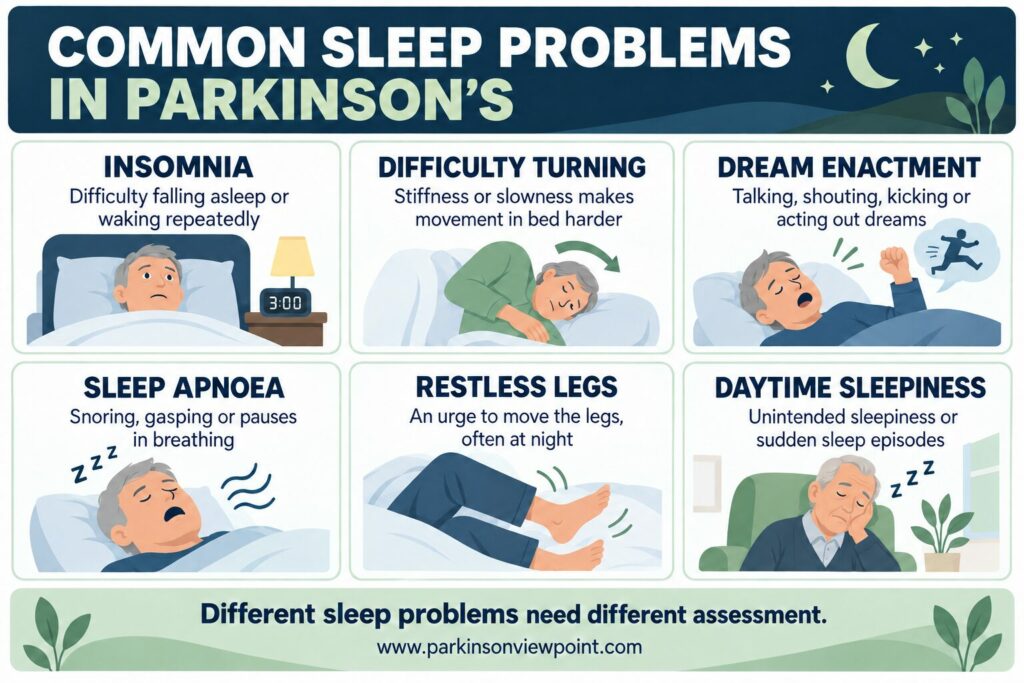
Insomnia
Insomnia includes difficulty falling asleep, waking repeatedly during the night or waking too early and being unable to return to sleep. In Parkinson’s disease, it may be related to anxiety, depression, pain, nighttime stiffness, tremor, urinary urgency, medication effects or an inconsistent sleep schedule.
Difficulty turning or moving in bed
Slowness and rigidity can make rolling over, changing position or getting out of bed difficult. Symptoms may become more noticeable when Parkinson’s disease medication wears off overnight. This can cause repeated awakenings and may also disturb a sleeping partner.
REM sleep behaviour disorder
During normal rapid eye movement—or REM—sleep, most muscles are temporarily relaxed. In REM sleep behaviour disorder, this relaxation is reduced or absent, allowing a person to physically act out dreams.
Possible signs include:
- Shouting, talking or swearing during sleep
- Punching, kicking or reaching
- Falling or jumping out of bed
- Vivid, action-filled dreams
- Injuries to the person or their sleeping partner
Occasional talking or movement does not automatically mean REM sleep behaviour disorder. Repeated or potentially dangerous dream enactment deserves medical assessment.
Restless legs and periodic limb movements
Restless legs syndrome creates an uncomfortable urge to move the legs, usually while resting in the evening or at night. Movement often provides temporary relief. Periodic limb movements are repeated leg or arm movements during sleep that the person may not notice, although they can fragment sleep.
These problems can have several causes, including iron deficiency and medication effects, so they should be assessed rather than assumed to be caused entirely by Parkinson’s disease.
Sleep apnoea
Obstructive sleep apnoea causes breathing to repeatedly stop or become restricted during sleep. Warning signs can include:
- Loud or persistent snoring
- Gasping, choking or witnessed pauses in breathing
- Morning headaches or dry mouth
- Unrefreshing sleep
- Excessive daytime sleepiness
- Problems with concentration or mood
A sleep study may be needed to confirm the diagnosis. Sleep apnoea is treatable and should not be dismissed as ordinary snoring.
Excessive daytime sleepiness
Some people with Parkinson’s disease feel unusually sleepy during the day or experience sudden episodes of sleep. Parkinson’s disease itself, disrupted nighttime sleep and certain medications—particularly some dopamine agonists—may contribute.
Unexpected sleepiness is especially important when driving, cooking or using machinery. Report it promptly to your healthcare team and avoid safety-sensitive activities until you have received appropriate advice.
Vivid dreams, nightmares and hallucinations
Vivid dreams may occur in Parkinson’s disease and can sometimes be influenced by medication. Hallucinations are different from dreams because they occur while a person is awake. New hallucinations, confusion or major behavioural changes require medical review, particularly when they appear suddenly.
Key takeaway: Identify the main pattern—difficulty sleeping, impaired movement, dream enactment, breathing disruption, uncomfortable legs or daytime sleepiness. This information helps healthcare professionals investigate the cause instead of treating every sleep problem in the same way.
Why Parkinson’s can disrupt sleep
Parkinson’s disease can affect the brain systems involved in regulating sleep and wakefulness. However, disrupted sleep is rarely caused by one factor alone. Movement symptoms, non-movement symptoms, medication effects and unrelated sleep disorders may all contribute.
The Parkinson’s Foundation notes that several of these factors often occur together.
Nighttime movement symptoms
Stiffness, tremor, muscle cramps and painful dystonia can make it difficult to relax or remain comfortable. Slowness of movement may also make turning over, adjusting bedding or getting to the bathroom more difficult.
Symptoms that return as medication wears off overnight can cause repeated awakenings. Recording when these symptoms occur in relation to medication doses can help the healthcare team determine whether nighttime OFF periods may be contributing.
Non-movement symptoms
Several non-movement symptoms can interrupt sleep, including:
- Anxiety or persistent worrying
- Depression
- Pain
- Urinary urgency or frequent nighttime urination
- Excessive sweating
- Vivid dreams or hallucinations
- Constipation or abdominal discomfort
- Reflux
- Drooling or difficulty managing saliva
Treating the underlying symptom may be more helpful than simply adding a sleeping medication.
Medication effects
Parkinson’s disease medications can influence sleep differently. Some may improve sleep by controlling nighttime movement symptoms, while others may contribute to vivid dreams, insomnia, confusion or daytime sleepiness.
Dopamine agonists can sometimes cause pronounced sleepiness or sudden episodes of sleep. Other medicines—including drugs used for pain, mood, allergies or bladder problems—may also affect alertness or sleep quality.
Do not independently change the dose or timing of prescribed medication. Instead, record the pattern and discuss it with your neurologist, Parkinson’s nurse or pharmacist.
Other medical and sleep conditions
Not every sleep problem is caused by Parkinson’s disease. Sleep apnoea, restless legs syndrome, heart or lung disease, thyroid problems, iron deficiency, chronic pain and age-related changes in sleep can occur independently.
Snoring, pauses in breathing, gasping, a strong urge to move the legs or severe daytime sleepiness may require targeted assessment or a sleep study.
Daily habits and environment
Irregular sleep times, long daytime naps, limited daylight exposure, inactivity, caffeine later in the day, alcohol and screen use close to bedtime can also interfere with sleep. Bedroom temperature, noise, lighting and an uncomfortable mattress may add to the problem.
These factors are not always the main cause, but adjusting them can support other treatments.
Key takeaway: Sleep disruption in Parkinson’s disease is usually multifactorial. Record the symptoms, timing, medication relationship and nighttime behaviours so your healthcare team can investigate the actual causes rather than treating poor sleep as one general problem.
Start by identifying your sleep pattern
Before trying a new treatment, record what actually happens during the night. A short sleep diary can reveal patterns that are difficult to remember during an appointment.
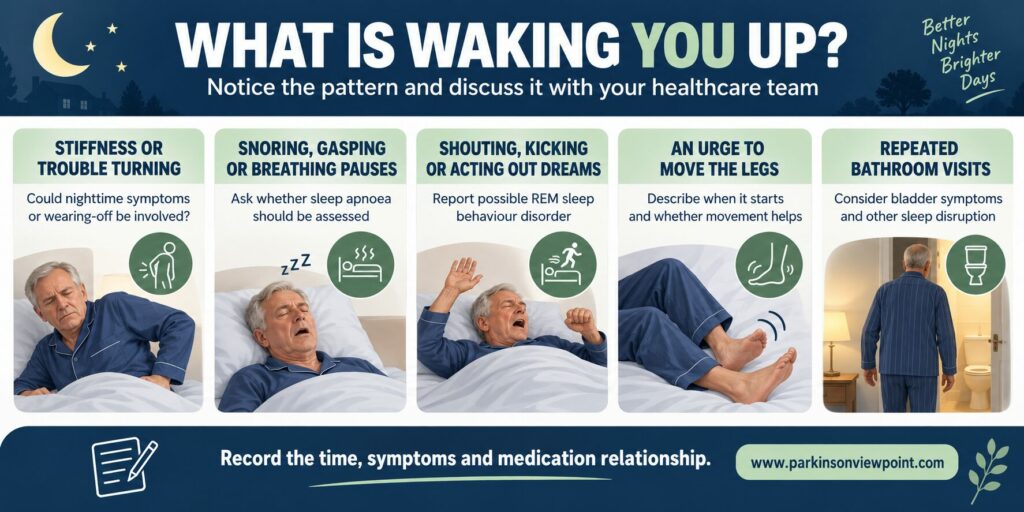
For one to two weeks, note:
- What time you go to bed
- Approximately how long it takes to fall asleep
- How often and why you wake
- Any stiffness, tremor, cramps, pain or difficulty turning
- Bathroom visits
- Snoring, gasping or pauses in breathing reported by another person
- Talking, shouting, kicking or acting out dreams
- Medication names and times
- Caffeine and alcohol intake
- Daytime naps
- Morning alertness and daytime sleepiness
If you share a bed, ask your partner or caregiver what they observe. Dream enactment, snoring, breathing pauses and repeated movements may be more noticeable to them than to you.
A phone recording may occasionally help document unusual sounds or movements, but do not intentionally provoke an episode or compromise anyone’s safety. A recording cannot diagnose a sleep disorder and should only be shared privately with an appropriate healthcare professional.
Bring the diary and an up-to-date medication list to your appointment. Depending on the pattern, your clinician may review medication timing, request blood tests, refer you to a sleep specialist or recommend an overnight sleep study.
Seek assessment sooner if you experience:
- Injuries caused by dream enactment
- Witnessed pauses in breathing or repeated gasping
- Sudden episodes of sleep during daytime activities
- Severe morning headaches with loud snoring
- New hallucinations, confusion or major behavioural changes
- Sleepiness that makes driving or other activities unsafe
Key takeaway: A sleep diary helps turn “I’m not sleeping well” into specific information that your healthcare team can investigate and act upon.
Build a consistent sleep routine
Good sleep habits cannot treat every Parkinson’s-related sleep disorder, but they can strengthen the body’s sleep–wake rhythm and reduce avoidable disruption.
Try to:
- Get up at approximately the same time every morning, including after a poor night.
- Go to bed when you feel sleepy rather than spending a long time awake in bed.
- Use the bed mainly for sleep and intimacy.
- Keep the bedroom dark, quiet and comfortably cool.
- Obtain daylight exposure soon after waking when possible.
- Remain physically active during the day according to your ability.
- Finish vigorous exercise several hours before bedtime if it makes you feel more alert.
- Create a calm wind-down routine, such as reading, listening to quiet audio or practising gentle breathing.
- Reduce bright screens and stimulating content before bed.
- Avoid caffeine in the late afternoon or evening.
- Avoid using alcohol as a sleep aid because it can fragment sleep and worsen balance, urination and breathing problems.
- Avoid heavy meals close to bedtime, particularly if reflux is a concern.
If you need a daytime nap, keep it relatively short and avoid napping late in the day. However, severe daytime sleepiness should be medically reviewed rather than managed only by taking more naps.
If you remain awake for a prolonged period, get out of bed if it is safe to do so. Sit somewhere quiet under low light and return to bed when you feel sleepy. People with mobility or fall concerns should keep the route clear, use suitable lighting and have stable support nearby.
The CDC’s sleep guidance similarly recommends a consistent schedule, a quiet and relaxing bedroom, reduced evening screen exposure and avoiding caffeine later in the day.
Key takeaway: Consistency matters more than creating a perfect bedtime routine. Choose a few realistic habits and practise them regularly while investigating persistent symptoms.
Manage nighttime stiffness and difficulty moving
Tremor, rigidity, painful muscle contractions and slowness can make it difficult to turn over, adjust the bedding or get out of bed. For some people, these symptoms appear or worsen when Parkinson’s disease medication wears off overnight.
Practical changes may include:
- Using lightweight bedding that is easier to move beneath
- Wearing smooth, comfortable sleepwear that reduces friction
- Using satin or silk-style sheets carefully if they make turning easier
- Choosing a bed height that allows the feet to rest securely on the floor
- Keeping a stable support close to the bed
- Installing a bedside rail only after professional advice and ensuring it cannot create an entrapment risk
- Practising safe turning and bed-transfer techniques with a physiotherapist or occupational therapist
- Allowing extra time when standing rather than moving suddenly
- Keeping mobility aids in a consistent, reachable position
Smooth sheets may make turning easier, but they can also increase the risk of sliding or falling when getting into or out of bed. Test any change cautiously and seek an occupational therapy assessment if transfers are becoming unsafe.
If symptoms repeatedly return at a similar time overnight, record:
- The time of the last evening medication dose
- The time symptoms begin
- Which symptoms appear
- Whether they improve after the next prescribed dose
- How often they interrupt sleep
Take this record to your neurologist or Parkinson’s nurse. A clinician may review the medication formulation, dose schedule or possible side effects, but you should not add nighttime doses or change medication timing independently.
Dizziness when sitting up or standing may be related to low blood pressure rather than stiffness alone. Sit on the edge of the bed for a moment, stand gradually and report recurring dizziness, fainting or falls to your healthcare team.
Key takeaway: Make the bed and surrounding area easier to navigate, record recurring overnight symptoms, and ask the healthcare team to review possible nighttime OFF periods rather than changing medication yourself.
Make the bedroom safer for dream enactment
Talking, shouting, punching, kicking or suddenly leaving the bed while dreaming may indicate REM sleep behaviour disorder. These episodes can injure the person with Parkinson’s disease or anyone sleeping nearby.
If dream enactment occurs, make safety the immediate priority:
- Remove sharp, heavy or breakable objects from beside the bed.
- Move bedside furniture away or pad sharp corners.
- Keep weapons and potentially dangerous objects outside the bedroom.
- Place a soft mat beside the bed to reduce injury if a fall occurs.
- Consider lowering the bed if this can be done without making transfers more difficult.
- Move the bed away from windows.
- Avoid restraining the person during an episode unless immediate danger makes intervention unavoidable.
- Consider separate sleeping arrangements when episodes are frequent or potentially dangerous.
Bed rails are not automatically safe. A person moving forcefully during sleep could strike, climb over or become trapped against them. Seek professional advice before installing rails or barriers.
Tell your neurologist or sleep specialist about repeated dream enactment. A clinical history—and sometimes an overnight video sleep study—may be needed to distinguish REM sleep behaviour disorder from sleepwalking, sleep apnoea, nighttime confusion or seizures.
The American Academy of Sleep Medicine’s clinical guideline emphasises creating a safe sleeping environment. It also conditionally recommends certain treatments, including immediate-release melatonin or clonazepam in selected adults, but the choice must be individualised.
Clonazepam can cause sedation, impaired balance, confusion and falls, particularly in older adults. Melatonin can also cause adverse effects and may vary in quality between products. Neither should be started at a high dose or used without discussing the appropriate product, dose and possible interactions with a healthcare professional.
Key takeaway: Repeated dream enactment is a medical and safety issue—not simply restless sleep. Make the bedroom safer immediately and seek professional assessment before using medication.
Do not ignore snoring or breathing pauses
Loud snoring, repeated gasping, choking or pauses in breathing may indicate obstructive sleep apnoea. This happens when the upper airway repeatedly narrows or closes during sleep, reducing airflow and disturbing sleep quality.
Other possible signs include:
- Waking with a dry mouth or headache
- Feeling unrefreshed despite spending enough time in bed
- Excessive daytime sleepiness
- Difficulty concentrating
- Irritability or mood changes
- Frequent nighttime urination
- A sleeping partner noticing breathing interruptions
Snoring alone does not confirm sleep apnoea, and not everyone with sleep apnoea snores loudly. A formal sleep assessment may be needed, particularly when breathing pauses or significant daytime sleepiness are present.
Diagnosis usually involves an overnight sleep study performed at home or in a sleep clinic. The test may record breathing, oxygen levels, heart rate, body position and sleep stages.
Treatment depends on the cause and severity. Options may include:
- Continuous positive airway pressure, commonly called CPAP
- Adjusting sleep position
- A professionally fitted oral appliance in selected cases
- Addressing nasal obstruction
- Weight management when appropriate
- Avoiding alcohol and sedating medicines that worsen airway collapse
- Referral to an ear, nose and throat or sleep specialist when necessary
Do not begin oxygen therapy or purchase a breathing device without proper assessment. Oxygen does not correct the airway obstruction itself, and the wrong equipment or settings may delay appropriate treatment.
Side sleeping can sometimes reduce position-dependent breathing problems, while flat back sleeping may worsen them. For practical positioning guidance, see our article on the best sleep positions for Parkinson’s patients.
Key takeaway: Repeated snoring, gasping or breathing pauses deserve assessment. Treating an underlying breathing disorder may improve sleep quality and daytime alertness more effectively than using a sleeping tablet.
Address restless legs at night
Restless legs syndrome causes an uncomfortable urge to move the legs, usually during rest in the evening or at night. People may describe crawling, pulling, tingling, aching or an internal restlessness that improves temporarily with walking or moving the legs.
It can be difficult to distinguish restless legs from other Parkinson’s-related problems, including:
- Nighttime rigidity
- Painful dystonia or muscle cramps
- Akathisia, which causes a more general inability to remain still
- Anxiety-related restlessness
- Neuropathy
- Wearing-off symptoms
A clear description of when the sensation begins, where it occurs and whether movement relieves it can help the clinician distinguish between these conditions.
Low iron stores can contribute to restless legs syndrome. Your healthcare professional may therefore request blood tests that include ferritin and other measures of iron status. Do not start high-dose iron independently because excessive iron can be harmful and treatment should be based on test results.
Helpful measures may include:
- Gentle walking or stretching before bed
- A warm bath or leg massage
- Limiting caffeine, particularly later in the day
- Keeping a regular sleep schedule
- Reviewing medicines that might aggravate symptoms
- Treating an identified iron deficiency
- Discussing persistent symptoms with a neurologist or sleep specialist
Some dopaminergic medicines can initially improve restless legs symptoms, but repeated use may sometimes cause augmentation—a pattern in which symptoms begin earlier, become more intense or spread to other parts of the body. Report these changes rather than taking an earlier or additional dose independently.
Key takeaway: Restless legs is not the same as ordinary stiffness or cramping. Describe the sensation and timing clearly, and ask whether iron testing or a medication review is appropriate.
Reduce nighttime bathroom disruption safely
Waking repeatedly to urinate — known as nocturia — is common in Parkinson’s disease. It may be related to bladder changes, medication, sleep apnoea, diabetes, prostate problems, fluid retention, urinary infection or other medical conditions.
Do not assume that every nighttime bathroom visit is caused by Parkinson’s disease. Contact a healthcare professional if urinary symptoms are new, painful, suddenly worse or accompanied by fever, blood in the urine, difficulty passing urine or unusual confusion.
Practical steps that may help include:
- Drinking adequately during the day rather than becoming dehydrated
- Reducing large amounts of fluid during the few hours before bedtime
- Limiting evening alcohol and caffeine
- Emptying the bladder shortly before bed
- Discussing the timing of diuretics or other relevant medication with a clinician
- Keeping the route to the bathroom clear and well lit
- Wearing footwear with good grip
- Keeping a walking aid within easy reach
- Sitting briefly before standing if you experience dizziness
- Using a bedside commode or urinal when walking to the bathroom is unsafe
Do not severely restrict fluids without professional advice. Dehydration can worsen constipation, dizziness, low blood pressure and confusion.
If your ankles or lower legs swell during the day, fluid may shift back into circulation when you lie down and increase urine production overnight. Ask your clinician whether daytime leg elevation, compression garments or further medical assessment would be appropriate for you.
Frequent nighttime urination may sometimes be a consequence of another sleep disorder: a person wakes because of sleep apnoea, pain or insomnia and then decides to use the bathroom. Recording whether bladder urgency actually caused the awakening can help clarify the pattern.
Key takeaway: Reduce evening disruption without becoming dehydrated, make the bathroom route safer and seek assessment for new or persistent urinary changes.
When to contact a healthcare professional
Contact your neurologist, Parkinson’s nurse or primary-care clinician if sleep problems persist, regularly affect daytime functioning or make it difficult to manage Parkinson’s disease safely.

Arrange an assessment if you notice:
- Difficulty falling or staying asleep on most nights
- Increasing nighttime stiffness, tremor, pain or difficulty turning
- Symptoms repeatedly returning as medication wears off overnight
- Loud snoring, gasping or witnessed pauses in breathing
- Shouting, punching, kicking or acting out dreams
- Falls or injuries during sleep or nighttime bathroom visits
- A strong urge to move the legs that repeatedly prevents sleep
- Frequent nighttime urination, particularly when it is new or worsening
- New vivid dreams, hallucinations or confusion
- Severe daytime sleepiness or unintended episodes of sleep
- Sleepiness that affects driving, cooking, work or other safety-sensitive activities
Bring a sleep diary and complete medication list to the appointment. Include prescribed medicines, over-the-counter sleep aids, antihistamines and supplements. Do not stop or change Parkinson’s disease medication independently.
Seek urgent medical help if a person:
- Has severe breathing difficulty, chest pain or bluish lips
- Cannot be awakened normally
- Develops sudden severe confusion or an abrupt change in awareness
- Sustains a significant head injury during a nighttime episode
- Shows possible signs of stroke, such as facial drooping, arm weakness or sudden speech difficulty
Key takeaway: Persistent sleep disruption deserves assessment, while breathing problems, inability to awaken, serious injury or sudden neurological changes require urgent help.
Key takeaways
Sleep problems in Parkinson’s disease can involve insomnia, nighttime movement symptoms, REM sleep behaviour disorder, restless legs, sleep apnoea, frequent urination or excessive daytime sleepiness. More than one problem may occur at the same time.
Start by recording what happens, when it occurs and how it relates to medication, daytime naps and other symptoms. A sleep partner’s observations can also provide valuable information.
A consistent sleep routine and a safer bedroom may help, but they cannot replace assessment for dream enactment, breathing pauses, sudden sleep episodes or recurring nighttime OFF symptoms.
Do not start, stop or change melatonin, sleeping tablets, Parkinson’s disease medication or other treatments without professional guidance. The most effective approach depends on identifying and treating the specific cause of disrupted sleep.
Disclaimer: The information shared here should not be taken as medical advice. The opinions presented here are not intended to treat any health conditions. For your specific medical problem, consult with your health care provider.