
Written and reviewed as a literature-based educational guide by Dr. Akbar Zaib, PhD in Neurosciences.
A good daily routine for Parkinson’s disease can make everyday life feel more manageable. From taking medication and getting moving in the morning to planning exercise, meals, rest, and sleep, a few well-timed habits can make a real difference. This practical morning-to-night guide uses research-backed strategies to help you build a routine around your symptoms, energy levels, and better movement periods—without making your day feel rigid or overwhelming.

Living with Parkinson’s disease can make everyday activities more unpredictable. You may wake up feeling stiff, notice that medication works better at certain times, feel tired in the afternoon, or find that simple tasks take longer than expected.
That is why having a daily routine for Parkinson’s disease can help.
The goal is not to plan every hour of your day. Instead, a useful routine helps you fit medication, movement, exercise, meals, rest and sleep around the times when your body tends to function best.
Research consistently supports regular physical activity and exercise as important parts of Parkinson’s management, while good sleep, nutrition and consistent medication use can also support everyday wellbeing.
Most importantly, your routine should remain flexible. Parkinson’s symptoms can change from one day to another.
Think of the routine in this article as a framework — not a strict timetable. Take what works for you, adapt it to your symptoms, and discuss significant changes with your Parkinson’s healthcare team.
Let’s start with the morning.
Morning: start slowly and give your body time
For some people with Parkinson’s disease, the first few minutes after waking can be difficult. Stiffness, slowness, poor balance, or an early-morning “OFF” period may make getting out of bed and starting the day harder.
Instead of rushing to stand, give your body a little time to get moving.
1. Before getting out of bed
Try a few gentle movements:
- Move your ankles up and down.
- Bend and straighten your knees if comfortable.
- Open and close your hands.
- Gently move your shoulders.
- Roll onto your side before sitting up.
Then sit on the edge of the bed for a moment before standing.
A simple sequence to remember is:
Wake → Move gently → Sit → Pause → Stand
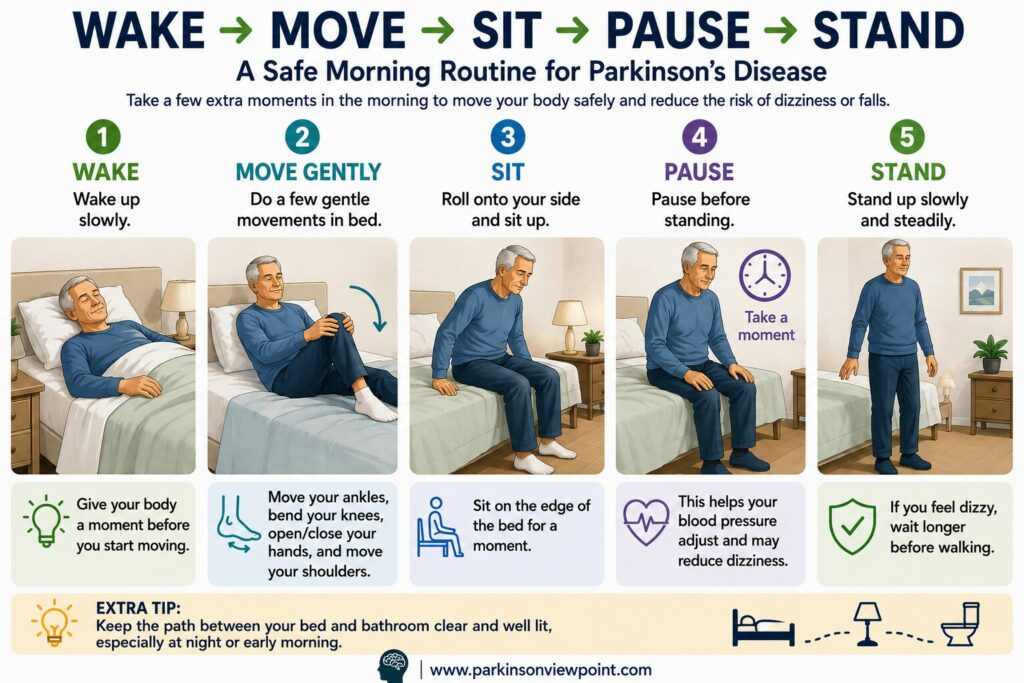
This can be particularly important if you experience dizziness or light-headedness when standing. Orthostatic hypotension — a fall in blood pressure after standing — is relatively common in Parkinson’s disease, affecting around 30% of people with Parkinson’s disease according to a systematic review and meta-analysis [1].
If you regularly feel dizzy when getting out of bed, tell your healthcare team rather than simply accepting it as part of Parkinson’s disease.
Practical tip: Keep the route between your bed and bathroom clear and well lit, especially if you sometimes need to get up during the night or early morning.
If mornings are consistently your most difficult time, also make a note of when your symptoms improve after your first medication dose. That information can be useful when discussing morning OFF periods and medication timing with your neurologist.
2. Take your morning medication at the prescribed time
For many people with Parkinson’s disease, medication timing can shape how the rest of the morning goes. If you take levodopa or another Parkinson’s medication, try to take it at the times prescribed by your healthcare team, rather than waiting until symptoms become difficult. For a deeper explanation, see our guide to Parkinson’s medication timing and wearing-off.
A few simple habits can make this easier:
- Set an alarm or medication reminder on your phone.
- Use a pill organizer if you take several medications.
- Keep a written medication schedule somewhere easy to see.
- Record doses that are missed or taken late.
- Notice whether symptoms regularly return before your next dose.
What about levodopa and breakfast?
If you take levodopa, the timing of breakfast may matter.
Dietary protein is broken down into amino acids that may compete with levodopa for transport in the intestine and, importantly, across the blood-brain barrier. This interaction appears to be particularly relevant for some people who experience motor fluctuations [2,3].
For this reason, levodopa is often recommended 30–60 minutes before a meal or about 1–2 hours after a meal, when tolerated and when this matches your prescribed instructions.
However, this does not mean you should remove protein from your diet. Protein is important for maintaining muscle and overall health. Some people also experience nausea when taking levodopa on an empty stomach and may need to take it with a small, low-protein snack.
If you notice that meals affect how well your medication works, learn more about the best time to eat protein with levodopa.
Practical tip: If you repeatedly notice that your morning medication works more slowly after breakfast, keep a short record of what you ate, when you took your medication, and when you began to feel “ON.” Discuss the pattern with your neurologist, Parkinson’s nurse, or dietitian rather than changing your medication or diet yourself.
The important point is simple:
Take your medication consistently, follow your own prescription, and pay attention to how meals affect your response.
3. Start the morning with water and a simple breakfast
After taking your medication according to your prescribed schedule, make hydration part of your morning routine.
A simple habit is to have a glass of water after waking, unless your healthcare team has advised you to limit fluids because of another medical condition.
This matters because constipation is very common in Parkinson’s disease, and inadequate fluid intake can make it more difficult to manage. Staying adequately hydrated may also be particularly important for people who experience low blood pressure or dizziness when standing.
Keep breakfast simple
You do not need a special “Parkinson’s breakfast.”
Aim for a balanced meal that provides energy and supports regular bowel movements. Depending on your preferences and dietary needs, this could include:
- whole-grain cereal or oatmeal;
- fruit or berries;
- whole-grain toast;
- vegetables;
- nuts or seeds;
- yogurt, eggs or another suitable source of protein.
Fiber-rich foods such as whole grains, fruits, vegetables, legumes, nuts and seeds can be particularly useful for supporting bowel regularity [4]. Research in people with Parkinson’s disease also suggests that dietary approaches involving prebiotic fiber and probiotics may help improve constipation symptoms [5].
Remember, however, that suddenly increasing fiber without drinking enough fluid can sometimes make constipation worse. Increase fiber gradually and make adequate hydration part of the same routine.
What if breakfast affects your levodopa?
As discussed above, some people notice that protein-rich meals affect how reliably levodopa works.
You do not need to automatically avoid protein at breakfast.
Instead, pay attention to your own pattern. If your morning dose repeatedly seems slower or less effective after particular meals, record what happens and discuss it with your Parkinson’s healthcare team or dietitian.
A simple morning rule
Water + a balanced breakfast + enough fiber + medication according to your prescribed schedule.
There is no need to make breakfast complicated. The best breakfast is one that meets your nutritional needs, works with your medication schedule, and is realistic enough to repeat regularly.
4. Get your body moving — even for a few minutes
Once you are up and your morning medication has had time to work, try to introduce some movement into your morning.
This does not need to be a full workout.
Even 5–10 minutes of comfortable movement can be a practical way to loosen up and prepare for the day, particularly if you tend to feel stiff or slow in the morning.
Depending on your mobility and balance, you might try:
- shoulder rolls and gentle arm movements;
- opening and closing your hands;
- gentle trunk rotations;
- ankle and foot movements;
- marching while seated or standing with support;
- repeated sit-to-stand movements, if safe;
- a short walk around your home or outside.
Think of this as “waking up your body” rather than completing your exercise for the day.
Save harder exercise for a better movement period
If your Parkinson’s symptoms fluctuate with medication, consider scheduling more demanding exercise for a time when you generally feel more mobile and your medication is working well.
For some people this may be mid-morning; for others it may be later in the day.
Rather than forcing yourself to exercise at a particular clock time, try to identify when you move most safely and comfortably and build your routine around that period.
Practical tip: If balance is uncertain, avoid doing unsupported standing exercises simply because they appear on a general Parkinson’s exercise list. A physiotherapist can help you choose exercises appropriate for your mobility, freezing and fall risk.
5. Use your better movement period for exercise
Exercise is one of the most important habits to build into a daily routine for Parkinson’s disease.
But when you exercise can matter too.
If your symptoms fluctuate during the day, try to plan exercise for a period when your medication is working well and you generally feel more mobile, steady and energetic. For many people this may be during an “ON” period.
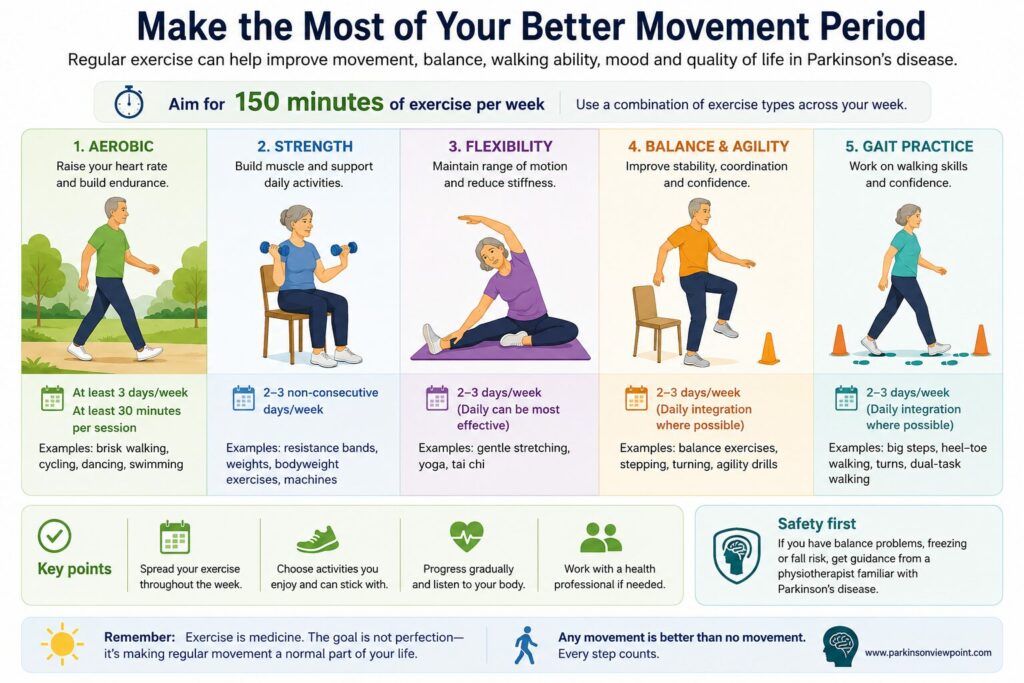
A balanced Parkinson’s exercise routine includes aerobic, strength, flexibility, balance and gait activities adapted to your individual abilities.
You do not need to do the same type of exercise every day. Across the week, aim for a combination of:
- Aerobic exercise: walking, cycling, swimming or another activity that safely raises your heart rate.
- Strength training: exercises that work the major muscle groups.
- Balance and agility: exercises designed to improve stability, coordination and changing direction.
- Flexibility: movements that help maintain comfortable range of motion.
- Gait practice: exercises focusing on walking, step length, turning or other specific movement difficulties.
How much exercise should you aim for?
The Parkinson’s Foundation and American College of Sports Medicine recommend working toward approximately 150 minutes of moderate-to-vigorous exercise per week, when appropriate for the individual [6].
That does not mean you have to exercise for a long period every day.
Your weekly exercise might be divided into shorter sessions depending on your fitness, symptoms, fatigue and other health conditions.
Most importantly, choose activities that are safe, challenging enough to be useful, and realistic enough to continue.
If you experience freezing, significant balance problems, frequent falls or are starting exercise after a long period of inactivity, consider working with a physiotherapist who understands Parkinson’s disease.
If balance is becoming more challenging, see these practical strategies for improving balance in Parkinson’s disease.
What does the research tell us?
Clinical guidelines strongly support exercise as part of Parkinson’s management. The American Physical Therapy Association recommends aerobic exercise, resistance training, balance training, gait training and task-specific training for people with Parkinson’s disease [7].
Research also suggests that exercise can improve more than movement. Systematic reviews and meta-analyses have reported benefits across outcomes including motor function, balance, walking ability and quality of life [8].
The important message is not to find the “perfect Parkinson’s exercise.” It is to make regular, appropriately challenging movement a normal part of your week.
Lunch: keep it balanced and don’t forget fiber
By lunchtime, keep things simple. You do not need a special Parkinson’s diet or complicated meal plan.
Aim for a balanced meal built around foods such as:
- vegetables;
- whole grains;
- fruits;
- legumes;
- nuts and seeds;
- healthy fats such as olive oil;
- an appropriate source of protein.
A Mediterranean-style eating pattern naturally includes many of these foods and is often studied in relation to healthy aging and neurological health.
For someone with Parkinson’s disease, however, one of the most immediate benefits of a fiber-rich diet may simply be better bowel regularity. Constipation is common in Parkinson’s disease, so continue including fiber-containing foods and adequate fluids throughout the day rather than trying to get everything at breakfast [4].
Don’t unnecessarily restrict protein
If you take levodopa and notice that protein affects your medication response, you may be tempted to cut protein from your meals.
That is generally not the goal.
Protein is important for maintaining muscle mass, strength and overall nutrition. Some people with motor fluctuations may benefit from adjusting when they eat larger amounts of protein rather than reducing their total protein intake [2,3].
Any significant protein redistribution should ideally be discussed with a dietitian or your Parkinson’s healthcare team, particularly if you are losing weight or already have a poor appetite.
Keep drinking throughout the day
Don’t make your morning glass of water your only hydration habit.
Continue drinking regularly throughout the day, unless you have been advised to restrict fluids for another medical reason.
A simple strategy is to associate drinking with things you already do:
Breakfast → drink
Medication → drink
Lunch → drink
Afternoon break → drink
Small, repeatable habits are often easier to maintain than trying to remember a daily target all at once.
After lunch, move a little
If you are able to do so safely, avoid going directly from lunch into several hours of uninterrupted sitting.
You don’t need another workout.
A short walk around the house, a few minutes outside, standing for a household task, or simply changing position regularly can introduce more movement into the afternoon.
Think:
Sit → move → sit → move
Structured exercise is important, but so is avoiding an otherwise completely sedentary day.
Afternoon: balance activity with rest
By the afternoon, you may notice that your energy is lower than it was earlier in the day. Fatigue is common in Parkinson’s disease and can affect physical activity, concentration, motivation and everyday tasks.
The answer is not necessarily to push through it — but neither does rest have to mean spending the entire afternoon sitting.
Instead, try to alternate activity with recovery.
For example:
Do something → Take a short break → Move again → Rest when needed
Plan demanding tasks around your energy
If you already know that you tend to become tired later in the day, try to schedule more demanding activities — such as exercise, shopping, appointments or household tasks — during periods when your energy and movement are usually better.
Save easier activities for lower-energy periods.
This might mean doing something as simple as:
- reading;
- making a phone call;
- preparing something for tomorrow;
- listening to music;
- doing a seated hobby;
- completing one small household task.
You do not need to make every part of the day productive.
What about taking a nap?
If you need a daytime nap, keep an eye on how it affects your nighttime sleep.
A short, earlier nap may be useful for some people, whereas long or late-afternoon naps can make it harder to fall asleep at night.
Rather than following a strict rule, notice your own pattern:
Does this nap leave me refreshed — or does it make tonight’s sleep more difficult?
Keep some movement in the afternoon
Even on a lower-energy day, try to avoid very long periods without changing position if you can do so safely.
Small amounts of movement might include:
- walking to another room;
- standing up during a television break;
- doing a few comfortable mobility exercises;
- watering plants;
- walking outside for a few minutes;
- changing from sitting to standing periodically.
These short periods of activity do not replace structured exercise. Their purpose is simply to keep some movement distributed throughout the day.
Listen for changes, not just tiredness
If fatigue suddenly becomes much worse, regularly interferes with daily life, or seems closely related to medication wearing off, mention it to your healthcare team.
Fatigue in Parkinson’s disease can have several contributors, including the disease itself, poor sleep, mood changes, medication effects and other medical conditions.
Practical takeaway: On a difficult afternoon, don’t ask, “How much can I force myself to do?” Instead ask, “What is important today, and when will I have the energy to do it safely?”
Evening: make tomorrow morning easier
By evening, Parkinson’s symptoms and fatigue may make everyday tasks feel more demanding. Instead of leaving everything until bedtime, use an earlier part of the evening to prepare a few things for the next day.
The goal is simple: reduce the number of things you need to remember or organize tomorrow morning.
Prepare the essentials
Before you become too tired, consider:
- organizing tomorrow’s medications using your usual medication system;
- setting medication reminders;
- laying out clothes;
- placing your walking aid where you can reach it safely;
- preparing anything you need for breakfast;
- checking tomorrow’s appointments;
- writing down one or two important tasks for the next day.
You don’t need to prepare everything. Even removing one or two morning decisions can make the next day easier.
Do a quick symptom check
Evening can also be a useful time to think briefly about how the day went.
Ask yourself:
Was anything noticeably different today?
You might record:
- tremor or stiffness;
- slowness;
- walking or balance difficulties;
- pain or fatigue;
- ON and OFF periods;
- medication taken late or missed;
- dizziness;
- any new or unusual symptom.
Keep this brief. Symptom tracking should help you identify patterns — not become another demanding task.
Over time, a simple record may help you and your healthcare team see whether symptoms repeatedly occur at particular times of day or in relation to medication.
Make Daily Tracking Easier
If you want a simple way to keep track of your day, the Parkinson’s Daily Diary App lets you record symptoms, medication status and notes in about a minute.
Over time, your entries can be turned into a doctor-ready report, making it easier to review patterns and discuss changes at your next appointment.
Free to use • Works on mobile and computer
Don’t try to “catch up” at night
If you had a difficult or less productive day, resist the temptation to squeeze everything into the evening.
Move unfinished tasks to another day when possible.
A useful Parkinson’s routine should help you work with your energy and symptoms rather than constantly trying to overcome them.
Practical takeaway: Before settling down for the evening, spend a few minutes preparing tomorrow and noting anything important about today.
Night: wind down and protect your sleep
A consistent bedtime routine can help signal that the active part of the day is ending.
Sleep problems are common in Parkinson’s disease and may include difficulty falling asleep, waking frequently during the night, vivid dreams, nighttime stiffness or difficulty turning in bed, restless legs, and excessive sleepiness during the day.
While a bedtime routine cannot solve every Parkinson’s-related sleep problem, a few habits may make sleep easier.

Create a predictable wind-down
During the last hour before bed, try to gradually reduce stimulation.
You might:
- dim bright lights;
- choose a quiet activity such as reading or listening to music;
- avoid caffeine later in the day;
- keep bedtime and wake-up time reasonably consistent;
- keep the bedroom dark, quiet and comfortable;
- avoid large meals immediately before bed;
- limit long or late-afternoon naps if they interfere with nighttime sleep.
You do not need an elaborate nighttime routine. Consistency is more important than perfection.
Make nighttime movement safer
Parkinson’s symptoms do not stop at bedtime.
If you sometimes need to get up during the night:
- keep the route to the bathroom clear;
- use appropriate night lighting;
- keep glasses and necessary mobility aids within easy reach;
- avoid loose rugs or other trip hazards;
- sit briefly before standing if you are prone to dizziness.
This is particularly important if you experience nighttime stiffness, balance problems or orthostatic hypotension.
For more ways to reduce everyday hazards around the home, see these simple home adjustments for Parkinson’s disease.
Remember that today’s exercise may help tonight’s sleep
Regular physical activity earlier in the day may also support sleep.
Research in people with Parkinson’s disease has found that exercise interventions can improve some measures of sleep, although the size of the benefit varies between studies [9,10].
This gives exercise another role in your daily routine: what you do during the day may influence how well you sleep at night.
Don’t assume every sleep problem is simply Parkinson’s disease
Persistent sleep difficulties deserve attention.
Tell your healthcare team if you regularly experience:
- severe daytime sleepiness;
- repeated insomnia;
- acting out dreams or potentially injuring yourself or your bed partner during sleep;
- uncomfortable urges to move your legs at night;
- loud snoring, choking or pauses in breathing;
- troublesome nighttime stiffness or OFF periods;
- frequent nighttime urination that significantly disrupts sleep.
Some sleep problems may be related to Parkinson’s disease itself, while others may be associated with medication, sleep disorders or other treatable conditions.
Practical takeaway: Keep your evenings predictable, make nighttime movement safe, and tell your healthcare team about persistent sleep problems rather than simply accepting poor sleep as part of Parkinson’s disease.
What if you’re having a difficult Parkinson’s day?
Not every day with Parkinson’s disease will follow the same routine.
You may wake up unusually stiff, experience a longer OFF period, feel exhausted after poor sleep, or simply have less energy than you did yesterday.
On those days, simplify the routine rather than abandoning it.
Focus on the essentials:
- Take your medication as prescribed.
- Eat and drink adequately.
- Move safely when you can.
- Rest when you need to.
- Ask for help when a task feels unsafe.
- Prepare the essentials for tomorrow.
Exercise can also be adjusted. A difficult day does not necessarily mean doing nothing, but it may mean choosing a shorter walk, gentle seated movements, or exercises previously recommended by your physiotherapist instead of a demanding workout.
Pay attention to an unusual change
A difficult day occasionally can happen.
But if you notice a new or persistent change—such as much worse mobility, repeated falls, increasing confusion, severe dizziness, difficulty swallowing, or medication suddenly seeming much less effective—contact your healthcare team.
The goal of a daily routine is not perfection.
It is to give your day enough structure to support medication, movement, nutrition, rest and sleep while remaining flexible enough to adapt when Parkinson’s symptoms change.
On a difficult day, doing the essentials safely is enough. Tomorrow’s routine can look different.
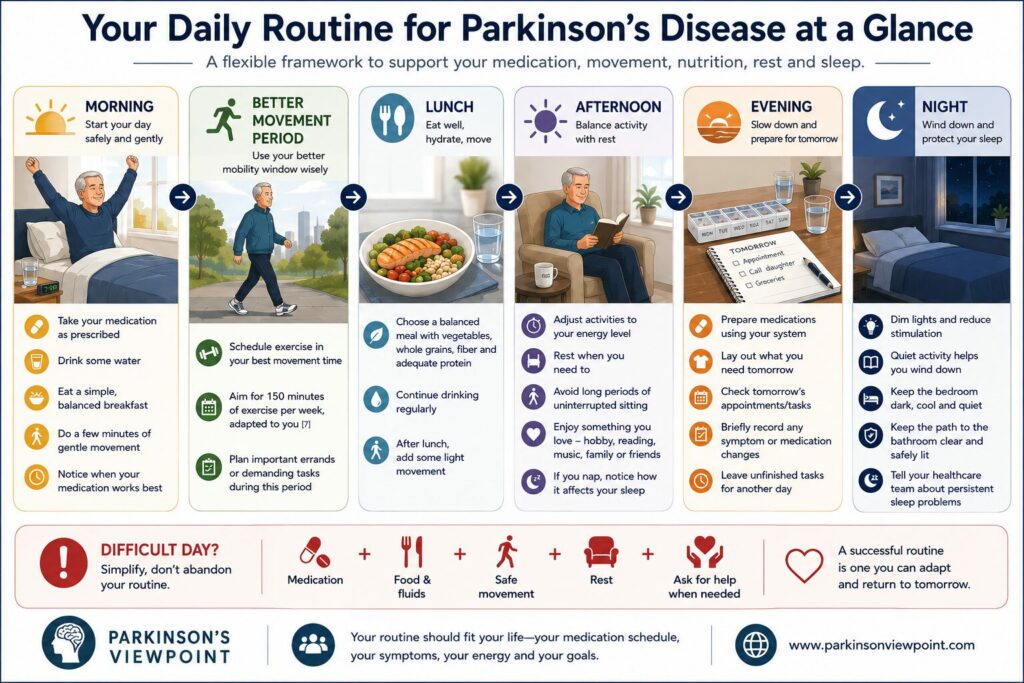
Your daily routine for Parkinson’s disease at a glance
You do not need to follow every part of your day perfectly. Use this as a flexible framework and adapt it around your medication schedule, symptoms, energy levels and advice from your healthcare team.
Morning
Wake slowly → Move gently → Sit → Pause → Stand
- Take your Parkinson’s medication as prescribed.
- Drink some water.
- Eat a simple, balanced breakfast.
- Do a few minutes of gentle movement.
- If symptoms fluctuate, notice when your medication begins working well.
Better Movement Period
Use your better mobility window wisely.
- Schedule exercise when you generally move most safely and comfortably.
- Across the week, combine aerobic, strength, flexibility, balance and gait activities.
- Aim toward the recommended 150 minutes of exercise per week, adapted to your abilities [6].
- Consider important errands or physically demanding tasks during a better movement period.
Lunch
Eat → Hydrate → Keep moving
- Choose a balanced meal with vegetables, whole grains, fiber and adequate protein.
- Continue drinking regularly.
- Don’t unnecessarily restrict protein because you take levodopa.
- After lunch, introduce some light movement rather than sitting continuously for several hours.
Afternoon
Activity → Rest → Move → Recover
- Adjust demanding activities to your energy level.
- Take a break when you need one.
- Avoid very long periods of uninterrupted sitting when possible.
- Make time for something enjoyable — a hobby, reading, music, family or friends.
- If you nap, notice whether it affects your nighttime sleep.
Evening
Slow down → Prepare tomorrow → Check today
- Prepare medications using your usual system.
- Lay out anything you may need tomorrow morning.
- Check tomorrow’s appointments or important tasks.
- Briefly record any important symptom or medication changes.
- Leave unfinished tasks for another day when possible.
Before bed
Dim lights → Quiet activity → Safe bedroom → Sleep
- Keep bedtime and waking time reasonably consistent.
- Reduce stimulation as bedtime approaches.
- Keep the route to the bathroom clear and safely lit.
- Keep necessary mobility aids within reach.
- Tell your healthcare team about persistent or unusual sleep problems.
On a difficult day
Make the routine smaller:
Medication → Food and fluids → Safe movement → Rest → Ask for help when needed
A successful Parkinson’s routine is not one you follow perfectly.
It is one you can adapt and return to tomorrow.
Final takeaway: build a routine that works for you
There is no single perfect daily routine for Parkinson’s disease. Symptoms, medication response, energy levels and mobility can vary from person to person — and even from one day to the next.
Instead of trying to follow a rigid timetable, build your day around a few important habits: take medication as prescribed, move regularly, exercise when you feel most able, eat and drink well, balance activity with rest, and protect your sleep.
Pay attention to the times when you tend to move and feel your best, and use those periods for activities that matter most to you. On more difficult days, simplify the routine and focus on what is essential.
Most importantly, your routine should support your life — not control it.
Start with one or two changes that feel realistic. Once they become part of your day, you can gradually build from there.
The best Parkinson’s routine is not the one you follow perfectly. It is the one you can safely adapt, maintain and return to each day.
Medical disclaimer
This article is for educational and informational purposes only and is not a substitute for personalized medical advice, diagnosis, or treatment. Parkinson’s symptoms, medication response, mobility, nutritional needs, and exercise abilities can vary considerably from person to person.
Do not change the dose or timing of your Parkinson’s medication, significantly alter your diet, or begin a new exercise program based solely on this article. Discuss appropriate changes with your neurologist, Parkinson’s nurse, physiotherapist, dietitian, or other qualified healthcare professional, particularly if you experience falls, dizziness, swallowing difficulties, significant weight loss, or new or worsening symptoms.
References
[1] Velseboer DC, et al. (2011). Orthostatic hypotension in Parkinson’s disease: the relation of blood pressure tests and symptoms in daily life. Movement Disorders. 26(4):691–696.
[2] Rusch C, Flanagan R, Suh H, Subramanian I. (2023). To restrict or not to restrict? Practical considerations for optimizing dietary protein interactions on levodopa absorption in Parkinson’s disease. npj Parkinson’s Disease. 2023;9:98. PMID: 37355689. DOI: 10.1038/s41531-023-00541-w.
[3] Cereda E, Barichella M, Pedrolli C, Pezzoli G. (2010). Low-protein and protein-redistribution diets for Parkinson’s disease patients with motor fluctuations: a systematic review. Movement Disorders. 25(13):2021–2034. PMID: 20669318. DOI: 10.1002/mds.23226.
[4] Beke MP, Dahl WJ. Managing Constipation and Its Risks in Parkinson’s Disease: Is There a Role for Dietary Fiber? Canadian Journal of Dietetic Practice and Research. 2026;87(1):33–39. PMID: 40459489.
[5] Barichella M, Pacchetti C, Bolliri C, et al. Probiotics and prebiotic fiber for constipation associated with Parkinson disease: An RCT. Neurology. 2016;87(12):1274–1280. PMID: 27543643.
[6] Parkinson’s Foundation & American College of Sports Medicine (ACSM). Parkinson’s Exercise Recommendations. Updated 2025. Parkinson’s Foundation.
[7] Osborne JA, Botkin R, Colon-Semenza C, et al. (2022). Physical Therapist Management of Parkinson Disease: A Clinical Practice Guideline From the American Physical Therapy Association. Physical Therapy. 102(4):pzab302. PMID: 34963139. PubMed record
[8] Ernst M, Folkerts AK, Gollan R, et al. (2023). Physical exercise for people with Parkinson’s disease: a systematic review and network meta-analysis. Cochrane Database of Systematic Reviews. 2023;1:CD013856. DOI: 10.1002/14651858.CD013856.pub2
[9] Amara AW, Wood KH, Joop A, et al. (2020). Randomized, Controlled Trial of Exercise on Objective and Subjective Sleep in Parkinson’s Disease. Movement Disorders. 35(6):947–958. PMID: 32092190. DOI: 10.1002/mds.28009.
[10] Cristini J, Weiss M, De Las Heras B, et al. (2021). The effects of exercise on sleep quality in persons with Parkinson’s disease: A systematic review with meta-analysis. Sleep Medicine Reviews. 55:101384. PMID: 32987321. DOI: 10.1016/j.smrv.2020.101384.
Get Your Free Parkinson’s Medication Management Diary
Download your free printable diary to easily track your medications, symptoms, and doses.