
Written and reviewed as a literature-based educational guide by Dr. Akbar Zaib, PhD in Neurosciences.
Anxiety during OFF periods in Parkinson’s disease can appear suddenly, bringing fear, restlessness, tension, or a sense of losing control as medication wears off. Understanding the pattern—and knowing what to do when it happens—can help you feel safer, calmer, and better prepared.

Anxiety during “OFF” periods in Parkinson’s disease can appear suddenly. One moment you may feel relatively calm and able to move; the next, you may feel tense, frightened, restless, or unable to cope.
For some people, this anxiety begins as their Parkinson’s disease medication starts to wear off. It may occur alongside increasing stiffness, tremor, slowness, sweating, breathing changes, or a sense that something is wrong.
This experience is real. It is not a personal weakness or simply “worrying too much.” Anxiety can be a non-movement symptom of Parkinson’s disease and, for some people, part of the “OFF” experience.
The encouraging news is that anxiety during “OFF” periods can often be managed. The first step is understanding when it happens, what may be contributing to it, and which strategies provide the most relief.
What is an “OFF” period?
An “OFF” period is a time when Parkinson’s disease symptoms return or become more noticeable because medication is not providing its usual level of benefit.
“OFF” periods may happen:
- Before the next medication dose is due
- Early in the morning
- When a dose takes longer than expected to work
- Unexpectedly, without an obvious pattern
- After eating, particularly if food affects medication absorption
- During periods of illness, poor sleep, or emotional stress
People often associate “OFF” periods with movement symptoms such as stiffness, tremor, slowness, or difficulty walking. However, non-movement symptoms can also emerge or intensify.
These may include anxiety, low mood, fatigue, pain, difficulty thinking, sweating, urinary urgency, or a general sense of discomfort.
What can anxiety during an “OFF” period feel like?
Anxiety does not feel the same for everyone. Some people experience anxious thoughts, while others notice mainly physical symptoms.
It may feel like:
- A sudden sense of fear or panic
- Restlessness or an inability to settle
- Tightness in the chest
- Rapid or shallow breathing
- A racing heartbeat
- Sweating or feeling unusually hot
- Worry about falling or freezing
- Fear that medication will not start working
- Feeling trapped, helpless, or unable to cope
- A strong need to leave a place or return home
- Increased stiffness, tremor, or freezing
Anxiety may also create a difficult cycle. Parkinson’s disease symptoms begin to return, which causes worry. That worry increases muscle tension and makes movement feel even harder, leading to more anxiety.
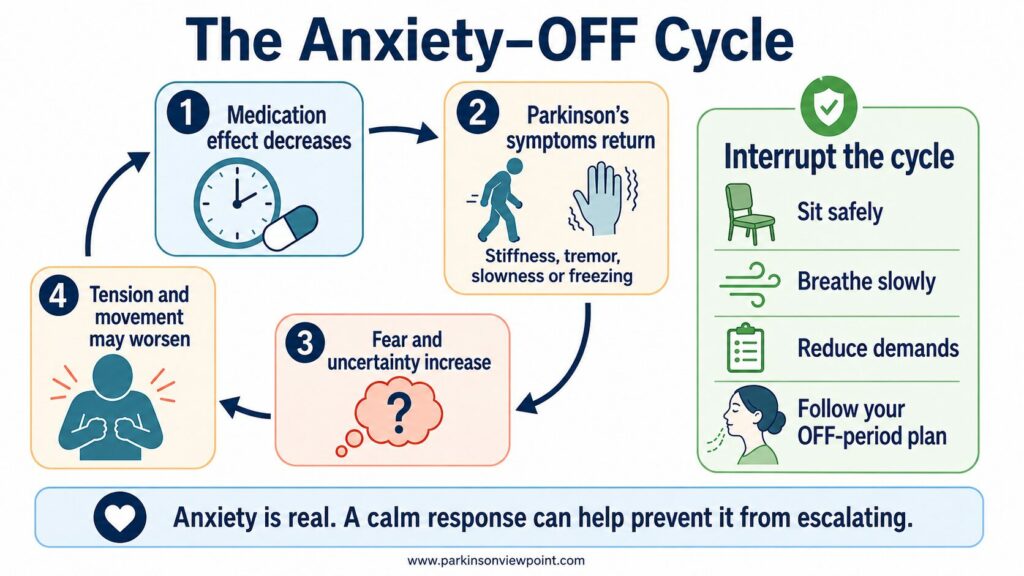
Recognising this cycle does not mean the symptoms are imaginary. It simply reveals more than one possible point at which the cycle can be interrupted.
Why can anxiety worsen during “OFF” periods?
Parkinson’s disease affects more than movement. The brain circuits and chemical messengers involved in Parkinson’s disease also contribute to mood, motivation, and the body’s response to stress.
As the effect of medication changes, some people experience fluctuations in both movement and emotional symptoms.
A study involving 250 people with Parkinson’s disease found that anxiety was more common among those experiencing motor fluctuations. When anxiety had a clear relationship with a particular motor state, it was usually associated with the “OFF” period. However, the researchers also found that anxiety did not always follow medication-related changes, showing that the connection is more complex than medication wearing off alone.¹
Earlier research also found that some people experienced significant changes in anxiety and mood between their “ON” and “OFF” states.²
This means there are at least two possibilities:
- Anxiety may be closely connected to medication wearing off.
- Anxiety may be present more generally but feel worse when movement, pain, fatigue, or uncertainty increases.
Identifying which pattern applies to you can help your healthcare team choose a more appropriate treatment.
What can help with anxiety during “OFF” periods?
Managing anxiety during an “OFF” period often requires two approaches: reducing distress when it happens and addressing the underlying pattern over time. The following seven strategies can help you recognise possible triggers, respond more calmly, and work with your healthcare team toward better symptom control.
1. Track when the anxiety happens
One of the most useful first steps is to record when anxiety appears and what else is happening at the time.
For one or two weeks, note:
- When you take each Parkinson’s disease medication
- When the medication begins to work
- When anxiety begins and ends
- Whether movement symptoms also worsen
- What and when you recently ate
- Sleep quality the previous night
- Stressful situations or activities
- Any dizziness, pain, sweating, or breathing changes
You do not need to write a detailed description. A few simple notes may be enough to reveal a pattern.
For example:
1:30 p.m.—anxiety and stiffness began about 30 minutes before my next dose. Improved approximately 25 minutes after taking medication.
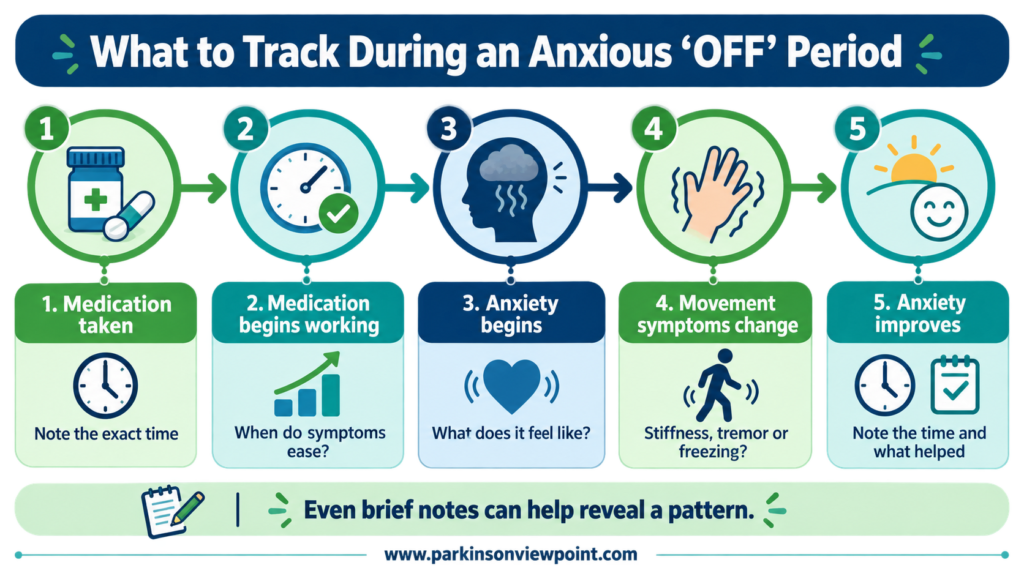
This information can help your neurologist determine whether anxiety may be part of wearing off or whether another cause should also be investigated.
Research based on people’s experiences of “OFF” periods shows that these episodes can involve several motor and non-motor symptoms and may be difficult to describe during a short appointment.³ Keeping a diary gives your healthcare team a clearer picture of what happens between visits.
Get Your Free Parkinson’s Medication Management Diary
Download your free printable diary to easily track your medications, symptoms, and doses.
2. Discuss the “OFF” pattern with your Parkinson’s specialist
If anxiety repeatedly occurs before a medication dose or improves when medication starts working, tell your neurologist or Parkinson’s nurse.
Your healthcare professional may review:
- The timing of levodopa doses
- How long each dose remains effective
- Whether doses take too long to work
- Whether meals are affecting medication absorption
- Whether another Parkinson’s disease treatment could provide more consistent symptom control
- Whether constipation or delayed stomach emptying may be affecting medication
- Whether anxiety also needs treatment in its own right
Do not change the dose or timing of Parkinson’s disease medication independently. Taking extra medication may cause side effects, including dyskinesia, low blood pressure, hallucinations, or impulsive behaviour.
The goal is not simply to take more medication. It is to understand the pattern and find the safest way to reduce fluctuations.
3. Use a simple breathing routine
During an anxious “OFF” period, complicated instructions may be difficult to remember. A short, familiar breathing routine can be more practical.
Try this:
- Sit somewhere safe and support your back.
- Relax your shoulders as much as possible.
- Breathe in gently through your nose.
- Breathe out slowly, making the out-breath slightly longer.
- Repeat for one or two minutes without forcing the breath.
You might silently say:
“This is an anxious ‘OFF’ period. I am safe. I will give my body time.”
Slow breathing may help reduce the body’s alarm response. It will not necessarily end the “OFF” period, but it may prevent fear and physical tension from escalating.
If you have a respiratory or heart condition, ask a healthcare professional whether breathing exercises are suitable for you.
4. Reduce demands until the medication begins working
Trying to push through a difficult “OFF” period may increase stress and the risk of falling.
When possible:
- Sit in a safe, familiar place.
- Postpone non-urgent tasks.
- Avoid rushing.
- Reduce noise and unnecessary conversation.
- Ask for help with walking or transfers.
- Use a mobility aid if one has been recommended.
- Give medication time to work.
This is not “giving in” to Parkinson’s disease. It is responding safely to a temporary change in your symptoms.
Many people naturally cope with “OFF” periods by taking a break, exercising when able, or using relaxation and meditation. In a large survey-based study of people with Parkinson’s disease, exercise and taking a break were among the most frequently reported coping strategies.³
5. Prepare an “OFF-period plan”
Anxiety becomes harder to manage when you must decide what to do in the middle of an episode. A written plan can reduce uncertainty.
Your plan might include:
- Where to sit safely
- A breathing reminder
- When your next medication dose is due
- A calming phrase
- The name of someone you can call
- Instructions for a caregiver
- Symptoms that require medical attention
Keep the plan somewhere easy to find, such as beside your medication, on the refrigerator, or on your phone.
A caregiver can help by speaking slowly, offering reassurance, reducing environmental stress, and avoiding too many questions at once.
Helpful language may include:
“You are safe. We know this can happen during an ‘OFF’ period. Let’s sit down and take one step at a time.”
Complete this plan during a calm “ON” period. Keep a printed copy somewhere you and your caregiver can easily find, and consider bringing it to your next healthcare appointment.
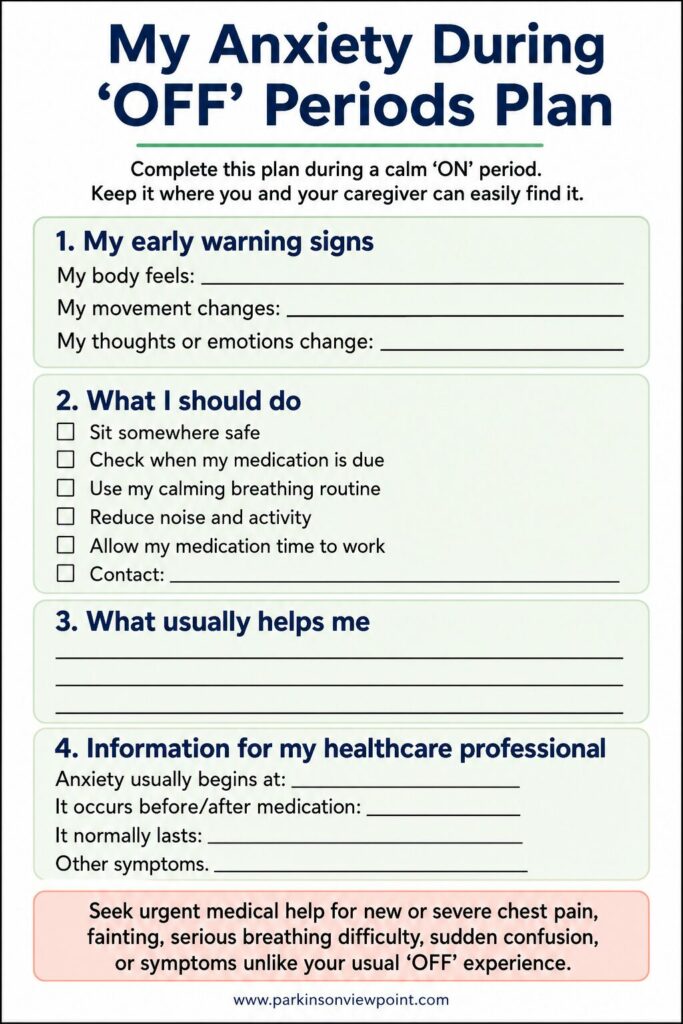
Download or print this personalised plan to record your warning signs, calming strategies, medication pattern, and important information for your healthcare team.
6. Consider cognitive behavioural therapy
Cognitive behavioural therapy, commonly called CBT, helps people recognise patterns between thoughts, feelings, physical sensations, and behaviour. It can also teach practical ways to respond to fear, uncertainty, avoidance, and panic.
A Parkinson’s-specific randomised controlled trial found that CBT produced greater improvement in anxiety symptoms than clinical monitoring alone. The therapy was adapted to address Parkinson’s-related concerns, including fear of falling, physical limitations, medication effects, and dependence on other people.⁴
A separate pilot study also found preliminary evidence that CBT could be a feasible and useful treatment for anxiety in people with Parkinson’s disease.⁵
CBT does not mean anxiety is “all in your head.” Instead, it provides skills for reducing the additional fear and avoidance that can develop around genuine Parkinson’s disease symptoms.
If leaving home is difficult, ask whether telephone- or video-based therapy is available.
7. Support your nervous system between “OFF” periods
Strategies practised regularly may be easier to use when anxiety suddenly increases.
Depending on your mobility and medical advice, these may include:
- Regular physical activity
- Gentle stretching
- Mindfulness or meditation
- Seated yoga
- Maintaining a consistent sleep routine
- Limiting excessive caffeine
- Eating and drinking regularly
- Planning demanding activities during more reliable “ON” times
- Staying socially connected
A randomised clinical trial involving 138 people with mild-to-moderate Parkinson’s disease compared mindfulness yoga with stretching and resistance exercise. Both approaches helped motor symptoms, while the mindfulness-yoga programme produced greater improvements in anxiety, depression, spiritual well-being, and health-related quality of life.⁶
These activities should support medical care rather than replace it. Choose options appropriate for your balance, mobility, and general health.
Could something else be causing the symptoms?
Not every sudden episode of fear, sweating, breathlessness, or a racing heart is necessarily caused by anxiety or Parkinson’s disease medication wearing off.
Similar symptoms can sometimes occur with:
- Low blood pressure
- Low blood sugar
- Heart or breathing problems
- Infection
- Dehydration
- Medication side effects
- Thyroid problems
- Panic disorder or another anxiety condition
Seek urgent medical help for new or severe chest pain, fainting, serious breathing difficulty, sudden confusion, new one-sided weakness, or symptoms that feel distinctly different from your usual “OFF” experience.
When should you speak to your healthcare team?
Contact your neurologist, Parkinson’s nurse, or primary-care clinician if:
- Anxiety occurs frequently or is becoming more severe.
- It regularly appears before medication doses.
- You avoid leaving home because you fear an “OFF” episode.
- Anxiety interferes with sleep, eating, relationships, or daily activities.
- You experience panic attacks.
- You feel persistently low or hopeless.
- Your current coping strategies are no longer enough.
Medication for anxiety may sometimes be considered. However, treatment must be personalised because some medicines can cause sleepiness, dizziness, falls, confusion, or other problems in people with Parkinson’s disease.
Key takeaways
- Anxiety can be a genuine non-movement symptom of an “OFF” period.
- It may occur alongside stiffness, tremor, slowness, pain, sweating, or difficulty thinking.
- Anxiety that happens during an “OFF” period is not always caused by wearing off, so looking for a pattern is important.
- Tracking medication, anxiety, meals, and movement symptoms can help your healthcare team understand what is happening.
- Medication timing should only be changed with professional guidance.
- Breathing, reducing immediate demands, preparing an “OFF-period plan,” exercise, mindfulness, and CBT may all help.
- New, severe, or unusual symptoms should not automatically be assumed to be anxiety.
Anxiety during an “OFF” period can feel overwhelming, but the experience usually becomes less frightening once you recognise the pattern and have a clear plan. You do not have to simply endure it. With appropriate Parkinson’s disease treatment, emotional support, and practical coping strategies, many people can feel safer and more in control when symptoms fluctuate.
References
- Leentjens AFG, Dujardin K, Marsh L, et al. Anxiety and motor fluctuations in Parkinson’s disease: a cross-sectional observational study. Parkinsonism & Related Disorders. 2012;18(10):1084–1088. https://doi.org/10.1016/j.parkreldis.2012.06.007
- Maricle RA, Nutt JG, Valentine RJ, Carter JH. Dose-response relationship of levodopa with mood and anxiety in fluctuating Parkinson’s disease: a double-blind, placebo-controlled study. Neurology. 1995;45(9):1757–1760. https://pubmed.ncbi.nlm.nih.gov/7651451/
- Mantri S, Edison B, Alzyoud L, et al. The experience of OFF periods in Parkinson’s disease: descriptions, triggers, and alleviating factors. Journal of Patient-Centered Research and Reviews. 2021;8(3):232–238. https://pmc.ncbi.nlm.nih.gov/articles/PMC8297496/
- Moonen AJH, Mulders AEP, Defebvre L, et al. Cognitive behavioral therapy for anxiety in Parkinson’s disease: a randomized controlled trial. Movement Disorders. 2021;36(11):2539–2548. https://pmc.ncbi.nlm.nih.gov/articles/PMC9290129/
- Reynolds GO, Saint-Hilaire M, Thomas CA, et al. Cognitive-behavioral therapy for anxiety in Parkinson’s disease. Behavior Modification. 2020;44(4):552–579. https://pubmed.ncbi.nlm.nih.gov/30931594/
- Kwok JYY, Kwan JCY, Auyeung M, et al. Effects of mindfulness yoga versus stretching and resistance training exercises on anxiety and depression for people with Parkinson disease: a randomized clinical trial. JAMA Neurology. 2019;76(7):755–763. https://pubmed.ncbi.nlm.nih.gov/30958514/
Medical disclaimer: This article is for general educational purposes and is not a substitute for personalised medical advice. Do not change Parkinson’s or anxiety medication without consulting a qualified healthcare professional.
Track your Parkinson’s day in less than a minute
The Parkinson’s Daily Diary App lets you record symptoms, medications, daily notes and doctor ready report in under a minute.