
Written and reviewed as a literature-based educational guide by Dr. Akbar Zaib, PhD in Neurosciences.
Parkinson’s OFF periods can cause sudden changes in movement, mood, thinking and communication—leaving caregivers unsure about what is happening or how to help. This practical guide to Parkinson’s OFF periods for caregivers explains how to recognize the signs, respond safely and record useful information for the healthcare team.

An OFF period can seem to arrive without warning. A person with Parkinson’s disease may suddenly become slower, stiffer, anxious, unusually quiet or unable to complete a task they managed comfortably an hour earlier. For caregivers, this change can be confusing and sometimes frightening—especially when it is unclear whether the person needs medication, physical help or simply more time.
OFF periods usually occur when Parkinson’s medication is no longer controlling symptoms effectively. However, they do not always look the same, and the signs may extend beyond movement difficulties. Learning to recognize these changes can help caregivers respond more calmly, protect the person’s safety and provide useful information to the healthcare team.
This guide explains what Parkinson’s OFF periods may look like, what caregivers can do when they occur and when a change requires medical attention.
What is a Parkinson’s OFF period?
An OFF period is a period of time when Parkinson’s medication is providing less symptom control than expected. Symptoms that had improved may gradually return or, in some cases, appear quite suddenly. When the medication is working well and symptoms are better controlled, this is often described as an ON period.
OFF periods commonly happen as a dose begins to wear off before the next one is due. However, they may also occur when medication takes longer than expected to work, fails to provide its usual benefit or has worn off overnight.
An OFF period is not necessarily the same as disease progression or an ordinary bad day. The important clue is a repeated connection between the change in symptoms and the person’s medication cycle. For example, stiffness, anxiety or difficulty walking may regularly develop shortly before the next dose and improve after the medication begins working.
Caregivers are often the first to notice these patterns, particularly when the person with Parkinson’s disease finds it difficult to describe what has changed.
Key takeaway: An OFF period is a temporary return or worsening of Parkinson’s symptoms when medication provides less control. Repeated timing around the medication cycle is an important clue.
What can an OFF period look like?
Many caregivers expect an OFF period to involve only tremor or difficulty walking. In reality, it can affect movement, mood, thinking and other body functions. The experience also differs from one person to another.
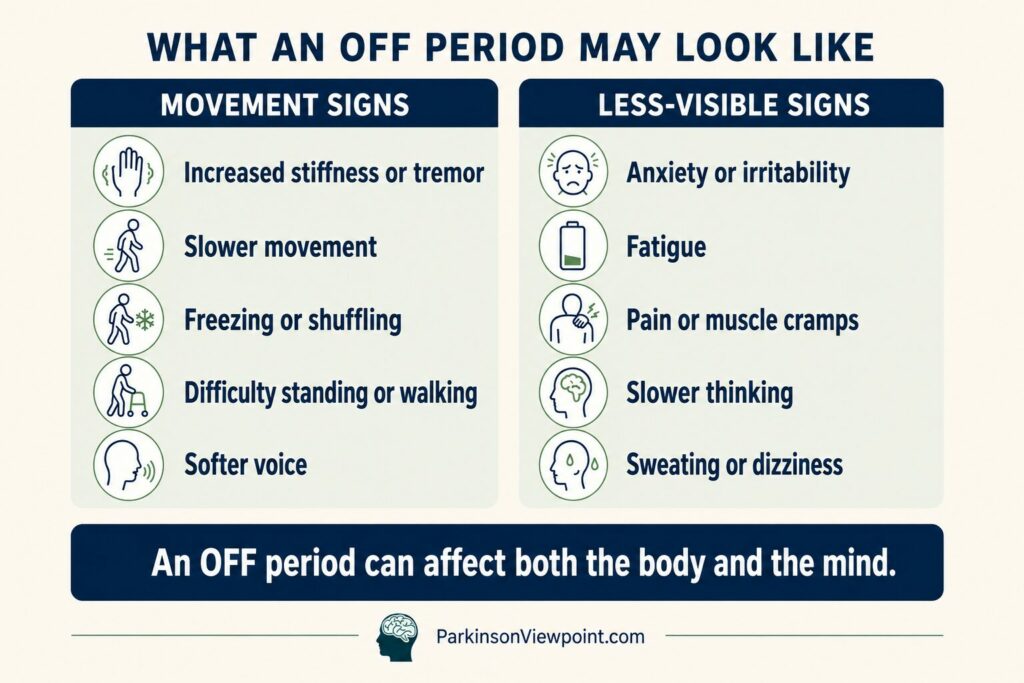
Movement-related signs
During an OFF period, you may notice:
- Increased stiffness or tremor
- Slower or smaller movements
- Difficulty standing up or beginning to walk
- Short, shuffling steps
- Freezing, especially near doors or when turning
- A softer voice or reduced facial expression
- Greater difficulty with dressing, eating or using the bathroom
A 2021 survey of 2,110 people with Parkinson’s illustrates this variation. Tremor was the most frequently reported description of an OFF period, followed by changes in walking and increased rigidity. However, no single symptom appeared in everyone, meaning caregivers need to learn what OFF looks like for the individual they support.
Non-movement signs
Some OFF symptoms are less visible but may be equally disruptive:
- Anxiety during an OFF period may appear as panic, irritability or unexplained uneasiness.
- Low mood or irritability
- Fatigue or sudden loss of energy
- Slower thinking or difficulty concentrating
- Pain, aching or muscle cramps
- Sweating, dizziness or abdominal discomfort
- A feeling of internal restlessness
In a 2009 study of 67 people experiencing OFF symptoms, approximately 70% reported at least one non-movement OFF symptom. Pain was the most common, followed by anxiety, sweating, palpitations, fatigue, abdominal bloating and dizziness.
These findings help explain why someone may say they feel “wrong” even when their movement does not appear dramatically different. The most useful question is not simply, “Does this look like Parkinson’s disease? ” Instead, ask: Does this change repeatedly appear at a similar point in the person’s medication cycle?
Key takeaway: OFF periods do not affect movement alone. Anxiety, fatigue, pain, irritability and slower thinking may also signal that medication is wearing off.
Why do Parkinson’s OFF periods happen?
OFF periods often develop because the effect of Parkinson’s medication —particularly levodopa — becomes shorter or less predictable over time. As Parkinson’s progresses, the brain becomes less able to store dopamine and maintain a steady response between doses.
Common patterns include:
- Wearing OFF: Symptoms return gradually before the next scheduled dose.
- Delayed ON: A dose takes longer than usual to begin working.
- Dose failure: A dose provides little or no noticeable benefit.
- Morning OFF: Symptoms are present on waking before the first dose takes effect.
- Unpredictable OFF: Symptoms return without an obvious connection to medication timing.
Medication absorption can also vary. Constipation, slow stomach emptying, dehydration and large or protein-rich meals may delay levodopa’s effect in some people. Because Parkinson’s medication timing can influence symptom control, doses should not be moved around meals or changed without guidance from the healthcare team.
Stress, anxiety, fatigue, poor sleep and illness may also make an OFF period feel more severe. In the 2021 survey of 2,110 people with Parkinson’s, stress was the most frequently reported trigger for worsening OFF symptoms.
These factors do not mean that the person or caregiver has done something wrong. Their value lies in helping identify patterns that can be discussed with the Parkinson’s care team.
Key takeaway: OFF periods may occur when medication wears off, takes longer to work or provides an unpredictable response. Sleep, stress, illness, digestion and meals may also influence how severe they feel.
What caregivers can do during an OFF period
The aim during an OFF period is not to force symptoms to disappear. It is to help the person remain calm, safe and as independent as possible while waiting for symptoms or medication effects to improve.
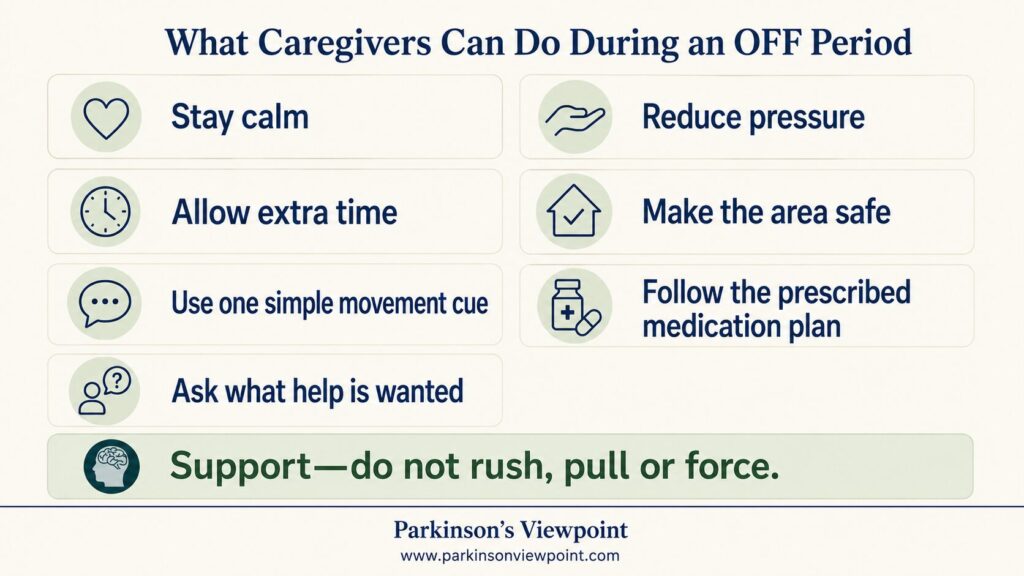
1. Stay calm and reduce pressure
Speak slowly and use short, clear sentences. Give the person extra time to answer, stand or complete a movement. Rushing, repeated instructions and visible frustration can increase anxiety and make movement even more difficult.
2. Make the immediate area safer
If balance or walking has worsened, remove nearby obstacles and offer a stable chair. Avoid encouraging the person to walk until they feel ready. If they normally use a walking aid, place it within easy reach.
If balance and freezing are recurring concerns, these simple home adjustments for Parkinson’s may help reduce everyday fall risks.
3. Help with freezing carefully
If the person freezes, do not pull their arm or push them from behind. Encourage them to pause, breathe and shift their weight gently from side to side. A simple cue — such as counting “one, two, step” or asking them to step over an imaginary line — may help restart movement.
4. Follow the prescribed medication plan
Check whether a scheduled dose was taken, but do not give an extra or early dose unless the clinician has provided clear instructions for that situation. If a prescribed rescue treatment is available, follow the agreed plan exactly.
5. Ask what kind of help is wanted
Some people need physical assistance, while others prefer quiet reassurance and time. A simple question such as, “Would you like help, or should I stay nearby?” supports both safety and independence.
Key takeaway: Focus on calm, safety and patience—not speed. Allow extra time, reduce pressure, support movement carefully and follow only the prescribed medication plan.
What caregivers should avoid during an OFF period
Even well-intended reactions can make an OFF period more stressful or unsafe. Try to avoid:
- Rushing the person: Pressure can worsen freezing, anxiety and difficulty communicating.
- Giving several instructions at once: Use one short cue, then allow time for a response.
- Pulling someone who has frozen: This may disturb their balance and increase the risk of falling.
- Forcing them to continue an activity: If movement is unsafe, pause and return to the task later.
- Assuming the behaviour is intentional: Withdrawal, irritability, reduced expression or slow responses may be part of the OFF period.
- Changing medication independently: Never increase, repeat, crush or reschedule a dose without an agreed medical plan.
- Speaking for the person unnecessarily: Offer help, but allow them to answer and make decisions whenever possible.
Most importantly, avoid treating every OFF period as a failure. A calm, patient response can prevent an already difficult episode from becoming more distressing for both the person with Parkinson’s disease and the caregiver.
Key takeaway: Do not rush, pull, argue or independently change medication. Behaviour that appears uncooperative may reflect anxiety, slowed thinking or difficulty communicating.
Track the pattern — not just the symptoms
A single OFF period provides limited information. A record collected over several days can show whether symptoms repeatedly appear before a dose, after a meal, early in the morning or during stressful or tiring activities.
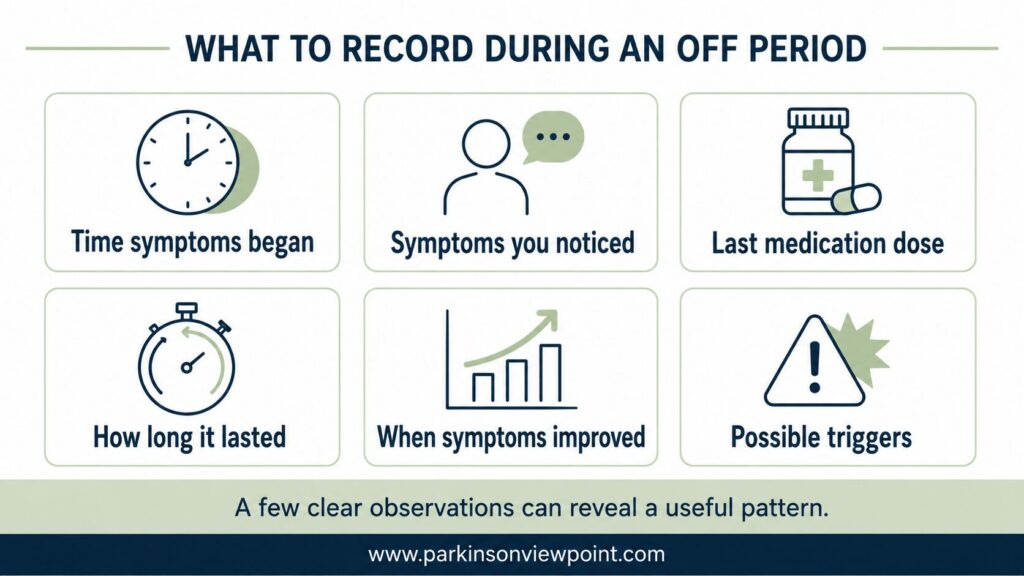
When an OFF period occurs, record:
- The time symptoms began
- What symptoms appeared
- When the last medication dose was taken
- Whether the dose was late, missed or taken as planned
- How long the episode lasted
- When symptoms improved
- Meals, constipation, poor sleep, stress or illness that may have contributed
- Any fall, freezing episode or activity the person could not complete
Keep the record simple. Caregivers do not need to document every movement or create a perfect medical report. A few clear observations are more useful than descriptions such as “a bad day” or “the medication did not work.”
The free Parkinson’s Daily Diary App can help patients and caregivers record symptoms, medication status and daily notes in less than a minute. Its doctor-ready report can then provide the healthcare team with a clearer picture of how symptoms change over time. Start tracking free here.
Key takeaway: Record when symptoms begin, medication timing, what changes and how long the episode lasts. A few specific observations are more useful than describing the day as simply “good” or “bad.”
When should caregivers contact the Parkinson’s care team?
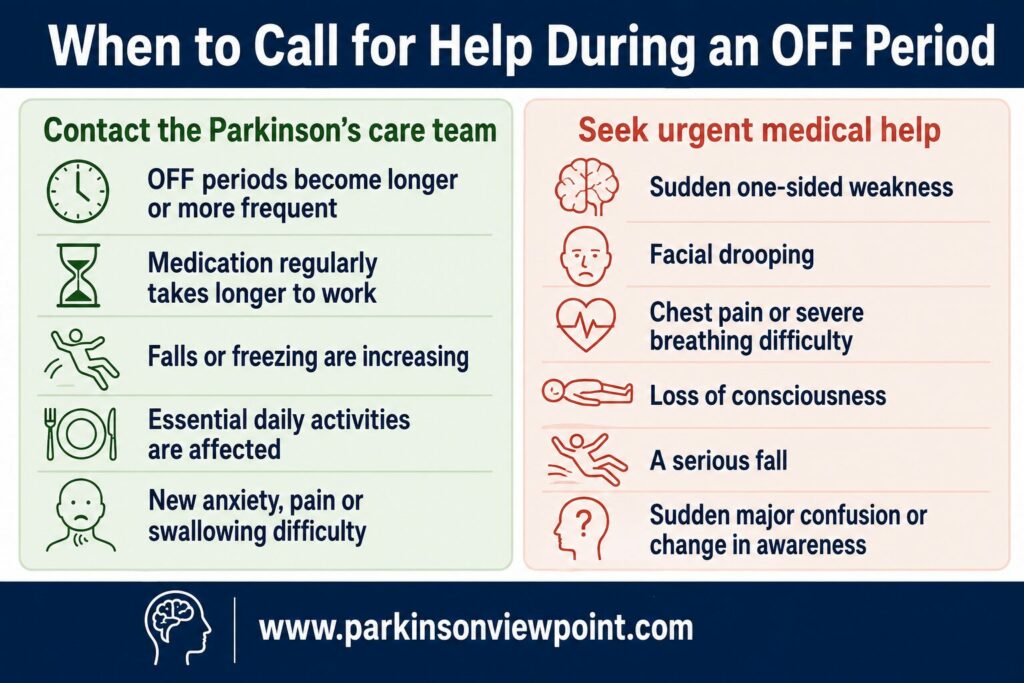
Occasional OFF periods may be expected, but a changing pattern can mean that the treatment plan needs to be reviewed. Contact the Parkinson’s nurse, neurologist or prescribing clinician if you notice:
- OFF periods becoming more frequent, longer or less predictable
- Medication regularly taking much longer to work
- Symptoms repeatedly returning before the next dose
- Increasing freezing, falls or near-falls
- New or worsening anxiety, pain, low mood or confusion
- Difficulty swallowing medication
- OFF periods interfering with eating, toileting or other essential activities
- A prescribed rescue treatment no longer working as expected
Bring the symptom and medication record to the appointment. Specific information — such as “stiffness begins around 30 minutes before the afternoon dose on most days” — is more useful than saying the person has generally become worse.
When the change may not be an ordinary OFF period
Seek urgent medical help for sudden one-sided weakness, facial drooping, chest pain, severe breathing difficulty, loss of consciousness, a serious fall or an abrupt major change in awareness. Sudden confusion, marked sleepiness, hallucinations or a rapid decline may also be related to infection, dehydration, medication effects or another medical problem rather than a typical OFF period.
When a symptom is new, severe or distinctly different from the person’s usual OFF pattern, do not automatically assume Parkinson’s disease is the cause.
Key takeaway: Report OFF periods that become longer, more frequent or less predictable. Seek urgent help when symptoms are sudden, severe or clearly different from the person’s usual pattern.
How the healthcare team may reduce OFF periods
Caregivers should not adjust Parkinson’s medication themselves, but their observations can help the healthcare team decide whether treatment needs to change.
If OFF periods are becoming more frequent, it may help to understand what can be done when Parkinson’s medications stop working effectively
Depending on the individual pattern, a clinician may consider:
- Adjusting the timing or spacing of existing doses
- Dividing levodopa into smaller, more frequent doses
- Changing to a longer-acting medication formulation
- Adding a medicine that helps levodopa remain effective for longer
- Prescribing an on-demand rescue treatment for sudden OFF periods
- Reviewing constipation, swallowing difficulties or meal timing that may affect absorption
- Considering device-assisted treatment or deep brain stimulation when fluctuations remain difficult to control
A 2023 clinical review of OFF-period management describes several available approaches, ranging from modifications to oral medication to on-demand and device-assisted therapies. However, there is no single solution that works for everyone.
The most appropriate option depends on the type of OFF period, other symptoms, medication side effects, cognitive health and the person’s daily priorities. This is why a clear caregiver record can be so valuable: it shows the clinician what is happening in everyday life, not only during an appointment.
Key takeaway: Several treatment approaches may reduce OFF time, but the right choice depends on the individual. Never change medication without guidance from the prescribing clinician.
Remember that OFF periods affect caregivers too
Unpredictable OFF periods can make everyday plans difficult. A caregiver may feel unable to leave the person alone, worry about falls or constantly watch the clock for the next medication dose. Over time, this level of alertness can become physically and emotionally exhausting.
A 2020 review examining the economic impact of OFF periods found that the consequences extend beyond the person with Parkinson’s disease. Caregivers of people experiencing OFF periods reported more missed or less productive workdays, changes to their working hours and lost employment opportunities. These findings illustrate how frequent or unpredictable OFF periods can affect the caregiver’s daily life as well as the patient’s symptom control.
Caregivers can protect their own well-being by:
- Sharing medication and observation responsibilities when possible
- Keeping an agreed plan for predictable OFF periods
- Asking the healthcare team what to do if symptoms suddenly worsen
- Preparing essential items before outings
- Accepting practical help from relatives, friends or professional services
- Taking regular breaks without feeling guilty
You do not need to manage every OFF period perfectly. Having a simple plan, knowing what requires medical attention and sharing responsibility can make these episodes feel less overwhelming. Supporting yourself is also part of providing safe and sustainable care.
Key takeaway: Caregiver stress matters. A shared plan, regular breaks and support from others can make unpredictable OFF periods safer and more manageable for everyone.
Practical takeaway for caregivers
Parkinson’s OFF periods can affect much more than movement. A person may suddenly become stiff, anxious, tired, withdrawn, slower in their thinking or unable to complete a familiar task. These changes are not intentional, and they do not always mean that Parkinson’s disease has suddenly progressed.
As a caregiver, your most valuable roles are to:
- Recognize the person’s usual OFF signs
- Remain calm and avoid rushing
- Support safe movement without pulling or forcing
- Follow the prescribed medication plan
- Record when symptoms happen and how long they last
- Report changing patterns to the Parkinson’s care team
- Seek urgent help when symptoms are new, severe or clearly different from a usual OFF period
You do not need to solve every episode yourself. Careful observation and a calm response can make an OFF period safer and less distressing, while the information you collect can help the healthcare team make better-informed treatment decisions.
Most importantly, remember that effective caregiving does not mean managing everything alone. Asking for guidance, accepting help and protecting your own well-being are essential parts of providing sustainable care.
Key takeaway: You do not need to solve every OFF period yourself. Calm support, careful observation and timely communication with the healthcare team can make a meaningful difference.
Medical disclaimer
This article is provided for general educational purposes and is not a substitute for individualized medical advice, diagnosis or treatment. Parkinson’s symptoms and responses to medication vary considerably between individuals. Caregivers should not change medication doses, timing or formulations unless instructed by the prescribing clinician. Seek advice from a neurologist, Parkinson’s nurse or other qualified healthcare professional about new or changing OFF periods. For sudden, severe or life-threatening symptoms, contact your local emergency services.