
Neuroscientist • Parkinson’s Researcher
Simple changes at home can make everyday activities safer and less tiring. These simple home adjustments for Parkinson’s disease can help reduce fall risks, support easier movement and allow you to remain independent and confident in familiar surroundings.

A home that once felt easy to move around can gradually become more difficult when you are living with Parkinson’s disease. A dim hallway may make it harder to judge where the floor ends. A low sofa can take more effort to rise from. Even a small rug or poorly placed table may become a serious obstacle during a moment of freezing or unsteadiness.
Fortunately, improving safety does not always require expensive renovations. A brighter light, a clearer walking path or a well-positioned grab rail can make an everyday activity safer while helping you remain independent.
Why the home environment matters in Parkinson’s disease
Parkinson’s disease can affect movement in several ways. Slowness, stiffness, reduced balance, shorter steps and freezing of gait can all make it harder to move safely through the home. Some patients may also experience fatigue, dizziness when standing, or changes in vision and depth perception.
Some falls are related to impaired automatic balance reactions rather than household hazards alone. Learn why people with Parkinson’s may fall backwards and what may help reduce the risk.
These difficulties do not remain exactly the same throughout the day. You might move comfortably when your medication is working well but feel slower or less steady during an “OFF” period. A familiar room can therefore become more challenging at certain times.
Research supports the importance of looking at the home environment. A three-year study, published in Scandinavian Journal of Occupational Therapy , involving 138 people with Parkinson’s disease found that the absence of bathroom grab bars and having stairs as the only available route were among the barriers causing the greatest accessibility problems. The researchers also found that these problems changed over time, showing why home safety should be reviewed regularly as a person’s needs change.
The purpose of adapting your home is not to make it look clinical or to remove everything you enjoy. It is to reduce unnecessary effort and create an environment that works with your movement rather than against it.
The following seven home adjustments focus on the areas where small, practical changes can make the greatest difference. You do not need to complete them all at once — begin with the changes most relevant to your daily routine and immediate safety needs.
This article is provided for general educational purposes only and is not a substitute for individualized medical advice, diagnosis or treatment. Parkinson’s disease symptoms, mobility and home-safety needs vary from person to person. Before installing grab rails or using mobility, bathroom or transfer equipment, seek advice from an occupational therapist, physiotherapist or other qualified healthcare professional. Always consult your healthcare team if you have experienced falls, near-falls or changes in your ability to move safely at home.
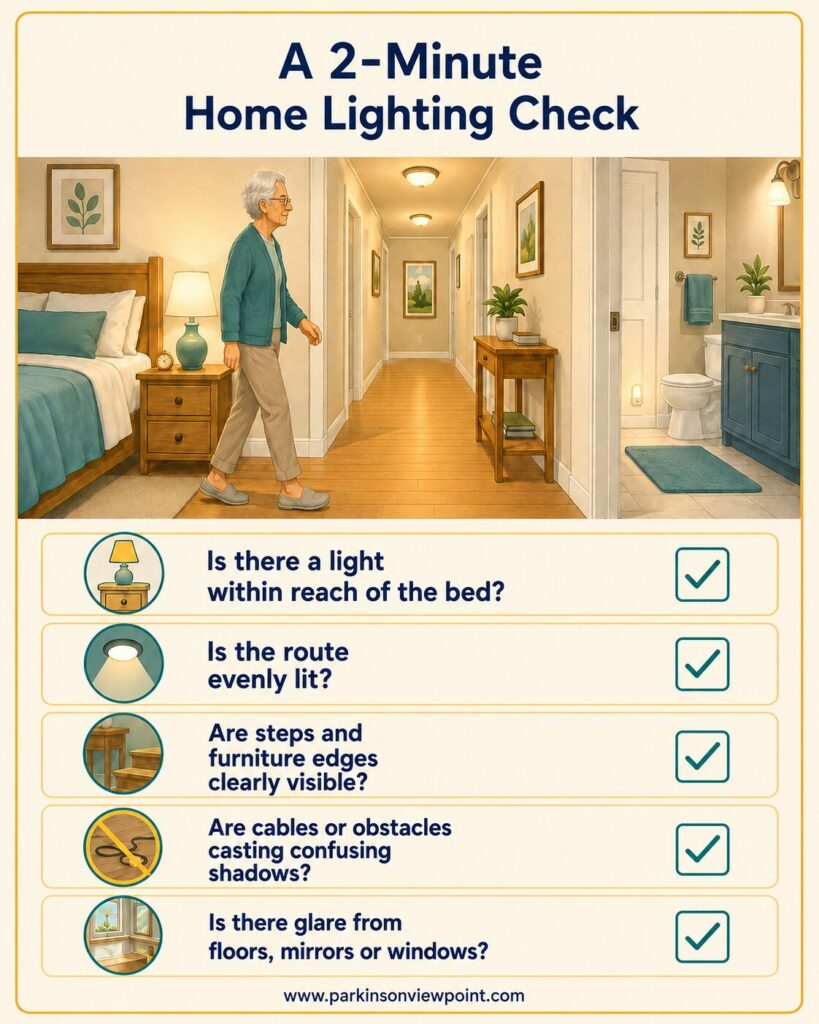
1. Improve the lighting
Good lighting does more than help you see. It can make changes in floor level, furniture edges and objects in your path easier to recognize.
Parkinson’s disease can sometimes affect contrast sensitivity and depth perception. This may make it difficult to distinguish a step from the floor or notice an obstacle in a dim hallway. Poor lighting is particularly risky when getting up during the night.
Simple changes include:
- Use brighter, evenly distributed lighting in hallways, bathrooms, kitchens and on stairs.
- Replace bulbs that take time to reach full brightness.
- Add a lamp near the bed and beside your usual chair.
- Use motion-activated night-lights between the bedroom and bathroom.
- Place light switches near room entrances so you do not have to cross a dark space.
- Reduce glare from shiny floors, mirrors and uncovered windows.
- Keep a small rechargeable light beside the bed in case of a power cut.
Try to avoid creating alternating patches of bright light and shadow. A dark strip across the floor may sometimes look like a step or obstacle, while glare can make the floor more difficult to judge.
If stairs are difficult to see, contrasting tape on the front edge of each step may help define where one step ends and the next begins. Choose one clear, consistent colour rather than a busy pattern. However, visual markings affect people differently, especially those who experience freezing, so test any change carefully before making it permanent.
A useful place to start: Tonight, walk slowly from your bedroom to the bathroom using the lighting you normally use. Notice whether any corner, step, cable or piece of furniture is difficult to see. This short check often reveals risks that are easily missed during the daytime.
2. Make sitting down and standing up easier
Standing up from a chair can become surprisingly difficult with Parkinson’s disease. Slowness, stiffness, muscle weakness and difficulty shifting the body forward can all make rising safely more challenging. A chair that is too low, deep or soft increases the effort even further.
The aim is not simply to add more chairs. It is to choose seating that provides firm support and is easier to use, especially during “OFF” periods or when you are tired.
Simple changes include:
- Choose a firm chair with a stable seat, supportive back and strong armrests.
- Avoid low sofas, deep armchairs and soft cushions that allow your body to sink.
- Avoid loose cushions or folded blankets on the seat, as they may slip when you sit down or stand up.
- If a chair is too low, ask an occupational therapist whether a firm height-adjusting cushion or properly fitted furniture raisers would be suitable.
- Keep at least one supportive chair in the rooms where you spend the most time.
- Leave enough clear space in front of the chair to position your feet safely before standing.
- Make sure the chair cannot slide backwards. Avoid lightweight chairs and chairs with wheels.
- Keep frequently used items within easy reach so you do not have to twist or lean suddenly.
- Consider a powered riser-recliner if standing has become consistently difficult, but seek professional advice before buying one.
A safer way to stand up
Before standing:
- Move your hips towards the front of the seat.
- Place both feet flat on the floor, slightly apart and as far back as comfortably possible.
- Lean your upper body forward—think “nose over toes.”
- Push firmly through the armrests as you rise.
- Once standing, pause to find your balance before taking your first step.
Try not to pull yourself up using a walking frame, nearby furniture or another person. These may move unexpectedly and cause you to lose your balance.
If you feel dizzy when standing, remain beside the chair and pause before walking. Parkinson’s disease and some medications can cause a drop in blood pressure after standing. Tell your doctor or Parkinson’s nurse if this happens repeatedly or you feel faint.
Do not overlook other seats
People often improve their main armchair but forget about other seats they use every day.
Check whether:
- your dining chair is stable and high enough;
- the edge of your bed allows you to place both feet firmly on the floor;
- your toilet is easy to rise from; and
- any outdoor chair you use is firm and has armrests.
A raised toilet seat or toilet safety frame may reduce the effort required in the bathroom. However, equipment should be fitted correctly. The wrong height can make transfers awkward or less safe.
For caregivers: Do not pull someone up by their arms or shoulders. This can cause pain and disturb their balance. If regular assistance is needed, ask a physiotherapist or occupational therapist to demonstrate a safer technique.
A useful place to start: Sit in each chair you regularly use and stand up once without rushing. Notice which seats make you rock repeatedly, grab nearby furniture or need another person’s help. Begin by improving the chair you find most difficult.

3. Keep walking routes clear and easy to follow
A small object on the floor may be easy to step around normally, but much harder when Parkinson’s disease causes short steps, reduced balance or freezing of gait. Narrow spaces, sharp turns and clutter can also interrupt the natural rhythm of walking.
The aim is to create clear, predictable routes through the home—especially between the places you use most often, such as the bed, bathroom, kitchen and favourite chair.
Simple changes include:
- Remove loose rugs, mats and runners whenever possible.
- If a mat is essential, choose a thin, non-slip version with securely fixed edges.
- Move electrical cables away from walking routes and secure them along the wall.
- Keep shoes, bags, toys and other objects off the floor.
- Keep pet toys, feeding bowls and bedding away from regular walking routes. A pet moving suddenly underfoot can also increase the risk of falling.
- Arrange furniture so frequently used routes are wide and direct.
- Avoid small tables, plant stands and footstools in areas where you turn.
- Repair loose flooring, raised carpet edges and uneven thresholds.
- Keep drawers and cupboard doors fully closed.
- Choose furniture that contrasts with the floor and walls so its edges are easier to see.
- Make sure a walking aid can pass through doorways and around furniture without becoming caught.
Be especially careful around changes in flooring. Moving from a light floor to a dark rug, crossing a patterned surface or approaching a narrow doorway can sometimes trigger hesitation or freezing. Busy patterns may also create visual confusion.
Plan for freezing of gait
Freezing can feel as though your feet are temporarily stuck to the floor even though you intend to move. It commonly happens when starting to walk, turning, passing through a doorway or entering a narrow space.
If you freeze:
- Stop trying to force your feet forward.
- Stand upright and take a slow breath.
- Shift your weight gently from one foot to the other.
- Count aloud—“one, two, three, step”—or imagine stepping over a line.
- Take one deliberate step and continue when you feel steady.
Avoid stepping backwards to escape a freeze, particularly near stairs or furniture. If you feel unsteady, remain still and ask for help.
Do not place permanent tape lines throughout the home without first testing whether they help. Visual cues can improve movement for some people but may distract or confuse others.
In the RESCUE trial, 153 people with Parkinson’s disease completed a three-week home-based cueing programme. The training produced small improvements in gait and balance, while freezing severity decreased among participants who experienced freezing. However, the benefits had reduced considerably six weeks later. This suggests that cueing can be useful, but it should be personalized, practised regularly and reviewed with a physiotherapist.
Do not remove every source of support without a plan
Clearing clutter does not mean leaving large empty spaces with nothing nearby for support. If you regularly hold onto furniture while walking, ask a physiotherapist or occupational therapist to assess your mobility.
Furniture is not a reliable substitute for a correctly fitted walking aid or securely installed handrail.
For caregivers: Involve the person with Parkinson’s disease before rearranging the home. Sudden changes can make familiar routes less predictable. During a freezing episode, give them time and space. Do not pull them forward or repeatedly tell them to “just walk.” Instead, use the cue they normally find helpful, such as counting aloud together.
A useful place to start: Walk your most frequently used route at the time of day when your movement is usually most difficult. Look for anything that makes you step sideways, turn sharply, squeeze through a narrow gap or reach for unstable furniture. Improve that route first.
4. Keep everyday items within easy reach
Reaching high shelves, bending towards the floor or twisting suddenly can be difficult when Parkinson’s disease affects balance, flexibility and movement. Carrying objects may also prevent you from using a handrail or walking aid safely.
Reorganizing frequently used items can reduce unnecessary effort and make everyday routines safer and more manageable.
Simple changes include:
- Keep frequently used items between waist and shoulder height.
- Move heavy, sharp or breakable objects away from high shelves.
- Avoid storing essential items in low cupboards that require deep bending.
- Use drawers, open baskets or clearly labelled containers so items are easy to find.
- Keep regularly used objects in the room where they are needed.
- Avoid climbing on chairs or step stools. Ask someone to help retrieve items that are out of reach.
- Choose lightweight cups, cookware and household items if heavier objects are difficult to control.
- Keep both hands available for balance or for using your walking aid. If you need to carry something, consider a securely attached walker basket, an apron pocket or a small body-worn bag that does not swing. Ask a physiotherapist or occupational therapist which option is safest for you.
- Sit at a table or stable work surface for tasks that take time or require both hands.
Make the kitchen easier to use
The kitchen often requires repeated reaching, carrying, turning and standing. Organizing it around your usual routine can save energy and reduce the risk of falls, spills and burns.
Consider keeping:
- everyday plates, cups and bowls together on an accessible shelf;
- frequently used ingredients close to the main preparation area;
- heavier pans at waist height rather than above your head or near the floor;
- tea- and coffee-making items together in one place;
- a properly fitted perching stool or stable chair nearby if standing is tiring—an occupational therapist can check whether it is suitable for your balance and mobility; and
- a lightweight kettle, hot-water dispenser or properly fitted kettle tipper if lifting and pouring are difficult.
Avoid carrying a full pan of hot water across the kitchen. Whenever possible, prepare food close to the sink, use a cooking basket or slotted spoon to lift food from the pan, or ask someone else to drain it.
If tremor, weakness, involuntary movement or poor balance makes handling hot food unsafe, stop doing the task alone and ask an occupational therapist about safer equipment and techniques.
When possible, prepare food during the part of the day when your medication is working well and your movement feels most reliable. Avoid rushing or multitasking while using knives, hot liquids or heavy cookware.
Create simple “activity stations”
Keeping everything needed for one activity together can reduce unnecessary trips around the home. For example:
- Place your diary, glasses and pen beside the chair where you usually write.
- Keep dressing items together near a stable seat.
- Keep medication in one clearly organized, well-lit place. Follow the storage instructions on the packaging and protect it from children, pets, excessive heat and moisture.
- Keep your telephone, charger and emergency contacts near your usual sitting area.
These simple activity stations can be especially helpful when fatigue or an “OFF” period makes movement more difficult.
For caregivers: Do not reorganize cupboards or move familiar items without discussing the changes first. Consistent storage helps the person with Parkinson’s disease find things independently. If something must be moved for safety, explain the change and use a clear label if helpful.
A useful place to start: Choose one activity you perform every day—such as making tea, getting dressed or taking medication. Notice how often you bend, stretch, carry something or walk back and forth. Then bring everything needed for that activity together in one safe, accessible place.
The One-Activity Test
Choose one everyday task—making tea, getting dressed or taking medication—and check:
☐ Everything is within comfortable reach.
☐ I do not need to carry items across the room.
☐ Sharp, heavy and hot items can be handled safely.
☐ A stable seat is available if I become tired.
☐ My hands remain free while walking.
☐ I can do the task during my medication “ON” time.
If you cannot tick every box: Move the items closer together, change where you perform the task or ask an occupational therapist for advice.
5. Make the bathroom safer
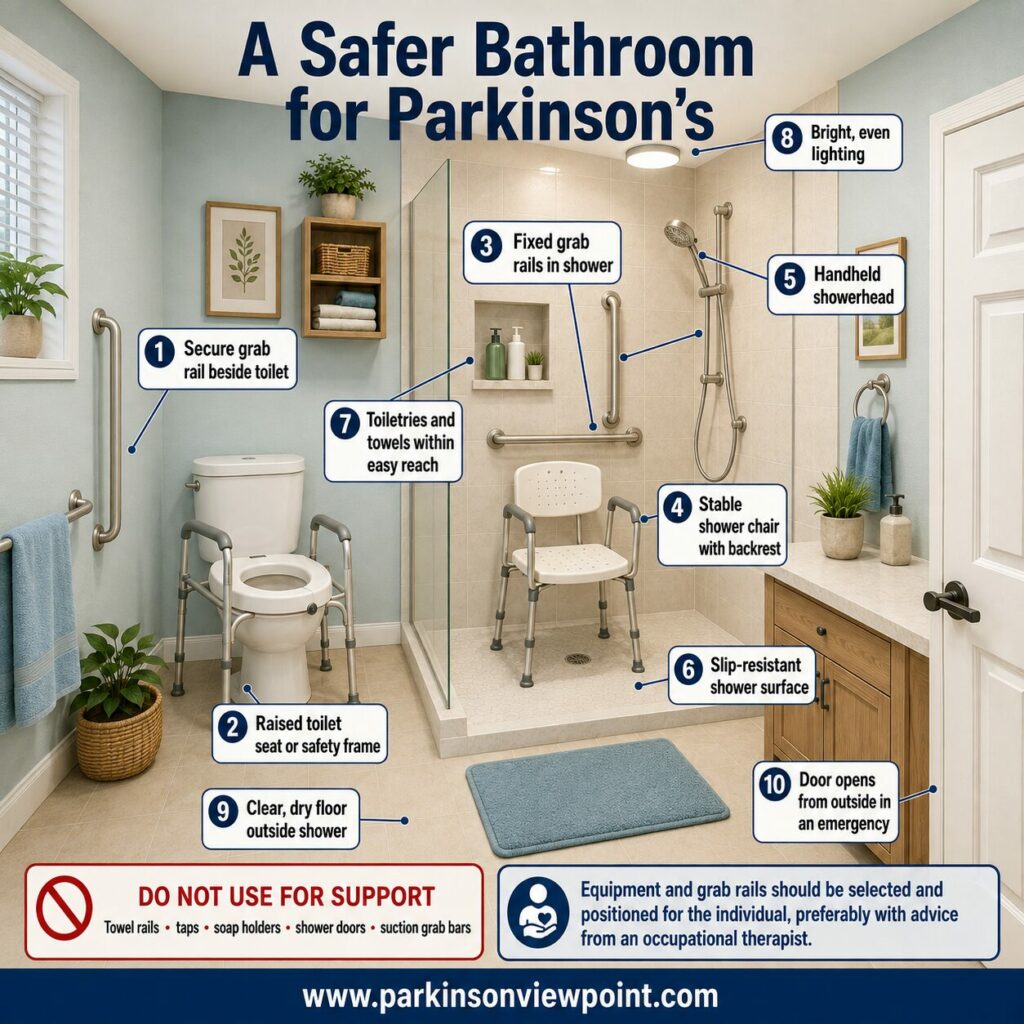
The bathroom can be one of the most challenging areas of the home for someone with Parkinson’s disease. Wet surfaces, limited space and repeated movements—turning, lowering onto the toilet, stepping into the shower and standing while washing—can increase the risk of slipping or losing balance.
A few carefully chosen adjustments can make personal care safer while helping you preserve privacy and independence.
Simple changes include:
- Remove loose bathroom mats. If a mat is necessary, choose a thin, securely backed non-slip version that lies completely flat.
- Keep routes to the toilet, sink and shower free from bins, scales, laundry and other objects.
- Wipe up water promptly and use slip-resistant flooring or properly fitted non-slip shower strips.
- Install securely fixed grab rails beside the toilet and in the bathing area.
- Never use towel rails, taps, soap holders or shower doors for support. They are not designed to hold body weight.
- Consider a raised toilet seat or toilet safety frame if lowering yourself or standing up is difficult.
- Use a stable shower chair with a backrest or a properly fitted bath board if standing while washing is tiring or unsafe.
- Choose a handheld showerhead so you can wash while seated.
- Keep soap, shampoo and towels within comfortable reach to avoid bending, stretching or twisting.
- Consider a wall-mounted soap dispenser or soap on a cord if an ordinary bar is difficult to hold.
- Use bright, even lighting, particularly for nighttime bathroom visits.
- Make sure the bathroom door can be opened from outside in an emergency.
Position grab rails correctly
Grab rails are most helpful when they are securely installed in the right places for the person using them. The ideal position depends on your height, strength, balance and usual way of getting on and off the toilet or entering the shower.
A rail fitted too far away or at the wrong angle may be difficult to reach and could encourage unsafe stretching or twisting. Suction grab bars can loosen unexpectedly and should not be relied upon as your main source of support.
Ask an occupational therapist to recommend the most appropriate type and position of rail. It should be installed by someone who can securely fix it to a suitable wall structure.
Make bathing less demanding
Fatigue, stiffness and “OFF” periods can make showering more difficult. When possible, bathe when your medication is working well and allow enough time so that you do not need to rush.
Prepare everything before you begin:
- Place clean clothes and towels within easy reach.
- Make sure the shower chair or bath board is stable.
- Check that the floor outside the bathing area is dry. The shower surface will become wet, so it should be slip-resistant.
- Set a comfortable water temperature before stepping in or sitting down.
- Use long-handled washing aids if reaching your feet or back is difficult.
- Consider an absorbent robe if drying yourself with a towel requires too much effort.
If you experience dizziness when standing, wash while seated and rise slowly when you finish. Pause before walking away. Repeated dizziness or faintness should be discussed with your doctor or Parkinson’s nurse.
Plan for emergencies without removing privacy
Improving safety does not have to mean giving up all privacy. A simple emergency plan may include keeping a waterproof alert button within reach or agreeing on a way to call a caregiver if assistance is needed.
Avoid locking the bathroom door if this could delay help after a fall. An outward-opening door, an emergency-release lock or a lock that can be opened from outside may allow safer access.
For caregivers: Offer assistance only where it is needed, and involve the person with Parkinson’s disease in decisions about equipment and routines. Explain what you are going to do before helping. If transfers regularly require physical assistance, ask an occupational therapist or physiotherapist to demonstrate a safe technique.
A useful place to start: Stand at the bathroom entrance and go through your normal routine slowly. Notice every moment when you reach for a towel rail, wall, sink or shower door for support. These are the places where a professionally fitted grab rail or another adjustment may be needed.
6. Make the bedroom safer and easier to use
Parkinson’s disease can make turning in bed, sitting up and getting to your feet more difficult. Stiffness and slowness may be particularly noticeable during the night or early morning, when medication may not be working as well.
The aim is to make getting into and out of bed easier while creating a safe, well-lit route to the bathroom.
Simple changes include:
- Keep a lamp or light switch within easy reach of the bed.
- Use motion-activated night-lights along the route to the bathroom.
- Remove loose rugs, cables, shoes and other objects beside the bed.
- Leave enough clear space to approach the bed and use a walking aid safely.
- Keep glasses, tissues, water, a telephone and any personal alarm within comfortable reach.
- Choose a stable bedside table with rounded edges where possible.
- Avoid furniture with wheels or lightweight tables that may move if you reach towards them.
- Keep the bedcovers light enough to move easily but warm enough for comfort.
- Sit down while dressing rather than balancing on one leg.
- Keep commonly worn clothes between waist and shoulder height.
Check the height of the bed
A bed that is too low may make standing difficult. A bed that is too high may prevent your feet from reaching the floor or make it harder to lift your legs onto the mattress.
When sitting on the edge of the bed, you should ideally be able to place both feet firmly on the floor. The bed should also remain stable when you sit down, turn or stand.
Bed raisers may help in some situations, but they must be suitable for the bed and fitted securely. Raising the bed too much can create a new risk. Ask an occupational therapist to assess the height before changing it.
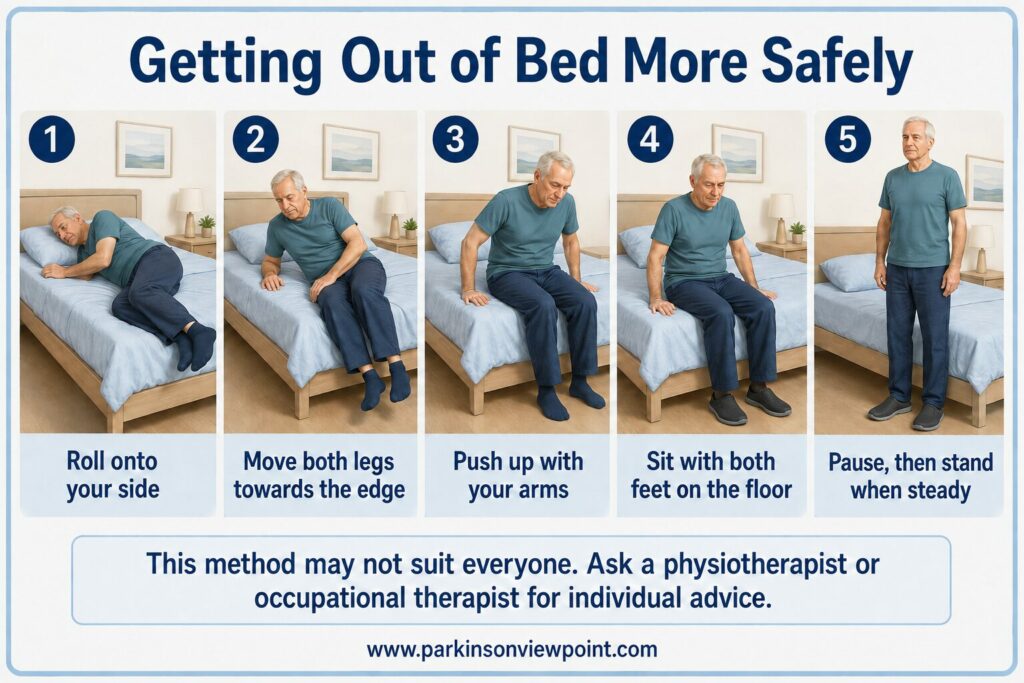
Make turning and getting out of bed easier
Stiffness can make it difficult to roll over, move towards the edge or sit upright. Try to avoid rushing or pulling forcefully on nearby furniture.
When getting out of bed:
- Roll onto your side.
- Move your legs towards the edge of the bed.
- Use your arms to push your upper body into a sitting position.
- Sit for a moment with both feet on the floor.
- Stand only when you feel steady.
This technique may not suit everyone. A physiotherapist or occupational therapist can show you a method based on your strength, balance and usual movement pattern.
Satin sleepwear or a carefully positioned low-friction panel may make turning easier for some people. However, very slippery bedding can also make sitting on the edge of the bed less secure. Seek professional advice before using it, particularly if you have previously slipped or fallen from bed. Parkinson’s UK also recommends choosing bedroom equipment according to individual needs rather than relying on a single solution.
Be cautious with bed equipment
Bed rails, support handles, lifting poles and adjustable beds may help some people, but they are not suitable for everyone. Poorly fitted equipment can move, create gaps or make transfers more difficult.
Do not pull yourself up using the bedside table, headboard or a walking frame. If you regularly need physical help to turn or get out of bed, ask for an assessment before buying equipment.
Plan for nighttime bathroom visits
Before standing during the night:
- switch on the light;
- sit at the edge of the bed for a moment;
- place both feet firmly on the floor;
- stand slowly and pause to find your balance; and
- use your prescribed walking aid if needed.
If you frequently feel dizzy after sitting or standing, or urgently rush to the toilet at night, discuss this with your doctor or Parkinson’s nurse. These problems may require more than a change to the bedroom.
For caregivers: Avoid pulling the person upright by their arms. If help is regularly needed with turning or getting out of bed, ask a physiotherapist or occupational therapist to demonstrate a safer technique. Keep agreed nighttime assistance within privacy and dignity.
A useful place to start: Lie down as usual, then slowly get out of bed and walk towards the bathroom using your normal nighttime routine. Notice whether you struggle to reach the light, slide towards the edge, grab unstable furniture or encounter anything on the floor. Improve the first difficulty you identify.
7. Make stairs and entrances safer
Stairs and entrances require several movements at once: judging changes in height, lifting the feet, maintaining balance, turning and sometimes opening a door or carrying something. Parkinson’s disease can make these movements slower and less automatic, particularly during an “OFF” period, when tired or when attention is divided.
The aim is to make every step clearly visible, provide reliable support and avoid rushing.
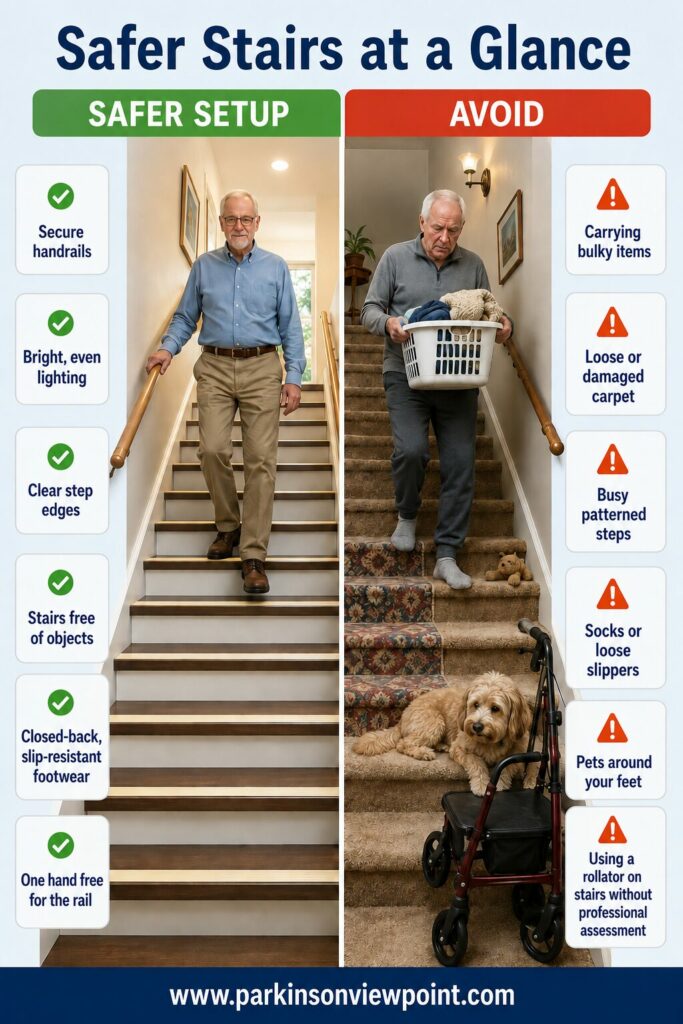
Make stairs easier to see and use
Simple changes include:
- Keep stairs, landings and the areas at the top and bottom completely clear.
- Install secure handrails. Rails on both sides may provide additional support when appropriate.
- Make sure the entire staircase is evenly lit, with switches accessible at both the top and bottom.
- Repair loose carpet, damaged flooring and uneven or unstable steps promptly.
- Avoid patterned stair coverings, which may make step edges harder to distinguish.
- Use contrasting strips on step edges if they are difficult to see, but test them first because visual markings do not help everyone.
- Avoid storing objects on the stairs, even temporarily.
- Keep pets away from the staircase when you are using it.
- Do not carry items that prevent you from seeing the steps or holding the handrail.
- Wear secure, well-fitting footwear with a closed back and slip-resistant sole.
Contrasting markings may be particularly helpful on the first and last steps, where a change in level can be missed. However, too many stripes or highly patterned surfaces may create visual confusion. An occupational therapist can help determine whether contrast markings would be useful for you.
Take one step at a time
When using stairs:
- Pause before the first step and make sure you feel balanced.
- Face forward and hold the handrail securely.
- Place your whole foot on each step whenever possible.
- Move at a steady pace without rushing.
- Pause on a landing if you become tired or unsteady.
Avoid using stairs while carrying a walking frame or rollator unless a physiotherapist has assessed the situation and shown you a safe method. Never leave a walking aid where it could become a trip hazard at the top or bottom of the stairs.
If freezing, dizziness, repeated near-falls or difficulty judging the steps occurs, stop using the stairs alone until you have received professional advice.
Make entrances easier to manage
Doorways can trigger freezing because they create a narrow visual space and often require several actions in quick succession.
Consider the following:
- Keep shoes, parcels, bags and umbrellas away from the entrance route.
- Provide bright lighting inside and outside the doorway.
- Repair raised thresholds and uneven paving.
- Use a secure handrail beside outdoor steps or ramps.
- Choose a non-slip doormat that is thin, lies flat and does not move.
- Keep keys easy to reach so you are not searching while standing at the door.
- Avoid carrying several bags through the doorway at once.
- Allow enough space to open the door without stepping backwards suddenly.
- Keep outdoor routes free from wet leaves, snow and ice.
If you tend to freeze in a doorway, pause before entering, stand upright and use the cue that normally helps you—such as counting, shifting your weight or imagining yourself stepping over a line. A physiotherapist can help identify and practise an appropriate strategy. Doorways and surface changes are recognized freezing triggers in Parkinson’s disease.
Consider larger adaptations carefully
If stairs are becoming consistently unsafe, an occupational therapist can assess whether additional rails, rearranging frequently used rooms or a stairlift may help. Do not purchase major equipment before checking whether it suits your mobility, home layout and likely future needs.
A stairlift does not remove every risk. You must still be able to approach it, sit down, operate it and transfer safely at the other end.
For caregivers: Do not rush, pull or distract someone while they are using stairs. Avoid carrying their walking aid while also physically supporting them unless a physiotherapist has shown you a safe method. If supervision is needed, agree in advance how and where you will assist.
A useful place to start: Stand at the main entrance and follow your usual route into the home and towards the stairs. Look for poor lighting, loose mats, difficult thresholds, objects that require you to step sideways and places where no secure support is available. Correct the first hazard you encounter.
Download the Whole-Home Safety Checklist
Use this printable checklist to review lighting, floors, bathrooms, bedrooms, stairs and other important areas of your home. It can help you identify possible hazards and decide which safety changes to address first.
Free printable PDF • 3 A4 pages • Designed for people with Parkinson’s and their caregivers
Download the Free ChecklistYou can save it, print it or share it with a caregiver, family member or healthcare professional.
When to request a professional home assessment
Consider requesting a home assessment if you have fallen or nearly fallen, feel unsteady or worried about falling, struggle with stairs, bathing or getting in and out of bed, or notice that everyday tasks are becoming less safe. It is also wise to seek advice before installing grab rails, ramps or transfer equipment.
An occupational therapist can observe how you move around your home, identify risks that may be easy to overlook and recommend practical changes suited to your needs. Ask your doctor, Parkinson’s nurse or local health service about a referral—you do not need to wait until a serious fall occurs. Parkinson’s UK explains how occupational therapists can support safer movement and fall prevention at home.
Key takeaways
- Small home adjustments can make daily life safer and easier for people with Parkinson’s disease.
- Begin with the areas used most often—especially routes between the bedroom, bathroom and kitchen.
- Improve lighting, remove trip hazards and keep commonly used items within easy reach.
- Choose properly fitted grab rails, seating and mobility equipment instead of relying on furniture for support.
- Review the home regularly, as symptoms and everyday needs may change over time.
- Ask an occupational therapist for a home assessment if falls, near-falls or daily activities become a concern.
You do not need to change everything at once. Start with the most immediate risk, make one practical improvement and build from there. The goal is not to create a perfect home — it is to create a home that supports greater safety, confidence and independence.
Get Your Free Parkinson’s Medication Management Diary
Download your free printable diary to easily track your medications, symptoms, and doses.