
Reviewed by Dr. Akbar Zaib, PhD (Neurosciences)
Parkinson’s researcher and founder of Parkinson Viewpoint
Last updated: August 2026 12 min read
Best eating aids for Parkinson’s disease can make everyday meals safer, easier, and more independent. From electronic stabilizing spoons that help reduce the effects of hand tremor to adaptive mugs, scooper plates, and weighted utensils, the right eating aid can significantly improve comfort and confidence at mealtimes.
In this guide, we’ve carefully compared some of the best adaptive eating aids available today, explaining who each product is best suited for, its key benefits, and what to consider before buying. Whether you’re looking for help with hand tremor, reduced grip strength, difficulty scooping food, or swallowing problems, this guide will help you choose the most appropriate solution for your individual needs.
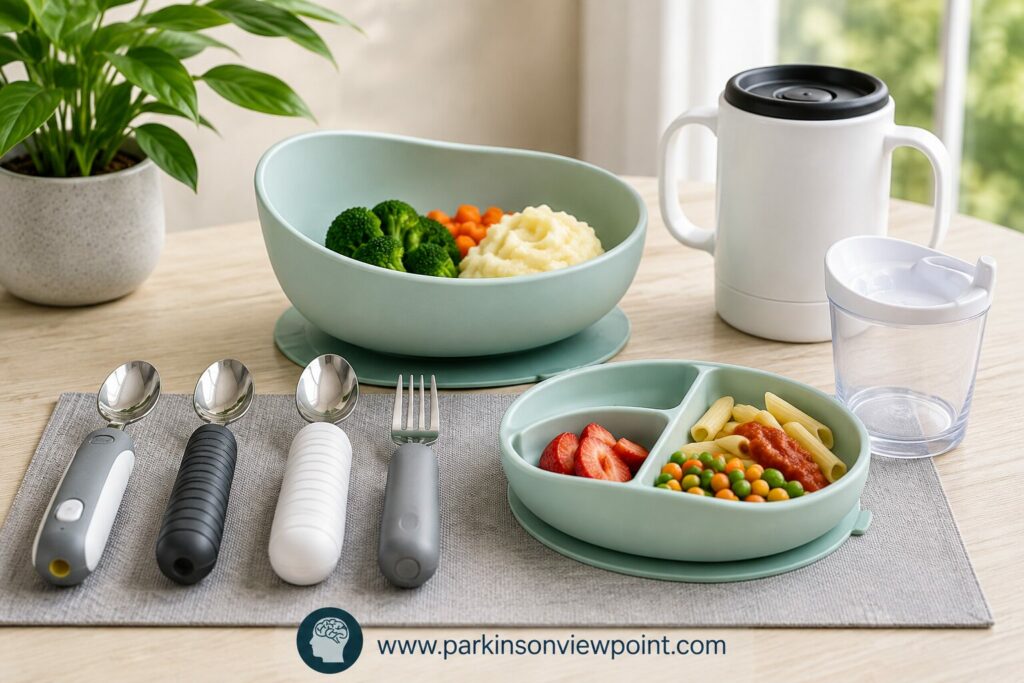
Eating should feel simple and enjoyable. But for many people living with Parkinson’s disease, an ordinary meal can gradually become tiring, frustrating or embarrassing.
Hand tremor may cause food to fall from a spoon. Muscle stiffness can make it difficult to grip or turn standard cutlery. Slowness of movement may make meals take much longer, while reduced coordination can increase the risk of spills. Parkinson’s can also affect strength, dexterity and the ability to bring food or a drink steadily to the mouth.
The right eating aid will not remove the underlying Parkinson’s disease symptoms. However, it may make mealtimes more manageable and help a person continue eating with greater comfort, confidence and independence.
Depending on the difficulty, useful products may include:
- weighted or stabilizing spoons for hand tremor;
- large-handled or bendable cutlery for a weaker grip;
- rocker knives for easier one-handed cutting;
- high-sided plates and plate guards to prevent food from sliding away;
- non-slip mats that keep dishes in place;
- lightweight, two-handled or spill-resistant cups; and
- insulated bowls and mugs for people who need more time to finish a meal.
Parkinson’s organizations and occupational-therapy guidance commonly recommend adaptive utensils, covered cups, plate guards and larger handles as practical ways to make eating easier. An occupational therapist can also help identify which type of equipment best matches a person’s symptoms and abilities.
What you will find in this guide
In this guide, we compare some of the most useful adaptive eating aids for people with Parkinson’s disease, including stabilizing spoons, weighted utensils, adaptive cups and mugs, scooper plates, bowls, and suction-base dining aids.
To keep the guide practical and easy to use, each product includes:
- an overall rating;
- who it is best suited for;
- a short review of its main benefits;
- key advantages;
- and a direct link to check the latest price and availability.
We also include comparison tables for spoons and utensils, cups and mugs, and plates and bowls, so readers can quickly identify which option best matches their main mealtime difficulty.
Rather than assuming that one product will work for everyone, this guide focuses on matching each aid to a specific Parkinson’s-related challenge, such as hand tremor, reduced grip strength, poor wrist control, difficulty scooping food, plate movement, frequent spills, or swallowing difficulties.
The best eating aid is not necessarily the most advanced or expensive one. It is the product that most closely matches the individual’s symptoms, abilities, and everyday needs.
Important: Eating aids can help with grip, tremor, coordination and spills, but they are not a treatment for swallowing difficulties. Coughing during meals, choking, unexplained weight loss, a wet or gurgling voice after swallowing, or a feeling that food is becoming stuck should be discussed with a healthcare professional. Parkinson’s disease can affect the muscles involved in chewing and swallowing, and specialist assessment may be needed.
Editor’s Note: We independently researched and selected the adaptive eating aids featured in this guide based on product design, usability, value, customer feedback, and their potential benefits for people living with Parkinson’s disease. If you purchase through our affiliate links, we may earn a small commission at no extra cost to you. This helps support Parkinson Viewpoint and allows us to continue creating free, evidence-based educational content.
Why eating can become difficult with Parkinson’s disease
Eating is something most people do without thinking. It involves reaching for utensils, gripping them firmly, lifting food steadily to the mouth, chewing safely, swallowing comfortably and putting the utensil back down—all in one smooth sequence of movements.
Parkinson’s disease can affect several of these steps. While not everyone experiences the same difficulties, changes in movement, muscle control and coordination can make everyday meals more challenging over time.
Understanding which symptom affects you the most is the first step toward choosing the right adaptive eating aid.
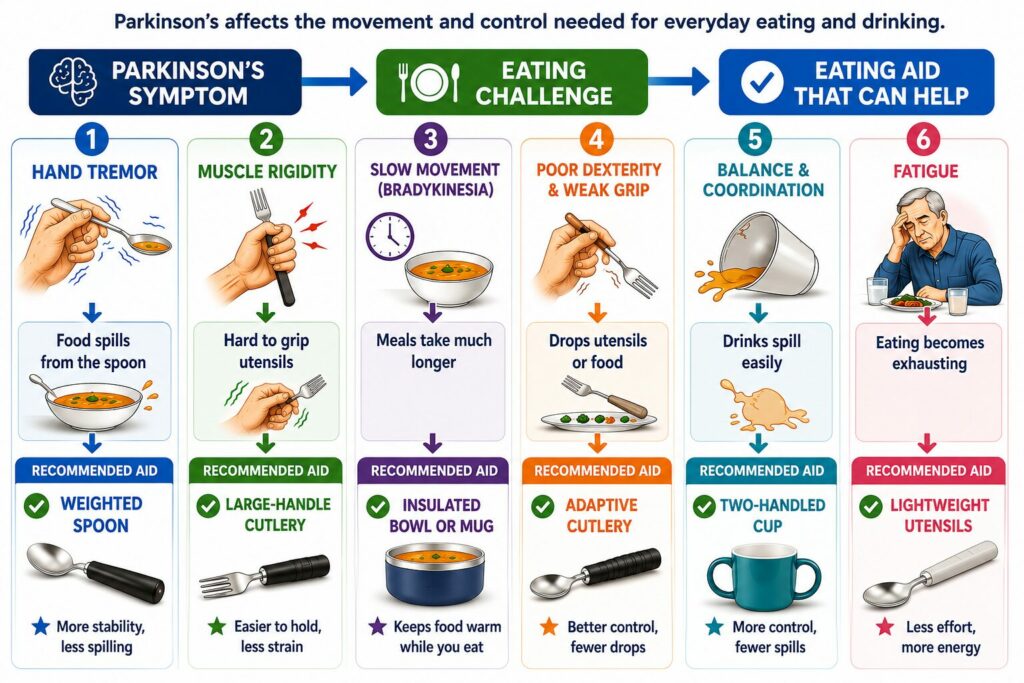
Hand tremor
Tremor is one of the most recognized symptoms of Parkinson’s disease. Although not everyone develops tremor, those who do may notice shaking of the hand while it is at rest, and sometimes when beginning a movement.
During meals, tremor can make it difficult to carry food or drinks without spilling them. Soup may splash from a spoon, drinks may shake in a cup, and small foods can become frustrating to manage.
For some people, a heavier utensil or a stabilizing spoon can reduce unwanted movement enough to make eating easier.
Muscle rigidity
Rigidity refers to increased muscle stiffness, which can affect the hands, wrists, arms and shoulders.
A stiff hand often finds it harder to grip standard cutlery comfortably. Holding a thin knife or spoon for an entire meal may become tiring or even painful.
Many people find that utensils with larger, cushioned handles require less grip strength and provide better control.
Bradykinesia (slowness of movement)
Bradykinesia, or slowed movement, is one of the hallmark symptoms of Parkinson’s disease.
Simple tasks such as lifting a fork, cutting food or bringing a spoon to the mouth may take much longer than before. Meals can become exhausting, particularly if food cools before the meal is finished.
Adaptive utensils that are easier to hold and lightweight dishes that stay in place can reduce the effort required throughout the meal.
Reduced dexterity and grip strength
Parkinson’s disease can reduce fine motor control, making precise hand movements more difficult.
Tasks such as picking up peas with a fork, cutting meat, opening containers or holding a cup by a small handle may become frustrating.
Eating aids with wider grips, textured handles and ergonomic designs can compensate for reduced finger dexterity and improve confidence during meals.
Balance and postural changes
Parkinson’s disease may also affect posture and sitting balance.
Leaning forward, reduced trunk stability or difficulty coordinating arm movements may increase the likelihood of spilling food or drinks.
Simple accessories such as non-slip placemats, plate guards and two-handled cups can help improve stability while eating.
Fatigue
Many people with Parkinson’s disease experience fatigue that goes beyond normal tiredness.
Preparing food, eating slowly and concentrating on each movement can become physically and mentally exhausting. As fatigue increases, coordination may worsen, making spills more common.
Choosing utensils that reduce effort can help conserve energy and make mealtimes feel less demanding.
Why the right eating aid depends on your symptoms
There is no single “best” eating aid for everyone with Parkinson’s disease.
Someone with mild tremor may benefit from a weighted spoon, while another person with severe hand stiffness may find a large-handled utensil much more helpful. Others may need a spill-proof cup, a plate guard or simply a non-slip mat to regain confidence during meals.
The most effective solution is the one that addresses your specific challenge rather than the most expensive product available.
Throughout this guide, we’ll explain which products are best suited for different Parkinson’s disease symptoms, helping you choose equip
Which Eating Aid Is Right for Your Parkinson’s Symptoms?
Start with the difficulty that affects you most, then choose an eating aid designed to make that specific part of mealtimes easier, safer, or more independent.
🥄 Spoons & Adaptive Utensils
Moderate to severe hand tremor
Electronic stabilizing spoon
Actively reduces utensil movement to help keep food steadier while lifting it.
Mild to moderate tremor
Mechanical self-leveling spoon
Helps reduce spills without requiring batteries, charging, or electronic parts.
Reduced grip strength or dexterity
Weighted adaptive utensils
Larger ergonomic handles and added weight can improve grip and utensil control.
Several utensil-related difficulties
Complete adaptive utensil set
Provides multiple easy-grip utensils for more supportive everyday dining.
☕ Cups & Mugs
Hand tremor or reduced wrist control
Stabilizing or rotating-handle mug
Helps keep the cup more level and may reduce spills while lifting and drinking.
Reduced grip strength
Two-handled adaptive mug
Provides extra balance and allows the drink to be supported with both hands.
Swallowing difficulties
Flow-regulating dysphagia cup
Controls sip size and supports slower, more manageable drinking.
Frequent drink spills
Spill-resistant cup or mug
A fitted lid or straw-compatible design helps limit accidental spills.
🍽️ Plates & Bowls
Difficulty scooping food
Scooper bowl
A raised curved edge helps guide food onto a spoon or fork with less effort.
Food slides across a flat plate
Scooper plate with raised rim
Makes one-handed scooping easier and helps keep food contained.
Plate moves during meals
Suction-base plate
Secures the dish to a smooth surface for improved stability while eating.
Mixed or semi-solid meals
Deep scoop dish
Combines the wider surface of a plate with the containment of a bowl.
Parkinson Viewpoint tip
If you’re unsure where to start, focus on the activity that frustrates you the most during meals. For example, if you frequently spill soup, a weighted or stabilizing spoon may be the best first purchase. If your plate moves while cutting food, a non-slip mat or plate guard may provide greater benefit than changing your cutlery.
In many cases, combining two or three simple eating aids is more effective than relying on a single product.
How we chose the best eating aids for Parkinson’s disease
Hundreds of adaptive eating products are available online, but not all of them are suitable for people living with Parkinson’s disease.
Rather than recommending products based solely on popularity or sales rankings, we evaluated each eating aid according to features that are most relevant to Parkinson’s disease symptoms and everyday use.
Our goal is to recommend products that can genuinely make mealtimes easier, safer and more comfortable.
Our evaluation criteria
Every product included in this guide was assessed using the following criteria:
1. Ease of use
The product should be simple to use without requiring complicated adjustments or extensive setup.
We considered how easily it could be picked up, held and used during everyday meals.
2. Comfort and grip
Many people with Parkinson’s disease experience hand stiffness, reduced dexterity or weaker grip strength.
We gave preference to products with ergonomic designs, larger handles or soft-grip materials that may improve comfort during longer meals.
3. Stability
A major purpose of adaptive eating aids is to improve stability while eating.
Depending on the product, this may include reducing spills, helping food stay on the plate or making cups easier to hold.
4. Build quality
Eating aids are used every day and should withstand regular washing and repeated use.
We looked for products made from durable materials with good overall construction.
5. Ease of cleaning
Products should be practical to maintain.
Whenever possible, we preferred utensils and accessories that are dishwasher safe or easy to clean by hand.
6. User feedback
Real-world experiences can provide valuable insights that are not always obvious from product descriptions.
We considered verified customer reviews, particularly comments relating to Parkinson’s disease, hand tremor, arthritis and reduced hand function.
7. Value for money
The most expensive product is not always the best choice.
Whenever two products offered similar performance, we generally favored the option that provided better overall value.
8. Suitability for Parkinson’s disease
Most importantly, we assessed whether the product addresses common challenges experienced by people with Parkinson’s disease, including tremor, rigidity, reduced dexterity, slower movements and difficulty eating independently.
Best adapted spoons and utensils for Parkinson’s disease
For many people living with Parkinson’s disease, keeping food on a spoon can become one of the biggest challenges at mealtimes. Hand tremor, reduced coordination and slower movements may increase the likelihood of spilling food before it reaches the mouth.
A weighted spoon is designed to improve stability by adding extra weight to the handle. The additional weight may help some people achieve smoother, more controlled movements, making it easier to eat foods such as soup, cereal, yogurt and rice.
It is important to understand that weighted spoons do not stop tremors or treat Parkinson’s disease. Instead, they are adaptive eating aids that may help reduce the functional impact of tremor for some individuals.
Not everyone benefits from additional weight. People with significant muscle weakness, severe fatigue or painful hand stiffness may actually find a heavy utensil more tiring to use. In these situations, lightweight adaptive cutlery or ergonomic handles may be a better choice.
The products below represent some of the best options currently available, ranging from simple weighted utensils to advanced electronic stabilizing spoons designed specifically to reduce the effects of hand tremor.
| Rank | Product | Rating | Best For |
|---|---|---|---|
| 1 | Liftware Steady | Moderate to severe hand tremor | |
| 2 | EliSpoon No-Spill Spoon | Mild to moderate hand tremor and reducing spills while eating | |
| 3 | Greenants adaptive utensils | Mild tremor and reduced grip strength | |
| 4 | PKPKAUT Adaptive Adaptive Utensils | People needing multiple adaptive utensils for everyday meals | |
| 5 | BUNMO Adaptive Utensils | Reduced hand strength and finger dexterity |
1. Liftware steady spoon
⭐⭐⭐⭐⭐ 9.8/10
Best for
People with moderate to severe hand tremor who need maximum stabilization while eating.
Quick review
The Liftware Steady is our top-rated adaptive spoon because its electronic stabilization technology helps reduce the effects of hand tremor, making eating easier and more comfortable. While it’s more expensive than traditional weighted utensils, it offers the greatest assistance for people whose tremor significantly affects mealtimes.
Pros
✔ Electronic stabilization
✔ Comfortable grip
✔ Easy to clean
✔ Rechargeable
2. EliSpoon no-spill spoon
⭐⭐⭐⭐⭐ 9.6/10
Best for
People with mild to moderate hand tremor, reduced wrist control, or involuntary hand movement who want a mechanical self-leveling spoon without batteries or charging.
Quick review
The EliSpoon no-spill spoon uses a mechanical self-leveling design that helps keep the spoon bowl more stable as the hand moves. Unlike electronic stabilizing utensils, it requires no batteries, charging, or complicated setup, making it a practical everyday option for people with Parkinson’s disease.
Its design can help reduce spills while moving food from the plate to the mouth, particularly for users whose tremor or wrist movement makes a standard spoon difficult to control. It does not actively cancel severe tremor like an electronic spoon, but it offers a useful balance of simplicity, portability, and assistance.
Pros
✔ Mechanical self-leveling design
✔ No batteries or charging required
✔ Helps reduce spills
✔ Lightweight and portable
✔ Simple to use and clean
👉 Check price and availability
3. Greenants adaptive utensils
⭐⭐⭐⭐⭐ 9.4/10
Best for
People with mild to moderate hand tremor, reduced grip strength, or decreased hand dexterity who want an affordable weighted adaptive utensil set for everyday meals.
Quick review
The Greenants Adaptive Utensils Set is designed to make eating easier for people with Parkinson’s disease, arthritis, and other conditions that affect hand control. The utensils feature large ergonomic handles that are easier to grip and added weight to improve stability during meals. While they do not actively stabilize tremor like electronic utensils, they provide a practical and budget-friendly solution for improving confidence and independence during everyday eating.
Pros
✔ Weighted design helps improve utensil control
✔ Large ergonomic, easy-to-grip handles
✔ Complete adaptive utensil set
✔ Durable stainless-steel construction
✔ Excellent value for money
4. PKPKAUT adaptive weighted utensils set
⭐⭐⭐⭐⭐ 9.3/10
Best for
People with mild to moderate hand tremor, reduced grip strength, or decreased hand dexterity who need a weighted adaptive utensil set for everyday meals.
Quick review
The PKPKAUT adaptive weighted utensils set is designed to improve comfort and control during meals for people with Parkinson’s disease and other conditions affecting hand function. Its weighted stainless-steel utensils help reduce unwanted hand movements, while the large ergonomic handles provide a secure and comfortable grip. The complete set offers an affordable and practical solution for maintaining independence during everyday eating.
Pros
Pros
✔ Weighted utensils improve hand stability
✔ Large ergonomic non-slip handles
✔ Complete adaptive utensil set
✔ Durable stainless steel construction
✔ Dishwasher safe
✔ Good value for money
5. BUNMO adaptive weighted utensils
⭐⭐⭐⭐⭐ 9.2/10
Best for
People with mild to moderate hand tremor, reduced grip strength, or decreased hand dexterity who want a comfortable weighted utensil set for everyday meals.
Quick review
The BUNBOO adaptive weighted utensils are designed to help people with Parkinson’s disease eat more comfortably and independently. The utensils feature weighted stainless-steel heads that help improve hand stability, while the large ergonomic handles provide a secure, non-slip grip that’s easier to hold than standard cutlery. The complete set includes essential dining utensils, making it a practical solution for everyday meals at home or while traveling.
Although it does not actively stabilize tremor like electronic utensils, its weighted design and comfortable grip can help reduce unwanted hand movements and improve confidence during eating.
Pros
✔ Weighted design helps improve utensil control
✔ Large ergonomic, non-slip handles
✔ Complete adaptive utensil set
✔ Durable stainless-steel construction
✔ Dishwasher safe
✔ Good value for everyday use
Looking specifically for traditional weighted cutlery? See our detailed guide to weighted utensils for Parkinson’s disease for additional sets, features and selection considerations.
Best adaptive cups & mugs for Parkinson’s disease
Many people with Parkinson’s disease find drinking just as challenging as eating. Hand tremor, muscle rigidity, reduced grip strength, and slowed movements can make it difficult to lift a regular cup without spilling drinks. Hot beverages such as coffee, tea, or soup may become particularly stressful because even a small tremor can lead to spills or burns.
Adaptive cups and mugs are designed to improve safety and independence during drinking. Features such as two large handles, lightweight construction, spill-resistant lids, and nose cut-outs allow many people to drink more comfortably without needing to tilt their head excessively or worry about dropping the cup.
While no single cup is right for everyone, choosing the right design can make everyday hydration easier and help reduce frustration at mealtimes.
Below are our top-rated adaptive cups and mugs for people with Parkinson’s disease, carefully selected for their ease of use, quality, and ability to promote greater independence during everyday drinking.
| Rank | Product | Rating | Best For |
|---|---|---|---|
| 1 | HandSteady Mug | Hand tremor and reduced wrist control | |
| 2 | EZSLINGGLIDE Dysphagia Regulating Cup | Parkinson’s-related swallowing difficulties and controlled sip sizes | |
| 3 | North Coast Medical Mug with Lid and Handles | Reduced grip strength and difficulty lifting heavier mugs | |
| 4 | Kennedy Cup | Drinking through a straw with less risk of spills | |
| 5 | Providence Spillproof Two-Handled Mug | Reduced grip strength and additional two-handed stability |
1. HandSteady mug
⭐⭐⭐⭐⭐ 9.8/10
Best for
People with Parkinson’s disease who experience hand tremor or reduced grip strength while drinking.
Quick review
The HandSteady mug features a unique rotating handle that allows the cup to remain level while lifting, helping reduce spills caused by tremor or wrist movement. Its innovative design makes drinking easier, safer, and more comfortable for everyday use.
Pros
✔ Rotating ergonomic handle
✔ Helps reduce spills
✔ Comfortable grip
✔ High-quality construction
2. EZSLINGGLIDE dysphagia regulating drinking cup
⭐⭐⭐⭐⭐ 9.6/10
Best for
People with Parkinson’s disease who experience swallowing difficulties (dysphagia).
Quick review
The EZSLINGGLIDE dysphagia drinking cup is designed to regulate the flow of liquids, helping users take smaller, safer sips. Its thoughtful design can improve drinking safety while reducing the risk of choking or spills.
Pros
✔ Flow-regulating drinking spout
✔ Helps support safer swallowing
✔ Comfortable two-hand grip
✔ Easy to clean
3. North coast medical mug with lid and handles
⭐⭐⭐⭐⭐ 9.5/10
Best for
People with hand tremor who need a lightweight mug with extra stability.
Quick review
The North coast medical mug combines two large ergonomic handles with a spill-resistant lid, making it easier to lift and control during drinking. Its lightweight design helps reduce fatigue while improving confidence at mealtimes.
Pros
✔ Dual ergonomic handles
✔ Spill-resistant lid
✔ Lightweight design
✔ Easy to clean
4. Kennedy cup
⭐⭐⭐⭐⭐ 9.4/10
Best for
People with reduced neck mobility or difficulty tilting their head back while drinking.
Quick review
The Kennedy cup features a cut-out rim that allows users to drink without excessive neck extension. It is especially useful for people with Parkinson’s disease who have difficulty maintaining a comfortable drinking position.
Pros
✔ Cut-out design supports natural drinking
✔ Lightweight
✔ Easy to hold
✔ Dishwasher safe
5. Providence spillproof two-handled mug
⭐⭐⭐⭐⭐ 9.3/10
Best for
People with Parkinson’s disease who experience hand tremor, reduced grip strength, or difficulty holding a standard mug without spilling.
Quick review
The Providence spillproof two-handled mug is designed to make drinking safer and easier by combining two large ergonomic handles with a spill-resistant lid. The dual-handle design provides better balance and control, helping users lift and hold the mug more securely. It’s a practical everyday solution for people with Parkinson’s who want greater confidence and independence while drinking hot or cold beverages.
Pros
✔ Dual ergonomic handles for extra stability
✔ Spill-resistant lid helps reduce accidents
✔ Lightweight and easy to grip
✔ Durable for everyday use
Best adaptive plates & bowls for Parkinson’s disease
Adaptive plates and bowls are designed to make eating easier and more independent. Features such as raised edges, scooped sides, deep bowls, and non-slip designs help guide food onto utensils, reduce mess, and make self-feeding more manageable for people with limited hand control.
In this section, we’ve reviewed some of the best adaptive plates and bowls for Parkinson’s disease, carefully selecting products that offer practical benefits, durability, ease of use, and good value. Whether you’re looking for a bowl that helps with one-handed eating or a scoop plate that minimizes spills, these products can help make mealtimes safer, easier, and more enjoyable.
Below are our top-rated adaptive plates and bowls for people with Parkinson’s disease, chosen for their practicality, durability, and ability to support safer, more independent eating.
| Rank | Product | Rating | Best For |
|---|---|---|---|
| 1 | Ableware Scooper Bowl | Tremor, reduced dexterity, and difficulty scooping food from a bowl | |
| 2 | Sammons Preston Scooper Plate | One-handed eating and difficulty collecting food from a flat plate | |
| 3 | Providence Scoop Dish | Mixed meals such as pasta, rice, vegetables, and casseroles | |
| 4 | Modaliv Adult Silicone Scooper Plate | Plate movement, reduced hand control, and the need for suction stability | |
| 5 | Essential Medical Supply Scooper Plate | Mild to moderate tremor and a lightweight everyday plate |
1. Ableware scooper bowl
⭐⭐⭐⭐⭐ 9.8/10
Best for
People with Parkinson’s disease who struggle to scoop food because of tremor, reduced dexterity, or slower hand movements.
Quick review
The Ableware scooper bowl features a raised curved edge that helps guide food onto a spoon or fork, making meals easier and reducing spills. It is one of the best adaptive bowls for promoting independent eating.
Pros
✔ Raised scooped edge
✔ Helps reduce spills
✔ Durable construction
✔ Dishwasher safe
2. Sammons preston scooper plate
⭐⭐⭐⭐⭐ 9.6/10
Best for
People with Parkinson’s disease who need extra support scooping food from a standard plate.
Quick review
The Sammons preston scooper plate uses a raised rim to help guide food onto utensils with one hand. Its simple yet effective design promotes more confident, independent eating while reducing frustration during meals.
Pros
✔ Raised scooping rim
✔ Large eating surface
✔ Lightweight
✔ Dishwasher safe
3. Providence scoop dish
⭐⭐⭐⭐⭐ 9.4/10
Best for
People with Parkinson’s disease who eat mixed meals such as rice, pasta, vegetables, or casseroles.
Quick review
The Providence scoop dish combines the benefits of a bowl and a plate with a deep scooped design that helps keep food contained and easier to collect. It offers excellent support for everyday meals.
Pros
✔ Deep scooped design
✔ Helps contain food
✔ Durable construction
✔ Easy to clean
4. Modaliv adult silicone scooper plate with suction base
⭐⭐⭐⭐⭐ 9.3/10
Best for
People with Parkinson’s disease who need both easier food scooping and extra plate stability during meals.
Quick review
The Modaliv silicone scooper plate combines a raised scooped rim with a built-in suction base, helping reduce spills while keeping the plate securely in place. Its food-grade silicone construction makes it a premium adaptive solution for everyday eating.
Pros
✔ Built-in suction base
✔ Raised scooping rim
✔ Food-grade silicone
✔ Microwave and dishwasher safe
5. Essential medical supply scooper plate
⭐⭐⭐⭐⭐ 9.2/10
Best for
People with Parkinson’s disease looking for a lightweight adaptive plate for everyday meals.
Quick Review
The Essential medical supply scooper plate features a raised rim that makes scooping food easier while remaining lightweight and comfortable to use. It is a practical and affordable option for improving independence during meals.
Pros
✔ Lightweight design
✔ Raised scooped rim
✔ Durable construction
✔ Easy to clean
Final thoughts
Eating difficulties are a common part of Parkinson’s disease, but the right adaptive eating aids can make a meaningful difference. Whether you’re looking for a spoon that helps reduce tremor, a mug that provides better stability, or a plate that makes scooping food easier, choosing the right product can help make everyday meals safer, more comfortable, and more independent.
Throughout this guide, we’ve reviewed a range of adaptive eating aids designed to address different challenges associated with Parkinson’s disease. While no single product is right for everyone, selecting an aid that matches your specific symptoms and needs can help reduce frustration and improve confidence at mealtimes.
If you’re unsure where to begin, consider starting with the product that addresses your biggest challenge. Small changes—such as using a weighted spoon, a two-handled mug, or a scooper bowl—can often make a noticeable difference in everyday life.
As Parkinson’s disease progresses, your needs may change. Regularly reviewing your eating aids with your healthcare professional or occupational therapist can help ensure you’re using the most appropriate equipment to maintain comfort, safety, and independence.
Medical disclaimer
The information in this article is provided for educational purposes only and should not replace professional medical advice. Always consult your neurologist, occupational therapist, or other qualified healthcare professional before purchasing or using adaptive eating aids, particularly if you experience swallowing difficulties (dysphagia) or other symptoms that require individualized assessment.