
Written and reviewed by Akbar Zaib, PhD in Neurosciences
Last reviewed and updated: October 3, 2026
Dressing with Parkinson’s disease can turn a simple daily task into a tiring and frustrating experience. This practical guide explains how the right routine, clothing and tools can make getting ready safer, easier and more independent.

Dressing with Parkinson’s disease can gradually become more difficult. Buttons that once took seconds may require several attempts. Pulling on trousers can affect balance, while putting an arm into a sleeve may feel uncomfortable because of stiffness.
These difficulties can make the beginning of the day tiring and frustrating. However, changing the dressing routine, choosing easier clothing and using a few simple aids can help you remain safer and more independent.
The goal is not to dress as quickly as possible. It is to make the process comfortable, manageable and less stressful.
Why does Parkinson’s disease make dressing difficult?
Getting dressed requires balance, flexibility, coordination, planning and fine finger movements. Parkinson’s disease can affect several of these abilities at the same time.
Common difficulties include:
- Slow movement: Bradykinesia can make every step of dressing take longer.
- Muscle stiffness: Rigidity may make it difficult to reach behind your back, raise an arm or bend toward your feet.
- Tremor: Shaking can interfere with buttons, zips, hooks and shoelaces.
- Balance changes: Standing on one leg while putting on trousers or shoes may become unsafe.
- Dyskinesia: Involuntary movements can make precise actions harder to control.
- Fatigue: Dressing may require more energy, especially after a poor night’s sleep.
- Thinking difficulties: Remembering the order of several dressing steps may sometimes feel overwhelming.
Symptoms may also vary throughout the day. Dressing may be manageable when medication is working well but much harder during an OFF period.
Understanding the exact source of the difficulty is important. Someone who struggles with buttons may need different help from someone who cannot stand safely. The best solution should address the person’s specific problem rather than replacing their entire wardrobe unnecessarily.
Quick Solutions for Common Dressing Difficulties
Use this guide to identify which part of dressing with Parkinson’s is difficult and what may make it easier.
| Dressing difficulty | What may help |
|---|---|
| Fastening buttons | Try larger buttons, a button hook or easy-close fastenings. |
| Pulling on trousers | Sit in a firm chair and consider trousers with an elastic waistband. |
| Putting on a shirt | Choose a wider opening and place the stiffer arm into the sleeve first. |
| Managing zips | Add a larger zipper pull that requires less precise finger control. |
| Putting on socks | Use a sock aid to reduce bending, reaching and hand effort. |
| Putting on shoes | Try a long-handled shoehorn and lightweight shoes with wide openings. |
| Tying shoelaces | Replace regular laces with elastic laces, lace locks or no-tie options. |
| Dressing while standing | Stay seated for as much of the task as possible and use a firm, supportive chair. |
| Dressing during an OFF period | If possible, dress when your Parkinson’s medication is working well. |
| Remembering each step | Lay out clothes in order and focus on completing one step at a time. |
Plan your dressing routine around your best time
One of the simplest ways to make dressing with Parkinson’s disease easier is to choose the right time.
If your movement improves after taking Parkinson’s medication, consider waiting until the medication has started working before getting dressed. During this time, you may feel less stiff and find it easier to control your hands. Sitting while dressing, allowing additional time and choosing easier fastenings may also make the process safer and more manageable [1].
Do not change your medication timing or dose without discussing it with your doctor. Instead, observe when dressing feels easiest and plan your routine around that period when possible.
Other helpful ways to prepare include:
- Lay out your clothes the night before.
- Place each item in the order you will put it on.
- Keep frequently worn clothes within easy reach.
- Avoid storing everyday items on very high or low shelves.
- Allow more time on mornings when you have an appointment.
- Reduce noise and other distractions in the room.
Before dressing, try a few gentle movements to loosen your shoulders, elbows, hands, hips and ankles. Only do movements that feel comfortable and that your healthcare professional has said are safe for you.
Hurrying can increase stress, and stress may make tremor or stiffness feel worse. Leaving even ten extra minutes can make the routine calmer.
If mornings regularly feel rushed or physically demanding, this daily routine for Parkinson’s disease offers more practical ways to plan activities around your energy, mobility and medication response.
If dressing is regularly difficult at the same time each day, keep a brief record of your medication time, symptoms and dressing difficulties. This information may help your Parkinson’s care team understand whether OFF periods are contributing to the problem.
Create a safer dressing position
Sitting down is usually safer than standing while putting on underwear, trousers, socks and shoes.
Use a stable chair with:
- A firm seat
- A supportive back
- Armrests
- Enough space around it
- Feet that do not slide
- A height that lets your feet rest flat on the floor
A soft bed may not provide enough support, particularly if you have balance difficulties. A firm chair also provides armrests that you can use when standing.
Avoid standing on one leg to step into trousers. Put both feet through the trouser legs while seated. Pull the trousers up as far as possible, then stand with stable support nearby if you need to complete the task.
If one side of your body is stiffer or slower, put that arm or leg into the garment first. When undressing, remove the less affected side first. This reduces the amount of movement required from the more affected limb.
For shoes and socks, bring one foot toward you rather than bending too far forward. A stable footstool, long-handled shoehorn or sock aid may help.
Keep the floor free of loose clothes, shoes, bags and other trip hazards. Good lighting is also important, especially when dressing early in the morning.
For a wider room-by-room safety review, see these simple home adjustments for Parkinson’s disease.
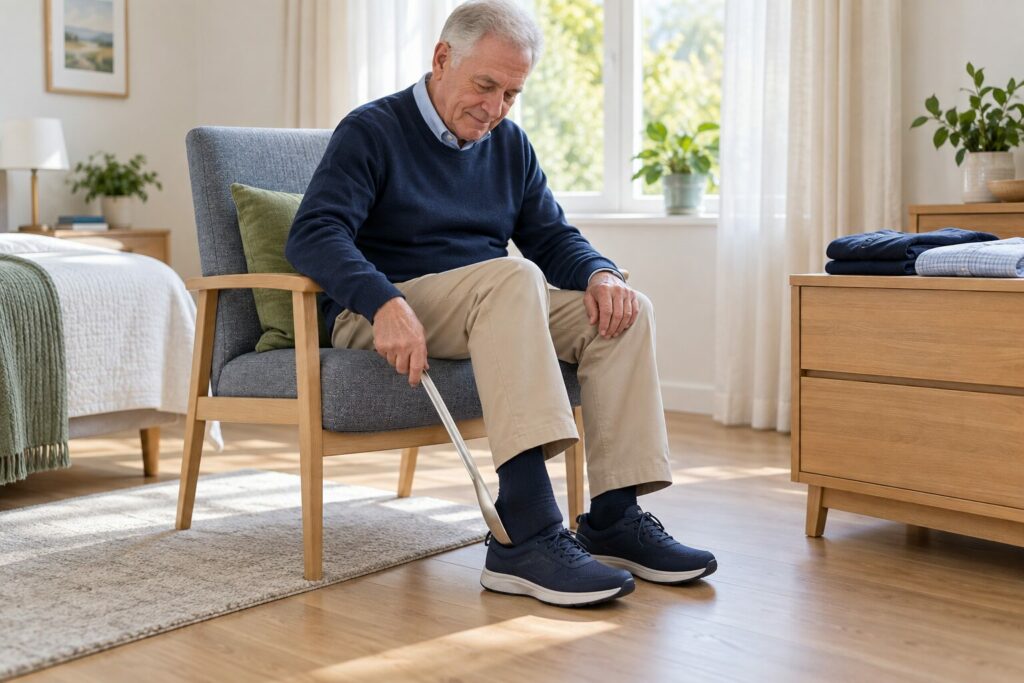
If you have experienced falls or feel unsteady while dressing, ask an occupational therapist or physiotherapist to assess your routine rather than continuing to stand unsupported.
Choose clothes that are easier to manage
The right clothes can make a major difference when dressing with Parkinson’s disease. You do not have to give up your personal style, but certain designs require less gripping, bending and precise finger movement.
Look for clothing with:
- Elastic or flexible waistbands
- Stretchy, lightweight fabrics
- Wide neck openings
- Roomy sleeves and trouser legs
- Front openings
- Large zip pulls
- Easy-touch hook-and-loop closures
- Large buttons
- Magnetic closures
- Flat seams that do not irritate the skin
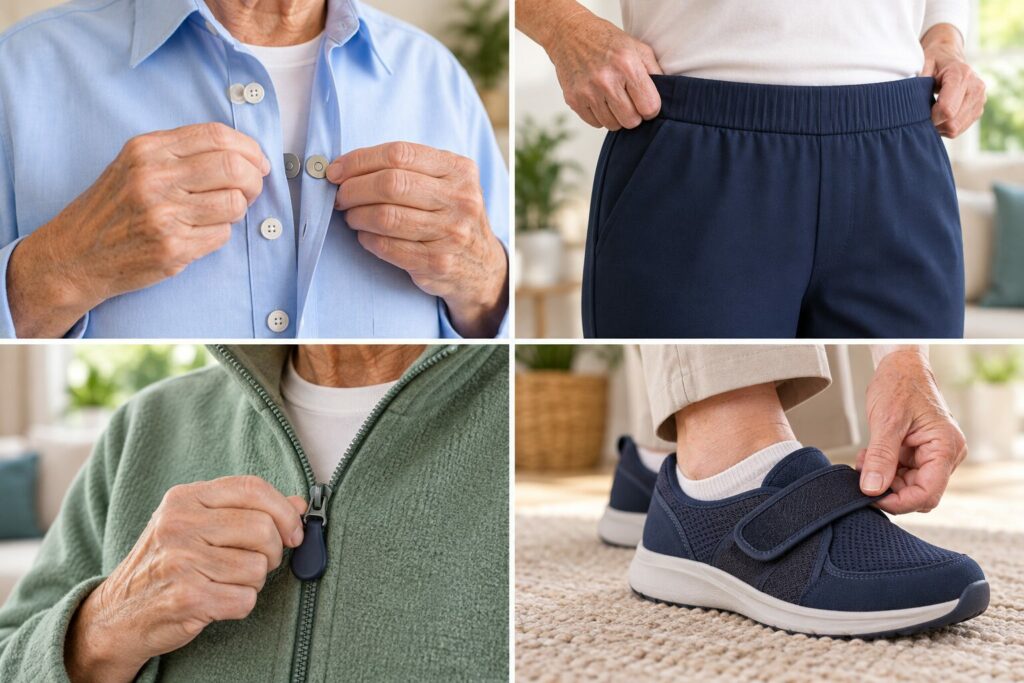
Smooth fabrics may slide over the arms and legs more easily. Very tight clothing can be difficult to pull into position, while rough fabrics may create friction against the skin or other garments.
Pull-on trousers remove the need to manage a button and zip at the waist. They can also make toileting easier, especially when movement is slow or urgency is a concern.
Shoes should be lightweight, supportive and properly fitted. Wide openings, adjustable easy-touch straps, elastic laces or no-tie fastenings can reduce bending and hand effort. Avoid loose slippers that can slide off and become a trip hazard.
If balance, shuffling or difficulty fastening shoes is a recurring concern, this guide explains what to look for when choosing shoes for Parkinson’s balance.
Adaptive Clothing That May Make Dressing Easier
Adaptive clothing looks like everyday clothing but uses features that require less gripping, reaching or precise finger movement. The most suitable option depends on which part of dressing has become difficult.
Affiliate disclosure: The Silverts links below are affiliate links. If you make a purchase through one of these links, Parkinson’s Viewpoint may receive a small commission at no additional cost to you. This helps support the free educational information and resources available on this website.
If buttons are difficult
A magnetic-front shirt can provide the appearance of an ordinary buttoned shirt without requiring each button to be pushed through a small opening.
May help with: tremor, reduced finger control or weak grip.
View magnetic shirts from Silverts →If trousers are difficult to fasten
Pull-on trousers with an elastic waistband remove the need to manage a button, hook or zip. Some designs also include pull tabs that may be easier to grip.
May help with: slow movement, hand stiffness or difficulty reaching the waist.
View pull-on trousers from Silverts →If shoes are difficult to put on
Wide-opening shoes with adjustable easy-touch straps may require less bending and hand control than traditional lace-up shoes.
May help with: difficulty tying laces, swollen feet or reduced hand dexterity.
View easy-close footwear from Silverts →If help from a care partner is needed
Open-back tops and side-opening trousers can allow a care partner to assist while the person remains seated.
May help with: limited mobility, wheelchair use or assisted dressing.
View assisted-dressing clothing from Silverts →Use dressing aids and break the task into steps
You may not need new clothing if a simple tool can make an existing garment easier to manage.
Helpful dressing aids include:
- A button hook
- A zipper pull
- A dressing stick
- A long-handled shoehorn
- A sock aid
- A reacher
- Elastic shoelaces
- A bra aid
- Foam tubing for a larger grip
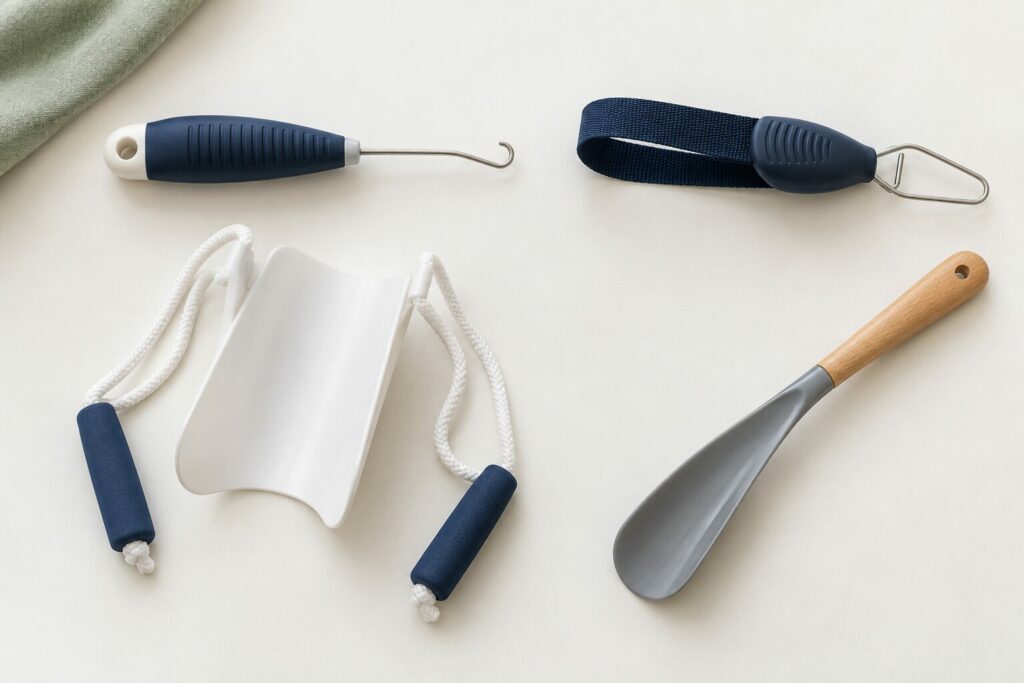
Not every tool will suit every person. If possible, try an aid before buying it or ask an occupational therapist to demonstrate it.
Breaking the task into smaller steps can also make dressing with Parkinson’s disease feel less overwhelming. For example:
- Sit securely in the chair.
- Put on underwear.
- Pause if you feel tired.
- Place the more affected leg into the trousers.
- Add the other leg.
- Pull the trousers up while seated.
- Stand with support only when necessary.
Focus on one action rather than thinking about the entire process. Short verbal cues such as “arm in,” “pull through” and “other arm” may help initiate the next movement.
On more difficult days, simplify your clothing. A pull-on top, elastic-waist trousers and easy-close shoes may conserve energy for other activities.
Support independence while knowing when to help
For care partners, it may feel easier to complete the whole task. However, taking over too quickly can reduce the person’s confidence and independence.
Ask which part is difficult before helping. You could say:
- “Which part would you like help with?”
- “Would you like me to hold the sleeve open?”
- “Do you want to try first?”
- “Shall we do this part together?”
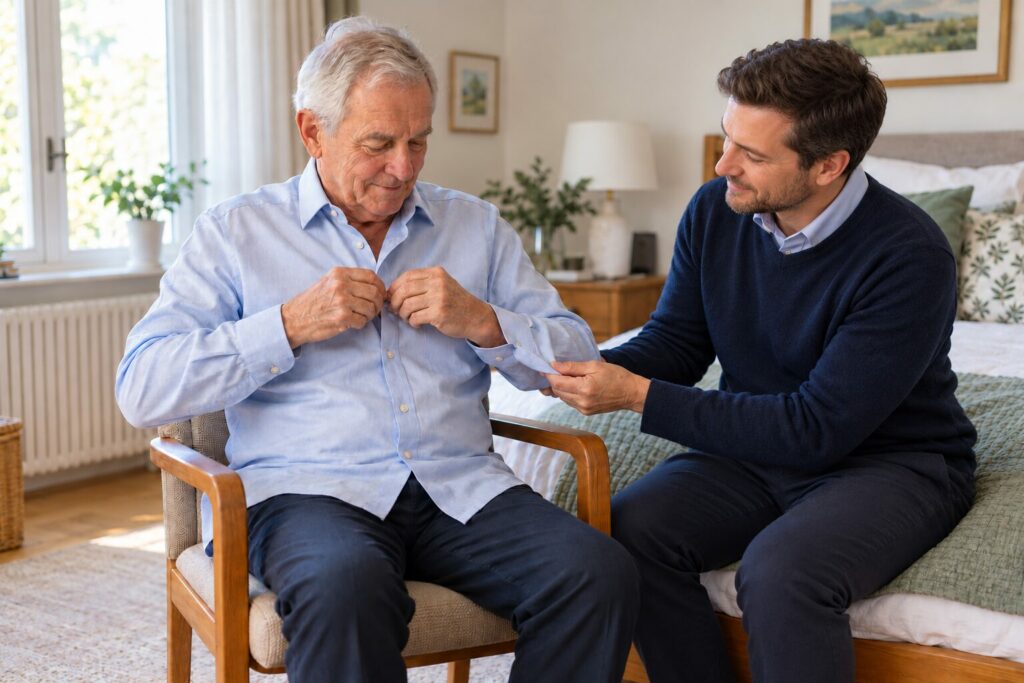
Give the person enough time to respond and move. Parkinson’s disease can slow movement and communication, but slowness does not mean the person cannot participate.
If movement and communication become noticeably harder when medication wears off, care partners may also find this guide to supporting someone during a Parkinson’s OFF period helpful.
Offer help only where it is needed. For example, you might arrange the clothes, hold a shirt open or fasten one difficult closure while allowing the person to complete the remaining steps.
Whenever possible, let the person decide what to wear. Clothing is connected to identity, privacy and dignity — not simply convenience.
Consider consulting an occupational therapist if:
- Dressing takes an unusually long time
- The person has fallen or nearly fallen
- Pain or stiffness limits movement
- A care partner is struggling physically
- You are unsure which dressing aid to choose
- Dressing from a wheelchair or bed has become difficult
- Changes at home are no longer enough
An occupational therapist can observe the actual routine, identify the most difficult steps and recommend personalized techniques, clothing modifications or equipment.
What research tells us about daily independence
A 2025 Japanese study, published in the American Journal of Occupational Therapy, examined independence in daily activities among 209 people with Parkinson’s disease at different stages of the condition. The participants had an average age of 73.3 years [2].

The researchers found that patterns of independence changed as Parkinson’s disease progressed. Most participants in the earlier stages remained independent in many daily activities, while those in more advanced stages were increasingly likely to require assistance [2].
The researchers concluded that support for daily activities should be matched to the person’s disease stage and current abilities. For dressing with Parkinson’s disease, this suggests that the most appropriate support may change over time.
Early support may involve allowing more time, changing the routine or practising a difficult movement. Later, adaptive clothing, assistive equipment or safer caregiver techniques may become more important.
However, this study did not test adaptive clothing or compare different dressing techniques. It should not be used to claim that a particular clothing product is clinically proven. Its main message is that daily-living support should be individualized.
A systematic review of occupational therapy-related interventions in Parkinson’s disease found evidence supporting task-specific training, external cues and supports, and individualized self-management strategies [3]. In practical terms, practising a real activity — such as putting on a shirt — in the person’s usual environment may be more useful than practising unrelated movements.
Common questions about dressing with Parkinson’s disease
What clothes are easiest for someone with Parkinson’s disease?
Clothes with elastic waistbands, wider openings, stretchy fabrics and easy-to-manage fastenings are often easier to use. The best choice depends on whether the main difficulty involves hand control, stiffness, balance or the need for caregiver assistance.
Can adaptive clothing help someone remain independent?
Adaptive clothing may help some people complete more of the dressing process themselves. Magnetic closures, pull-on trousers and easy-close footwear reduce the need for precise finger movements, but the clothing should be selected for the person’s particular difficulty.
Are magnetic shirts safe for people with pacemakers?
Magnets can interfere with some pacemakers, implantable cardioverter-defibrillators and other medical devices. Check the garment instructions and ask the device manufacturer or a healthcare professional before using magnetic clothing. Magnet-free closures are available.
What is the safest way to get dressed with balance problems?
Remain seated for as much of the task as possible and use a firm chair with a supportive back and armrests. Avoid standing on one leg to put on trousers, socks or shoes. Repeated unsteadiness, falls or near-falls should be discussed with a physiotherapist or occupational therapist.
When should an occupational therapist be consulted?
Consider an occupational therapy assessment if dressing takes an unusually long time, causes pain or exhaustion, feels unsafe, or requires increasing help from a care partner. An occupational therapist can assess the actual routine and recommend techniques, clothing adaptations or dressing aids.
The takeaway
Dressing with Parkinson’s disease may take more time, but it does not have to become a daily struggle.
Begin by identifying the most frustrating or unsafe part of the routine. Then try one suitable change:
- Dress during your best medication period.
- Sit in a firm, supportive chair.
- Prepare clothes the night before.
- Put the stiffer side into the garment first.
- Replace one difficult fastening.
- Try a simple dressing aid.
- Ask for an occupational therapy assessment.
Use the change for several days before deciding whether it helps. What works well for one person may not work for another, and needs can change over time.
The purpose of easier dressing is not simply to save time. It is to protect safety, conserve energy and support the person’s comfort, dignity and independence.
Important disclaimer: This article is for general educational purposes and does not replace individualized advice from a doctor, occupational therapist, physiotherapist or other qualified healthcare professional.
References
- Parkinson’s Foundation. Getting Dressed. Available at: https://www.parkinson.org/living-with-parkinsons/management/activities-daily-living/dressing. Accessed October 3, 2026.
- Yokoi K, Kawasaki I, Takeda A, Eakman AM, Hirayama K. Profile of independence in activities of daily living among patients with Parkinson’s disease: A retrospective observational study. American Journal of Occupational Therapy. 2025;79(3):7903205040. doi:10.5014/ajot.2025.050882.
- Foster ER, Bedekar M, Tickle-Degnen L. Systematic review of the effectiveness of occupational therapy–related interventions for people with Parkinson’s disease. American Journal of Occupational Therapy. 2014;68(1):39–49. doi:10.5014/ajot.2014.008706.
Track your Parkinson’s day in less than a minute
The Parkinson’s Daily Diary App lets you record symptoms, medication information and daily notes, and create a doctor-ready report in under a minute.