
Written and reviewed as a literature-based educational guide by Dr. Akbar Zaib, PhD in Neurosciences.
Signs of swallowing problems in Parkinson’s disease can be subtle — an occasional cough during meals, a tablet that feels stuck, or simply taking longer to eat. Because these changes often develop gradually, they may be mistaken for normal ageing or overlooked altogether. Recognising them early matters, as swallowing difficulties can affect nutrition, hydration, medication intake, and respiratory health. Here are seven important signs to watch for and what to do if you notice them.

Swallowing may feel like a simple, automatic action, but it requires carefully timed movements involving the lips, tongue, jaw, throat, airway, and esophagus. This process is usually divided into three stages: preparing and moving food through the mouth, passing it safely through the throat, and carrying it into the stomach.
Parkinson’s disease can disrupt this coordination. The same slowness and stiffness that affect walking or hand movements can also affect the muscles used for chewing and swallowing. The tongue may move food less efficiently, the swallow may start late, and the airway may not close quickly or completely. Reduced sensation in the throat can also make it harder for someone to notice that food or liquid has entered the airway. These difficulties are collectively called dysphagia.
Research suggests that swallowing changes may be present from the earlier stages of Parkinson’s disease, sometimes before the person recognises or reports a problem. Both dopamine-related and non-dopamine-related mechanisms appear to contribute to these difficulties, and Parkinson’s medication may not consistently or fully improve them. Recognising possible warning signs is therefore important rather than waiting for obvious choking to occur [1–3].
7 Signs of swallowing problems in Parkinson’s Disease
Swallowing difficulties do not always begin with dramatic choking. The earliest changes may be mild, inconsistent, or noticeable only to a caregiver. The following signs do not necessarily mean that food or liquid is entering the airway, but persistent or worsening changes should be discussed with a healthcare professional.
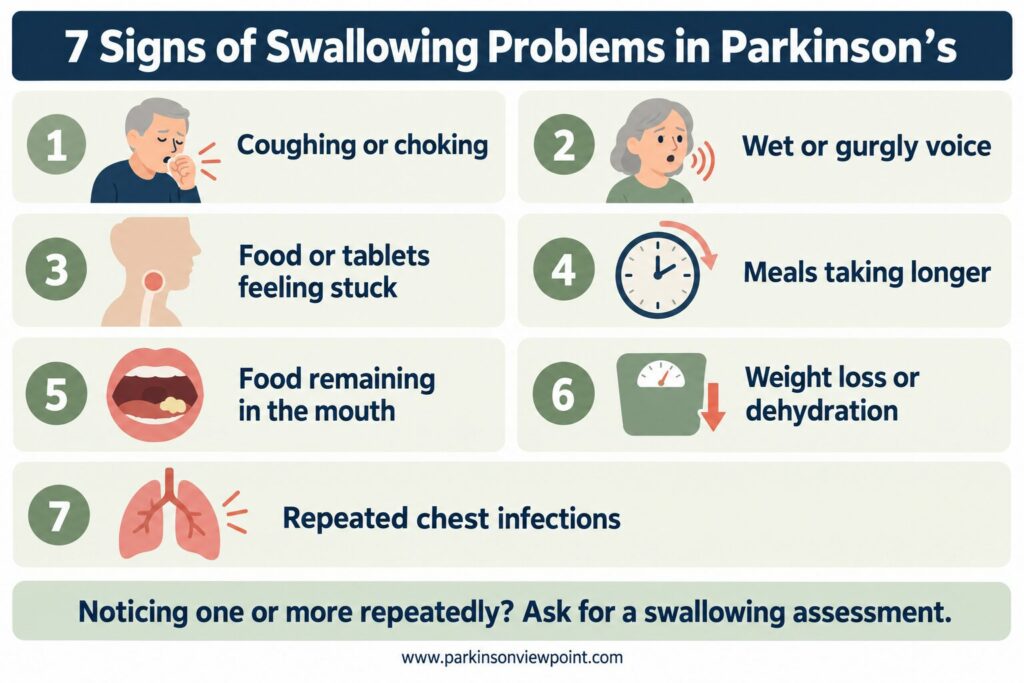
1. Coughing or choking while eating or drinking
Frequent coughing, choking, or throat-clearing during or shortly after a meal is one of the most recognisable warning signs. It may happen with food, drinks, saliva, or tablets.
Some people particularly struggle with thin liquids, such as water, tea, or coffee, because they move quickly and require precise timing to keep them out of the airway. However, swallowing patterns vary, so it is important not to assume that thicker drinks or softer foods are automatically safer without an assessment.
An occasional cough can happen to anyone. Repeated episodes, however, should not simply be attributed to eating too quickly or getting older.
2. A wet or gurgly voice after swallowing
Listen to how the person’s voice sounds after they eat or drink. A voice that suddenly sounds wet, bubbly, or gurgly may suggest that food, liquid, or saliva remains around the throat or voice box.
The person may also clear their throat repeatedly or need several swallows before their voice sounds normal again. A wet or gurgly voice does not prove that aspiration has occurred, and research suggests its accuracy may depend on what the person has swallowed. However, it remains a clinically relevant sign to record and report—especially when it repeatedly appears after eating or drinking [3,4].
3. Food, drink, or tablets feel stuck
A person may describe food as “sticking” in the mouth, throat, or chest. They might swallow several times to clear one mouthful, take repeated drinks to help food pass, or avoid dry and crumbly foods.
Tablets may also become more difficult to swallow. This is particularly important in Parkinson’s disease because delayed or missed medication can affect symptom control. Tablets should not be crushed, split, or mixed into food unless a pharmacist or prescriber confirms that it is safe, as doing so can change how some medicines work.
4. Meals take much longer than before
Parkinson’s-related slowness and reduced coordination can affect biting, chewing, moving food around the mouth, and initiating a swallow. As a result, meals may gradually take longer.
The person may:
- Chew the same mouthful for an unusually long time
- Pause frequently before swallowing
- Become tired before finishing
- Lose interest as the food becomes cold
- Regularly leave part of the meal uneaten
Longer mealtimes may seem like a minor inconvenience, but they can indicate that chewing and swallowing have become slower or less efficient. Over time, this may reduce food and fluid intake and make eating increasingly tiring or stressful [2,3].
5. Food remains in the mouth after swallowing
Food may collect inside the cheeks, beneath the tongue, on the roof of the mouth, or around the gums. This is sometimes called oral residue or “pocketing.”
The person may not realise that food remains there because Parkinson’s disease can affect both movement and sensation. Caregivers may notice food in the mouth after the meal, repeated tongue movements, drooling, or food spilling from the lips.
Remaining food may later move towards the throat when the person is no longer prepared to swallow. Persistent pocketing should therefore be mentioned during a swallowing assessment.
6. Unexplained weight loss, dehydration, or avoiding certain foods
Swallowing difficulties can gradually change eating behaviour. A person may avoid foods that feel difficult, eat smaller portions, drink less, or skip meals because eating has become tiring, embarrassing, or frightening.
Possible clues include:
- Unintentional weight loss
- Dry mouth or reduced urination
- Constipation becoming worse
- Avoiding meals with other people
- Removing particular textures from the diet
- Taking noticeably fewer drinks
Weight loss and dehydration can have many causes and should always be medically assessed. In someone with Parkinson’s disease, they may also be indirect signs of dysphagia—particularly when accompanied by longer mealtimes, difficulty swallowing, or avoidance of certain foods and drinks [3].
7. Repeated chest infections or breathing changes after meals
Recurring chest infections may be an indirect sign that food, liquid, saliva, or stomach contents are entering the airway. This is known as aspiration.
Other possible warning signs include increased congestion, wheezing, shortness of breath, fever, or changes in breathing after eating and drinking. These symptoms require medical attention, particularly when they occur repeatedly.
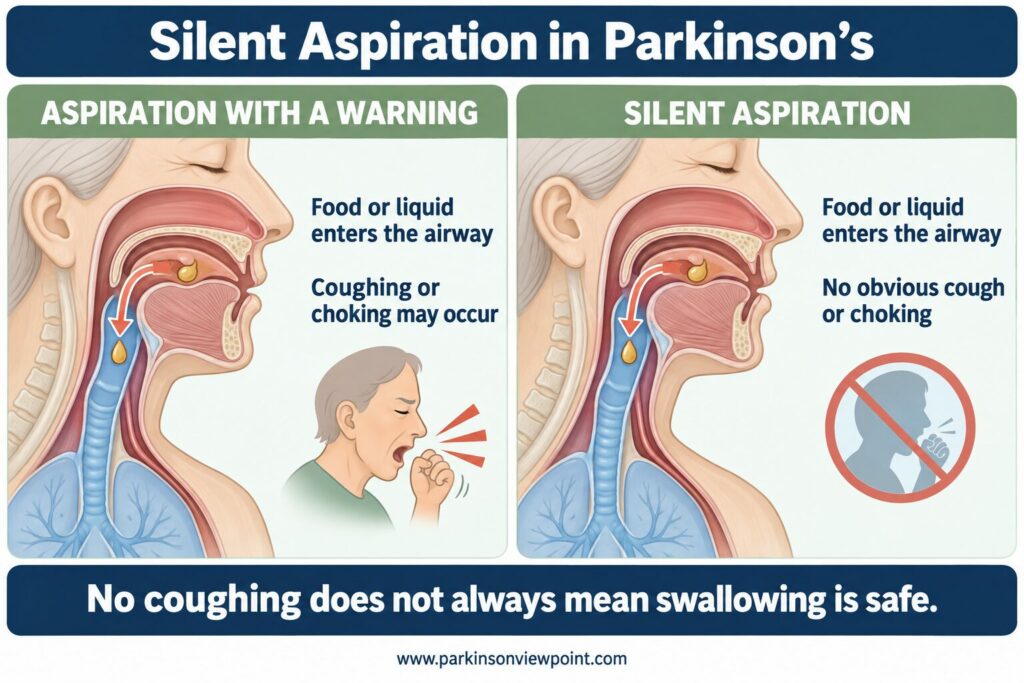
Importantly, some people with Parkinson’s disease may have reduced awareness of airway irritation and a weakened cough response. This means food or liquid can sometimes enter the airway without causing obvious coughing or choking [5].
Repeated chest infections or breathing changes can have several possible causes and do not confirm aspiration on their own. However, when they occur alongside swallowing difficulties, they should prompt medical review and, where appropriate, a specialist swallowing assessment [3].
Silent aspiration: when there may be no obvious warning
Aspiration occurs when food, liquid, saliva, or medication enters the airway instead of travelling safely towards the stomach. It often triggers coughing or choking, which helps clear the airway. In some people with Parkinson’s disease, however, reduced throat sensation and a weakened cough response mean that aspiration produces no obvious reaction. This is known as silent aspiration.
Someone experiencing silent aspiration may continue eating and drinking without feeling that anything has gone wrong. Possible indirect clues include repeated chest infections, unexplained fever, increased congestion, weight loss, or changes in breathing — but these signs can also have other causes.
Because silent aspiration cannot be reliably identified through observation alone, a professional swallowing assessment may be necessary. Tests such as a videofluoroscopic swallowing study or fiberoptic endoscopic evaluation of swallowing (FEES) allow clinicians to observe what happens inside the throat and determine whether food or liquid is entering the airway [3]. This information helps them recommend strategies tailored to the individual rather than relying on general advice.
What should you do if you notice these signs?
If swallowing changes are happening repeatedly, becoming more noticeable, or affecting eating, drinking, or medication, arrange a medical review. Start by speaking with the person’s neurologist, Parkinson’s nurse, or primary-care clinician. They may refer the person to a speech and language therapist, also called a speech-language pathologist, who has specialist training in swallowing disorders.
Before the appointment, record useful details such as:
- What happened—coughing, choking, food sticking, or a wet voice
- Whether it involved food, liquids, saliva, or tablets
- Which foods or drinks appeared difficult
- When it happened and how often
- Whether it changed during Parkinson’s “ON” and “OFF” periods
- Any recent weight loss, dehydration, or chest infections
Assessment may begin with questions and an examination of the mouth, voice, cough, and swallowing. If more information is needed, the clinician may recommend a videofluoroscopic swallowing study or FEES. These tests can show where the difficulty occurs and whether anything enters the airway [3].
Advice should be personalised. Depending on the findings, it may include changes to posture, bite or sip size, eating pace, food texture, drink consistency, swallowing techniques, exercises, or medication administration. Do not permanently thicken drinks, restrict foods, crush tablets, or begin swallowing exercises without professional guidance; an approach that helps one person may be unsuitable for another.
Safer mealtime habits while awaiting professional advice
A swallowing assessment is the best way to identify which strategies are appropriate. While waiting for professional advice, the following general habits may make meals calmer and reduce avoidable difficulties:
- Sit fully upright: Keep the head centred and the body well supported during meals. Avoid eating while reclining or lying in bed.
- Make sure the person is alert: Tiredness, drowsiness, or an “OFF” period may make eating more difficult. When possible, choose a time when the person feels most alert and physically comfortable. If swallowing seems easier at certain times, a consistent daily routine for Parkinson’s disease may help you plan meals around medication, energy levels, and periods of better movement.
- Reduce distractions: Turn off the television and limit conversation while food or drink is in the mouth. Concentrating on one action at a time may help.
- Use manageable bites and sips: Avoid overfilling the mouth. Allow each mouthful to be swallowed before offering or taking another.
- Slow the pace: Do not rush the meal. Allow enough time for chewing and repeated swallowing when necessary.
- Check for remaining food: After eating, look for food trapped inside the cheeks or beneath the tongue.
- Maintain good oral hygiene: Regular toothbrushing and mouth care reduce harmful oral bacteria, which may lower the risk of complications if saliva or food enters the airway [3].
Do not introduce straws, thickened drinks, special swallowing manoeuvres, or major texture changes unless recommended for that individual. These are not universally safer and should be guided by assessment findings.

When swallowing problems need urgent attention
Call your local emergency number immediately if the person:
- Cannot breathe, speak, or cough
- Appears to have a completely blocked airway
- Becomes blue, unresponsive, or loses consciousness
These may be signs of severe choking. Begin appropriate choking first aid if you are trained, and follow the emergency operator’s instructions. People with Parkinson’s disease and their caregivers may benefit from completing a recognised first-aid course before an emergency occurs.
Seek prompt medical advice if swallowing suddenly becomes much worse, the person cannot swallow saliva, or food appears firmly stuck. New fever, chest pain, shortness of breath, unusual confusion, or marked drowsiness after a suspected aspiration episode also requires urgent assessment.
Repeated but less severe coughing, prolonged meals, weight loss, dehydration, or difficulty taking medication may not require emergency care, but they should still be reported promptly. Swallowing problems are safer to assess early rather than waiting for a serious choking event or chest infection.
Preparing for a swallowing assessment
A swallowing assessment is more useful when the clinician has clear examples of what has been happening. Before the appointment, write down:
- Which foods, drinks, or tablets cause difficulty
- Whether the person coughs, chokes, or repeatedly clears their throat
- Any wet or gurgly voice after swallowing
- How long meals usually take
- Whether food remains inside the mouth
- Any recent weight loss, dehydration, fever, or chest infections
- Whether swallowing changes during Parkinson’s “ON” and “OFF” periods
- Whether tiredness, posture, distractions, or medication timing affect the problem
Bring a complete medication list and explain if swallowing tablets has become difficult. A caregiver’s observations can be especially valuable because the person with Parkinson’s disease may not notice every change. Caregivers may also find it helpful to understand Parkinson’s OFF periods, particularly when swallowing difficulties appear to change with medication response.
Notice Patterns Before Your Next Appointment
The Parkinson’s Daily Diary App can help you record swallowing concerns alongside medication status and other symptoms, making it easier to share clear patterns with your healthcare team. The app does not assess swallowing or replace professional medical advice.
Key takeaways
- Swallowing problems in Parkinson’s disease may develop gradually and can be easy to overlook.
- Warning signs include coughing during meals, a wet or gurgly voice, food or tablets feeling stuck, longer mealtimes, food remaining in the mouth, weight loss, and repeated chest infections.
- Not everyone coughs when food or liquid enters the airway. This is known as silent aspiration.
- Persistent swallowing changes should be discussed with a neurologist, Parkinson’s nurse, primary-care clinician, or swallowing specialist.
- Swallowing advice must be personalised. Do not begin thickened drinks, major dietary changes, swallowing exercises, or tablet alterations without professional guidance.
- Early assessment can help make eating, drinking, and medication use safer and more comfortable.
References
- Rudisch DM, Krasko MN, Burdick R, Broadfoot CK, Rogus-Pulia N, Ciucci MR. Dysphagia in Parkinson disease: Part I—pathophysiology and diagnostic practices. Current Physical Medicine and Rehabilitation Reports. 2023;11(2):176–187. https://doi.org/10.1007/s40141-023-00392-9
- Patel B, Legacy J, Hegland KW, Okun MS, Herndon NE. A comprehensive review of the diagnosis and treatment of Parkinson’s disease dysphagia and aspiration. Expert Review of Gastroenterology & Hepatology. 2020;14(6):411–424. https://doi.org/10.1080/17474124.2020.1769475
- Cosentino G, Avenali M, Schindler A, et al. A multinational consensus on dysphagia in Parkinson’s disease: screening, diagnosis and prognostic value. Journal of Neurology. 2022;269:1335–1352. https://doi.org/10.1007/s00415-021-10739-8
- Sampaio M, Argolo N, Melo A, Nóbrega AC. Wet voice as a sign of penetration/aspiration in Parkinson’s disease: Does testing material matter? Dysphagia. 2014;29(5):610–615. https://doi.org/10.1007/s00455-014-9552-7
- Troche MS, Brandimore AE, Okun MS, Davenport PW, Hegland KW. Decreased cough sensitivity and aspiration in Parkinson disease. Chest. 2014;146(5):1294–1299. https://doi.org/10.1378/chest.14-0066
Medical disclaimer: This article is for general educational purposes only and is not a substitute for individual medical advice, diagnosis, or treatment. Swallowing difficulties can have serious consequences. Speak with a qualified healthcare professional if you notice new, persistent, or worsening symptoms. Call your local emergency number if someone cannot breathe, speak, or cough.