
Written and reviewed as a literature-based educational guide by Dr. Akbar Zaib, PhD in Neurosciences.
Have people started asking you to repeat yourself, even though you feel you are speaking normally? Voice changes in Parkinson’s disease often develop gradually and may include a softer, breathier, hoarse, or less expressive voice. You may not notice these changes at first, but they can make phone calls, family conversations, and social situations increasingly difficult. The early assessment and targeted voice exercises can often help you speak more clearly and confidently.

Parkinson’s disease is commonly associated with tremor, stiffness, and slow movement, but it can also affect the muscles used for breathing, speaking, and producing sound. As these movements become smaller and less forceful, the voice may gradually become softer, flatter, or more difficult for others to understand. This reduced voice volume is known as hypophonia [1, 2].
One unusual feature of hypophonia is that you may not realize how quietly you are speaking. Your voice may sound normal to you, even when family members struggle to hear it. You might feel as though you are speaking loudly when you are actually using a normal conversational volume. This mismatch can lead to repeated misunderstandings and frustration for everyone involved.
Voice changes can affect more than speech. They may make it difficult to talk on the phone, join group conversations, order food, or speak in noisy places. Over time, some people begin avoiding social situations because communicating requires too much effort.
However, a softer voice should not simply be accepted as an unavoidable part of Parkinson’s disease. Speech and voice therapy, regular practice, and a few practical communication strategies can make a meaningful difference. This guide explains why these changes happen, which signs to watch for, and what you can do to keep your voice stronger and clearer.
Why does Parkinson’s make the voice softer?
Speaking depends on a carefully coordinated series of movements. The lungs provide airflow, the vocal cords produce sound, and the muscles of the tongue, lips, throat, and face shape that sound into clear words. Parkinson’s disease can affect the brain signals that control all these movements.
The same slowness and reduced movement that affect walking or handwriting can also affect speech. The breathing muscles may provide less support, the vocal cords may not close as firmly, and movements of the lips and tongue may become smaller. Together, these changes can make the voice quieter, breathier, or less clear [2].
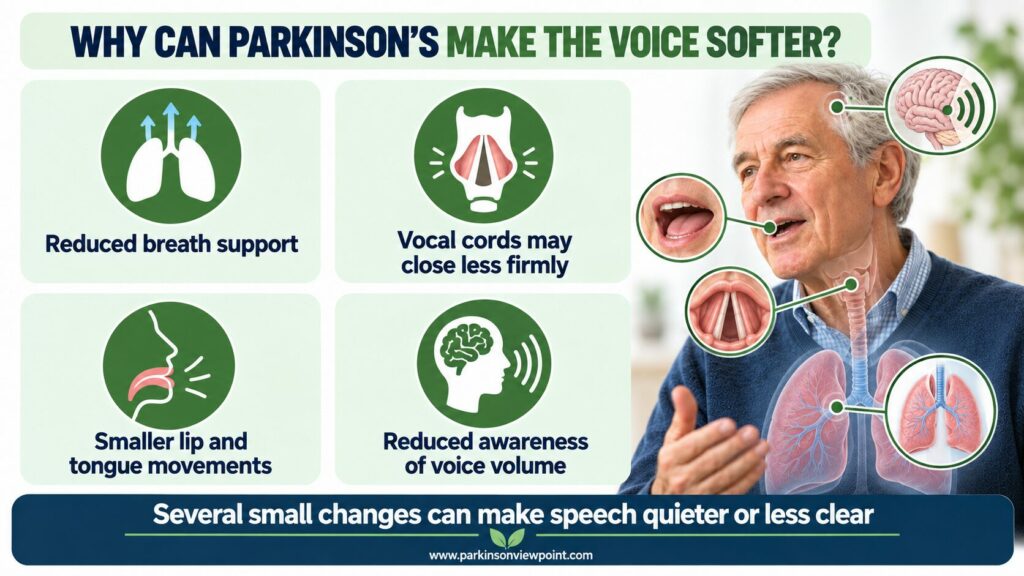
Parkinson’s disease may also affect how accurately a person judges the loudness of their own voice. You may feel that you are speaking at an appropriate volume—or even shouting — when other people still hear a quiet voice. This is not caused by a lack of effort. The brain may simply be giving you inaccurate feedback about how loudly you are speaking [1].
Medication may improve voice problems for some people, particularly when symptoms become worse during an “OFF” period. However, the response varies, and medication alone may not fully restore voice volume or clarity. This is why an assessment by a speech and language therapist can be particularly helpful.
Common voice and speech changes to watch for
A softer voice is often the first change noticed, but Parkinson’s disease can affect speech in several ways. These changes may appear gradually and can vary throughout the day.
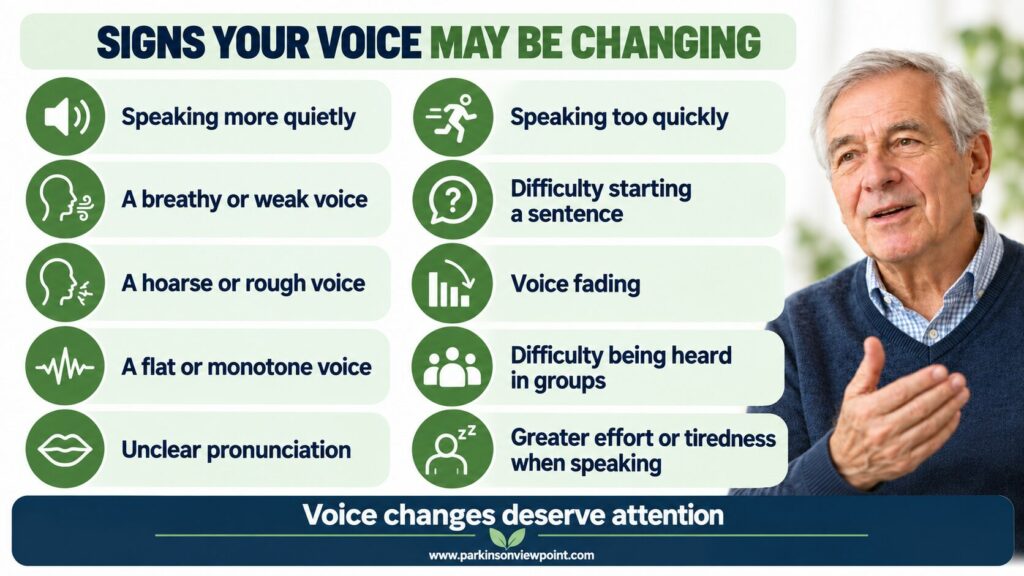
Common signs include:
- Speaking more quietly: Other people may frequently ask you to repeat yourself or speak louder.
- A breathy or weak voice: Your voice may sound as though it lacks strength or runs out of air.
- A hoarse or rough voice: The quality of your voice may change even when you do not have a sore throat.
- A flat or monotone voice: Speech may have less variation in pitch and volume, making it harder to express emotion.
- Unclear pronunciation: Reduced movement of the lips and tongue can cause words to sound blurred or mumbled.
- Speaking too quickly: Some people begin talking rapidly, with words running together.
- Difficulty starting a sentence: You may know what you want to say but struggle to begin speaking clearly.
- Voice fading: Your speech may start at a reasonable volume and become quieter toward the end of a sentence.
- Difficulty being heard in groups: Background noise and several people speaking at once can make communication especially challenging.
- Greater effort or tiredness when speaking: Long conversations or phone calls may become exhausting.
Family members often notice these changes before the person with Parkinson’s disease does. If people regularly ask you to repeat yourself, it may be useful to record a short conversation and listen to it later. A speech and language therapist can provide a more complete assessment of your voice volume, clarity, breathing, and speaking rate.
When should you ask for a voice assessment?
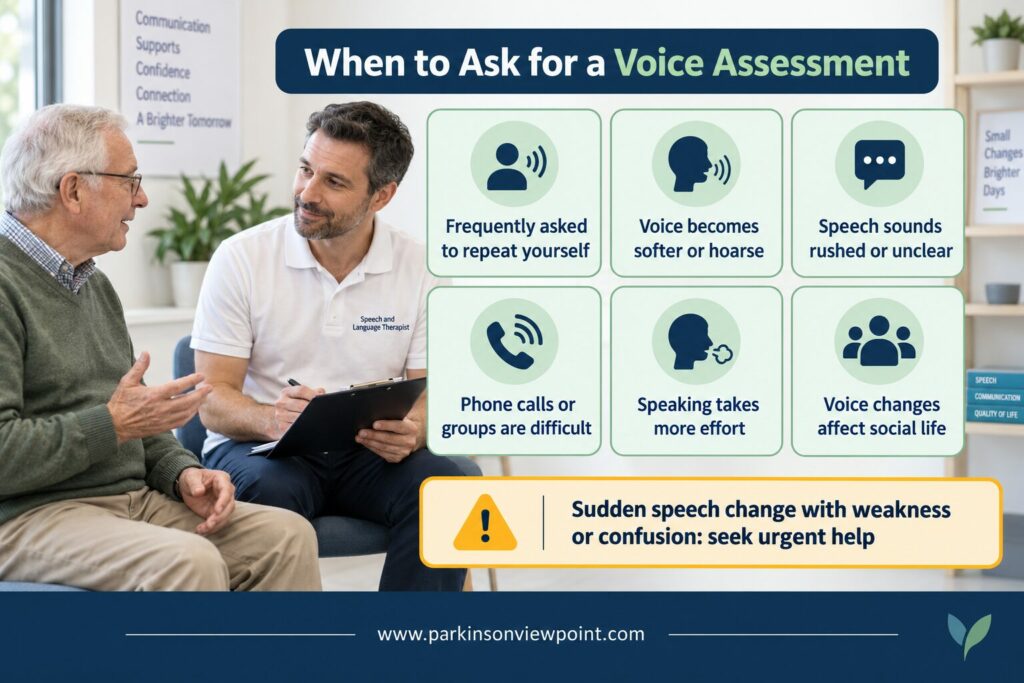
You do not need to wait until speaking becomes very difficult. Consider asking your neurologist, Parkinson’s nurse, or family doctor for a referral to a speech and language therapist if:
- People frequently ask you to speak louder or repeat yourself.
- Your voice has become noticeably softer, breathier, or hoarse.
- You struggle to communicate on the phone or in group settings.
- Your words sound rushed, mumbled, or unclear.
- Speaking requires more effort or leaves you tired.
- Voice changes are causing you to avoid conversations or social activities.
- Your speech becomes worse during medication “OFF” periods.
- You also cough, choke, or clear your throat frequently when eating or drinking.
A speech and language therapist can assess your voice volume, clarity, pitch, breathing, and speaking rate. They may also check whether swallowing difficulties are present, as speech and swallowing problems can sometimes occur together in Parkinson’s.
Do not assume that every new voice problem is caused by Parkinson’s disease. Persistent hoarseness, throat discomfort, or a sudden change in speech should be medically assessed. Seek urgent help if speech changes appear suddenly, particularly when accompanied by facial weakness, arm weakness, confusion, dizziness, or a severe headache, as these can be warning signs of a stroke.
How speech and voice therapy can help
Speech and language therapy is one of the main treatments for voice changes in Parkinson’s disease. The goal is not simply to make you shout. Therapy helps you use a stronger, clearer voice while improving breathing, pronunciation, speaking rate, and awareness of your own volume [1, 3].

One widely used approach is LSVT LOUD, an intensive voice-treatment program developed specifically for people with Parkinson’s disease. It trains people to use greater vocal effort and to carry this stronger voice into everyday conversations. Treatment usually includes individual sessions with a trained therapist and regular practice at home [3, 4].
Another program, SPEAK OUT!, focuses on speaking with deliberate effort rather than relying on automatic speech. Some people also continue practicing in maintenance groups after completing individual treatment [5].
A therapist may tailor treatment to help you:
- Increase voice volume safely.
- Coordinate breathing with speech.
- Speak at a steadier pace.
- Pronounce words more clearly.
- Add more expression to your voice.
- Recognize when your voice has become too quiet.
- Use communication aids when additional support is needed.
The most suitable approach depends on your symptoms, general health, and communication needs. Starting therapy before voice problems become severe can make it easier to learn and use these techniques in daily life. Continued home practice is also important because improvements may reduce over time if the exercises are stopped.
Practical ways to make your voice clearer
Alongside professional therapy, a few simple habits can make everyday conversations easier. These strategies do not replace an individual assessment, but they can help you use your voice more effectively.

1. Face the person you are speaking to
Maintain eye contact and make sure your face is clearly visible. Facial expressions and lip movements give the listener useful clues, especially when your voice is quiet.
2. Reduce background noise
Turn down the television or radio before starting a conversation. In restaurants or social settings, choose a quieter seat and sit close to the people you want to speak with.
3. Take a breath before speaking
Pause, breathe in comfortably, and then begin your sentence. Try to use shorter sentences rather than continuing until your voice runs out of strength.
4. Speak with deliberate effort
Think “strong and clear” before you start speaking. Avoid forcing or straining your throat. A speech and language therapist can help you find a volume that is louder but still comfortable.
5. Slow down when words run together
Pause between phrases and give each word enough space. If one message is especially important, say it in a short and direct sentence.
6. Practise at the right time
If your voice changes with your medication cycle, practise or plan important conversations during an “ON” period when your symptoms are better controlled.
7. Use helpful technology
A phone voice recorder can help you monitor your volume. In more difficult situations, a small voice amplifier, text-to-speech tool, or communication app may reduce the effort required to be heard.
Before beginning regular voice exercises, ask a speech and language therapist which techniques are suitable for you. Exercises performed with excessive force may cause unnecessary vocal strain.
How family members and caregivers can help
Communication works best when both the speaker and the listener make adjustments. If someone with Parkinson’s disease is speaking quietly, repeatedly saying “Speak up” may cause frustration. Instead, explain gently which part you did not hear and give the person enough time to try again.

Helpful steps include:
- Face the person and maintain natural eye contact.
- Move closer instead of trying to communicate from another room.
- Reduce background noise before beginning a conversation.
- Avoid interrupting or finishing sentences too quickly.
- Ask one question at a time and allow enough time for a response.
- Confirm important information to prevent misunderstandings.
- Encourage voice practice without turning every conversation into a therapy session.
Family members can also attend speech therapy sessions when appropriate. This helps everyone understand the recommended strategies and learn how to support clearer, less stressful conversations at home.
Track when your voice changes
Voice problems may not remain the same throughout the day. Your voice may become softer when you are tired, stressed, in a noisy environment, or approaching a medication “OFF” period. Recording these patterns can give your healthcare team useful information.
For one or two weeks, note:
- When your voice is strongest and weakest.
- Whether changes occur before or after medication.
- Which situations make speaking more difficult.
- Whether you also experience coughing or swallowing problems.
- How voice changes affect phone calls, meals, or social activities.

You can record these details in a notebook or use the free Parkinson’s Daily Diary App to track symptoms, medication timing, and daily notes in one place. Bringing a short summary to your appointment can help your neurologist or speech and language therapist understand when the problem occurs and recommend more personalized support.
Can Parkinson’s medication improve the voice?
Parkinson’s medication may improve speech for some people, especially when a softer voice appears alongside other “OFF” symptoms such as stiffness, slowness, or reduced facial movement. However, the effect is not always predictable. A medication that noticeably improves walking or hand movement may have only a small effect on voice volume and clarity [2].
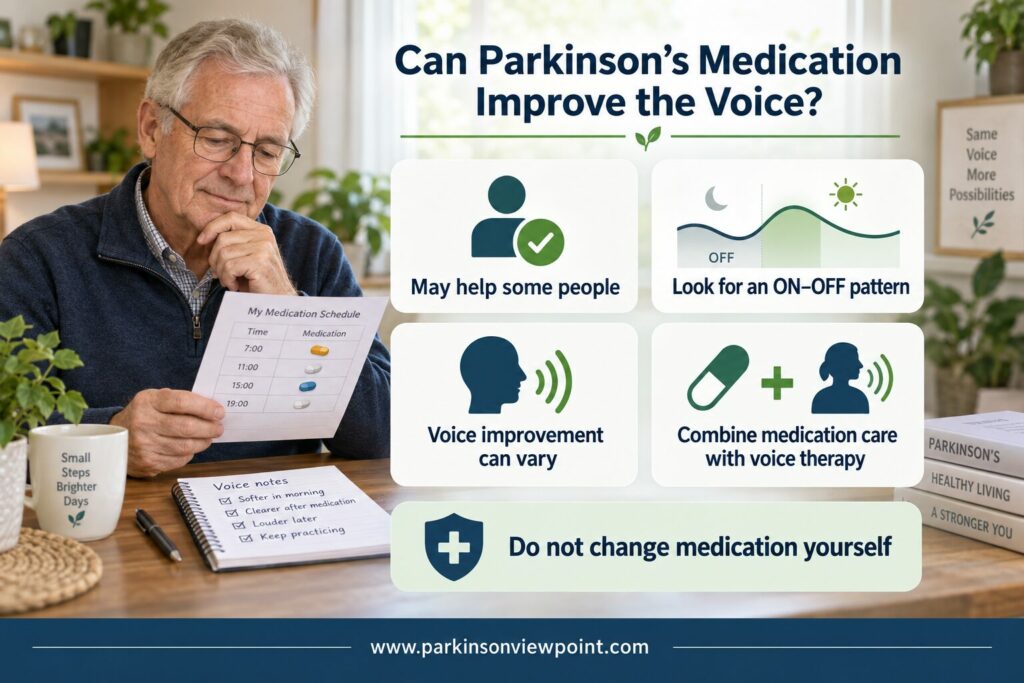
If your voice consistently becomes weaker before the next dose and improves after taking medication, record the timing and discuss it with your neurologist or Parkinson’s nurse. Learning how to track Parkinson’s medication effects and side effects can help you identify whether these voice changes follow a consistent “ON” and “OFF” pattern
Do not change the dose or timing yourself. Voice difficulties can have several causes, and adjusting Parkinson’s medication may not solve the problem. In many cases, the most effective approach combines appropriate medication management with targeted speech and voice therapy.
Practical takeaway
A softer voice is a common but often overlooked change in Parkinson’s disease. You may not notice it yourself, even when other people are frequently asking you to repeat what you said. Changes may also include a breathy or hoarse voice, unclear words, rushed speech, or reduced expression.
Do not wait until communication becomes severely affected before asking for help. A speech and language therapist can identify the specific changes in your voice and teach techniques to improve volume, clarity, breathing, and speaking pace. Regular practice and small adjustments at home can make conversations easier and less tiring.
It is also helpful to notice whether your voice changes with fatigue, stress, or medication “OFF” periods. Record these patterns and share them with your healthcare team. With early support and consistent practice, many people with Parkinson’s disease can maintain clearer and more confident communication.
References
[1] Parkinson’s UK. Speech and communication. Available at: Parkinson’s UK
[2] Dashtipour K, Tafreshi A, Lee J, Crawley B. Speech disorders in Parkinson’s disease: pathophysiology, medical management and surgical approaches. Neurodegenerative Disease Management. 2018;8(5):337–348. PubMed
[3] Ramig LO, Halpern A, Spielman J, Fox C, Freeman K. Speech treatment in Parkinson’s disease: randomized controlled trial. Movement Disorders. 2018;33(11):1777–1791. Journal article
[4] Liotti M, Ramig LO, Vogel D, et al. Hypophonia in Parkinson’s disease: neural correlates of voice treatment revealed by PET. Neurology. 2003;60(3):432–440. PubMed
[5] Parkinson Voice Project. SPEAK OUT! Therapy and Research. Available at: Parkinson Voice Project
Medical disclaimer: This article is for general educational purposes and is not a substitute for personalised medical advice. Do not change Parkinson’s or anxiety medication without consulting a qualified healthcare professional.
Track your Parkinson’s day in less than a minute
The Parkinson’s Daily Diary App lets you record symptoms, medications, daily notes and doctor ready report in under a minute.