
Neuroscientist • Parkinson’s Researcher
Maintaining independence in Parkinson’s disease is one of the biggest concerns for many people living with the condition. While Parkinson’s disease can make everyday activities more challenging over time, small practical changes can help you stay active, confident, and in control of your daily life.
In this guide, you’ll discover seven simple, research-informed strategies that can help you maintain your independence, improve safety, and continue doing the things that matter most.

For many people living with Parkinson’s disease, one of the biggest concerns isn’t the diagnosis itself—it’s the fear of losing independence. Questions like “Will I still be able to cook?”, “Can I continue living on my own?”, or “Will I always need someone to help me?” are common and completely understandable.
The reassuring news is that Parkinson’s disease does not take away independence overnight. While symptoms such as stiffness, slower movement, balance problems, and fatigue can make everyday activities more challenging, many people continue to live active, fulfilling, and independent lives for years by making small, practical adjustments along the way.
Maintaining independence isn’t about doing everything without help. It’s about finding new ways to continue doing the things that matter most to you—whether that’s preparing your own meals, enjoying a favorite hobby, spending time with family, or managing your daily routine with confidence.
In this article, you’ll discover seven practical, research-supported strategies that can help you stay independent for longer, along with simple daily habits that can make everyday life easier and help you remain in control of your health.
Why can Parkinson’s disease make independence more challenging?
Parkinson’s disease affects everyone differently, but many of the symptoms that develop over time can make everyday tasks require more effort than they once did. Activities that used to feel automatic — such as getting dressed, preparing a meal, writing a shopping list, or getting out of a chair — may gradually take longer or require more planning.
Several Parkinson’s disease symptoms can contribute to these changes:
- Slower movement (bradykinesia) can make routine activities feel more time-consuming.
- Muscle stiffness (rigidity) may make it harder to bend, reach, or turn comfortably.
- Balance and walking difficulties can reduce confidence when moving around the home or outdoors.
- Fatigue may limit how much you can accomplish in a day, even if your motivation remains strong.
- Changes in thinking or concentration can make planning, organizing, or multitasking more difficult for some people.
It’s important to remember that these symptoms don’t usually appear all at once. More often, they develop gradually, and each small change can add a little more effort to daily life.
The encouraging news is that many of these challenges can be managed. Staying physically active, adapting your home, using helpful tools, planning activities around your best times of the day, and tracking changes in your symptoms can all help you remain independent for longer.
The goal isn’t to do everything exactly as you did before. It’s to find practical ways to keep doing the things that matter most to you — safely, confidently, and with as much independence as possible.
Disclaimer: The information shared here should not be taken as medical advice. The opinions presented here are not intended to treat any health conditions. For your specific medical problem, consult with your healthcare provider.
7 practical ways to stay independent longer
Maintaining your independence with Parkinson’s disease isn’t about doing everything on your own — it’s about finding practical ways to keep doing the things that matter most to you. While Parkinson’s disease can make everyday activities more challenging, many people continue living active, fulfilling, and independent lives by making small adjustments to their daily routine.
The most effective strategies are often the simplest. Staying physically active, making your home easier to navigate, using helpful tools, planning activities around your best times of the day, and asking for support when needed can all help you remain confident and in control.
You don’t have to make every change at once. Every small improvement builds on the last, and over time these changes can make a meaningful difference to your mobility, safety, confidence, and overall quality of life.
Below are seven practical, research-supported strategies that can help you stay independent for longer. Choose one that feels achievable today, then build from there.
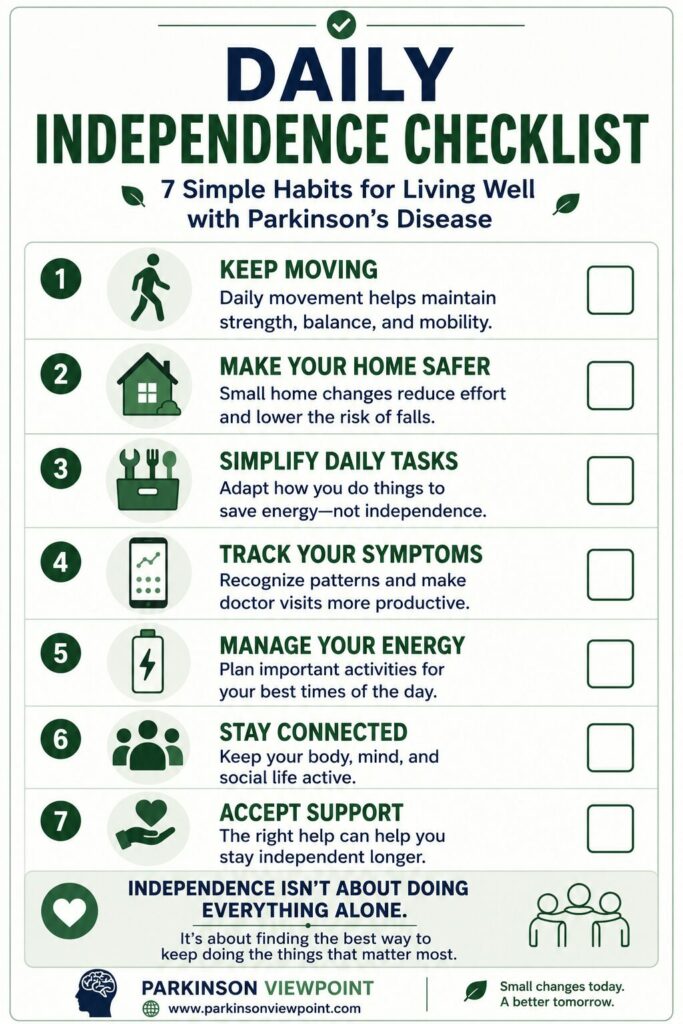
1. Keep moving every day
Staying active is one of the most effective ways to maintain your independence with Parkinson’s disease. While exercise cannot stop the progression of the disease, research consistently shows that regular physical activity can improve mobility, balance, flexibility, strength, and confidence in everyday activities.
The goal isn’t to become an athlete or spend hours at the gym. Instead, focus on moving your body in ways that fit your abilities and lifestyle. Whether it’s taking a daily walk, stretching in the morning, gardening, swimming, dancing, or practicing tai chi, regular movement helps keep your muscles and joints working more efficiently.
Physical activity also helps with many of the symptoms that can make independence more difficult, including stiffness, slower movement (bradykinesia), balance problems, and fatigue. Over time, staying active can make everyday tasks—such as getting out of a chair, climbing stairs, getting dressed, or carrying groceries—feel more manageable.
If possible, try to exercise during your medication “ON” periods, when your symptoms are better controlled. This often makes movement easier, safer, and more enjoyable. If you’re unsure where to begin, ask your neurologist or a physiotherapist to recommend exercises that match your current abilities.
Practical tips
- Aim for at least 150 minutes of moderate physical activity each week, if appropriate for your health and mobility.
- Include exercises that improve strength, balance, flexibility, and posture.
- Start small if needed — even 10 to 15 minutes of movement is a great beginning.
- Choose activities you enjoy so they’re easier to stick with.
- Listen to your body and rest when needed, but try to avoid sitting for long periods.
Key takeaway: Staying active isn’t about doing more — it’s about making everyday movement part of your routine. Small, consistent efforts can help you stay stronger, move with greater confidence, and maintain your independence for longer.
2. Make your home work for you
Your home should support your independence — not make everyday tasks more difficult. As Parkinson’s disease symptoms change over time, small adjustments around the house can reduce the effort needed for daily activities and lower the risk of falls.
The good news is that you don’t need to renovate your entire home. Often, simple changes can make a noticeable difference. For example, removing loose rugs can reduce tripping hazards, improving lighting makes it easier to move around safely, and keeping frequently used items within easy reach helps avoid unnecessary bending or stretching.
In the bathroom, installing grab bars near the toilet or shower can provide extra stability. In the kitchen, lightweight cookware and easy-to-grip utensils can make preparing meals less tiring. Even using a chair while getting dressed or preparing food can help conserve energy without reducing your independence.
Take a moment to walk through your home and ask yourself: “Is this space making everyday tasks easier or harder?” Small adjustments made today can help you continue living safely and confidently at home for years to come.
Practical tips
- Remove loose rugs, clutter, and electrical cords from walkways.
- Improve lighting in hallways, staircases, and bathrooms.
- Store everyday items at waist or shoulder height to reduce bending and reaching.
- Install grab bars or handrails where extra support is helpful.
- Use chairs, shower seats, or long-handled tools to make daily tasks easier and reduce fatigue.
Key takeaway: Independence isn’t about doing everything the hard way. Creating a safer, more accessible home helps you save energy, reduce fall risk, and continue doing everyday activities with greater confidence.
3. Simplify everyday tasks, not your independence
One of the biggest challenges of Parkinson’s disease is that everyday activities can take more time and effort than they once did. Getting dressed, preparing meals, writing a shopping list, or carrying laundry may become frustrating — not because you can’t do them, but because they now require more energy and concentration.
The key isn’t to push through every task the way you always have. Instead, look for ways to make daily activities simpler and more manageable. Conserving your energy for the things that matter most can help you stay independent for longer.
For example, break larger tasks into smaller steps rather than trying to finish everything at once. Sit down while folding laundry or preparing food if standing becomes tiring. Wear clothing with zippers or magnetic fasteners instead of small buttons if hand stiffness makes dressing difficult. Keep frequently used items together so you spend less time searching for them.
Remember, using tools or changing how you do a task isn’t “giving in” to Parkinson’s disease. It’s a practical way to stay in control and continue doing things for yourself.
Practical tips
- Break larger tasks into smaller, manageable steps.
- Take short breaks before you become overly tired.
- Use adaptive tools, such as jar openers, button hooks, or easy-grip kitchen utensils, if they make tasks easier.
- Sit down for activities like dressing, meal preparation, or ironing when possible.
- Keep commonly used items organised and within easy reach.
Key takeaway: Working smarter — not harder — helps you save energy for the activities that matter most. Small adjustments in how you complete everyday tasks can make a big difference to your confidence and independence.
4. Learn your patterns by tracking your symptoms
Parkinson’s disease symptoms rarely stay the same throughout the day. You may feel more mobile after taking your medication, notice increased stiffness in the evening, or find that fatigue appears after certain activities. Understanding these patterns can help you plan your day more effectively and stay independent for longer.
Keeping track of your symptoms doesn’t have to be complicated. Spending just a minute each day recording how you’re feeling can reveal trends that are difficult to notice from memory alone. Over time, you may begin to recognise when you’re at your best, what activities drain your energy, or whether certain symptoms are becoming more frequent.
This information can also make conversations with your neurologist much more productive. Instead of trying to remember how you’ve felt over the past several weeks, you’ll have a clear record of your symptoms, medication timing, and daily experiences. Together, this can help you and your healthcare team make more informed decisions about your care.
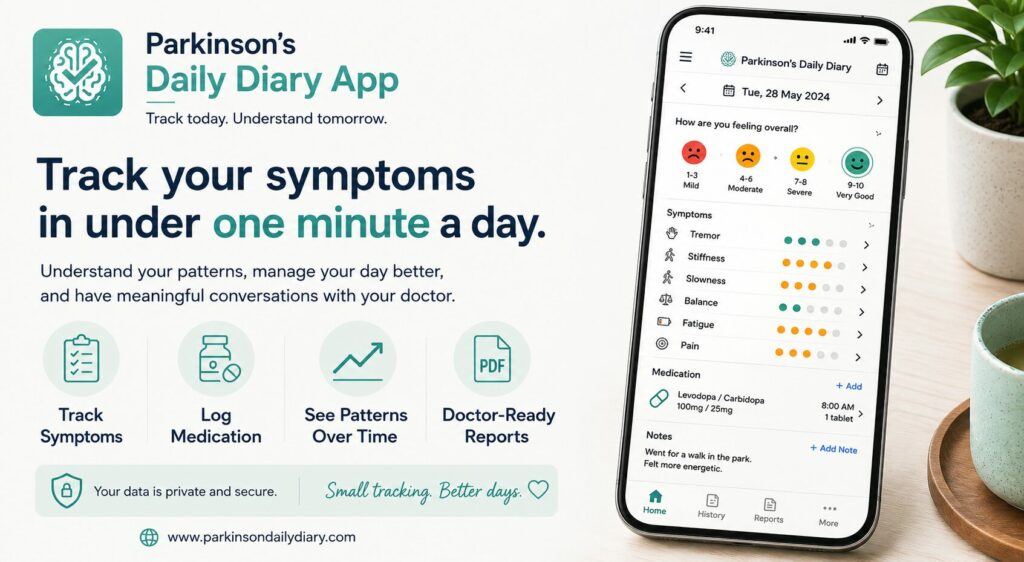
If you’re looking for an easy way to do this, the Parkinson’s Daily Diary App allows you to record your symptoms, medications, and daily notes in less than a minute. It also creates a doctor-ready report that you can share during appointments, making it easier to discuss changes in your condition over time.
Practical tips
- Record your symptoms at the same time each day.
- Note when you take your Parkinson’s disease medication and how well it works.
- Pay attention to changes in movement, balance, fatigue, pain, sleep, or mood.
- Look for patterns rather than focusing on a single difficult day.
- Bring your symptom records to your medical appointments whenever possible.
Key takeaway: The better you understand your Parkinson’s disease, the better you can plan your day, communicate with your healthcare team, and make decisions that help you stay independent.
5. Manage your energy, not just your time
Many Parkinson’s patients find that fatigue can be just as limiting as tremor or stiffness. Even on days when your movement feels good, you may notice that your energy doesn’t last as long as it used to. Learning how to manage your energy can help you stay active and independent throughout the day.
Rather than trying to do everything in one go, spread demanding activities across the day and take short breaks before you become exhausted. If you know your medication works best in the morning, use that time for tasks that require more movement or concentration, such as shopping, exercising, or household chores. Save less demanding activities, like reading, answering emails, or watching television, for times when your energy naturally dips.
It can also help to think about priorities. Ask yourself, “What really needs my energy today?” Focusing on the most important tasks and letting go of less essential ones can reduce stress and help you make the most of your day.
Managing your energy doesn’t mean doing less. It means using your energy wisely so you can continue doing the things that matter most.
Practical tips
- Plan important activities during your medication “ON” periods.
- Alternate active tasks with quieter ones throughout the day.
- Take short breaks before you feel completely exhausted.
- Don’t hesitate to ask for help with tasks that drain your energy unnecessarily.
- Get enough sleep and speak with your healthcare team if fatigue is becoming a regular problem.
Key takeaway: Energy is one of your most valuable resources. Planning how you use it can help you stay active, reduce frustration, and maintain your independence.
6. Stay connected and keep your mind active
Maintaining independence isn’t only about staying physically active. It also means continuing to do the things that give your life purpose, enjoyment, and connection. Spending time with family and friends, pursuing hobbies, learning new skills, or taking part in community activities can all support your emotional well-being and help you remain engaged in everyday life.
Parkinson’s disease can sometimes make people withdraw from social situations because of slower movement, speech changes, or concerns about how others might react. While these feelings are understandable, staying connected with others is an important part of maintaining your independence. Regular social interaction can help reduce feelings of isolation, boost confidence, and encourage you to stay active.
Keeping your mind engaged is equally important. Reading, puzzles, card games, music, gardening, cooking, learning a new hobby, or even trying a different walking route can stimulate your brain and add variety to your daily routine. The goal isn’t to keep your brain busy every minute of the day—it’s to continue doing activities that you enjoy and that challenge you in meaningful ways.
Remember, independence isn’t measured by how much you can do alone. It’s also reflected in your ability to stay connected with the people, activities, and experiences that matter to you.
Practical tips
- Stay in touch with family and friends, even if it’s just a short phone call.
- Continue hobbies you enjoy or adapt them if needed.
- Join a local or online Parkinson’s disease support group.
- Challenge your mind with activities such as reading, puzzles, or learning something new.
- Don’t let fear of symptoms stop you from participating in social activities.
Key takeaway: Staying socially and mentally active helps you maintain confidence, purpose, and quality of life—important parts of remaining independent with Parkinson’s disease.
7. Accept support before you need it
Many people living with Parkinson’s disease see accepting help as a sign that they’re becoming less independent. In reality, the opposite is often true. Knowing when to ask for support can help you stay active, safe, and in control of your daily life for much longer.
Support doesn’t mean giving up the things you enjoy or handing over responsibility for everyday tasks. It simply means making life easier when Parkinson’s disease begins to make certain activities more challenging. Whether it’s asking a family member to help with heavy shopping, using grocery delivery, accepting a ride to a medical appointment, or working with a physiotherapist or occupational therapist, these small adjustments can reduce stress and conserve your energy for the things that matter most.
Remember that independence isn’t about doing everything alone. It’s about continuing to make your own choices, staying involved in your daily life, and finding practical ways to adapt as your needs change. Accepting the right support at the right time can help you maintain that independence—not lose it.
Practical tips
- Ask for help with physically demanding tasks before they become overwhelming.
- Work with healthcare professionals to find practical solutions that support your daily routine.
- Explore community resources or Parkinson’s support services available in your area.
- Talk openly with family and friends about the type of support that is helpful—and the support you prefer to manage yourself.
- Remember that using support is a strategy for staying independent, not a sign of failure.
Key takeaway: Independence isn’t about doing everything yourself. It’s about continuing to live life on your own terms, even if that means accepting a helping hand along the way.
Key takeaways
- Parkinson’s disease can make everyday activities more challenging, but many people remain independent for years with the right strategies.
- Regular movement, home modifications, and simplifying daily tasks can reduce effort and improve safety.
- Tracking your symptoms helps you recognize patterns and have more productive conversations with your healthcare team.
- Managing your energy and staying socially connected are just as important as maintaining physical mobility.
- Accepting support when needed isn’t giving up your independence—it’s one of the best ways to preserve it.
- Small, consistent changes can make a meaningful difference in maintaining your independence and quality of life.
Frequently asked questions
Can people with Parkinson’s disease live independently?
Yes. Many people with Parkinson’s disease continue to live independently for many years, especially when symptoms are well managed. Regular exercise, taking medications as prescribed, making simple home adaptations, tracking symptoms, and asking for support when needed can all help maintain independence for longer.
At what stage of Parkinson’s disease do people usually need more help?
There isn’t a single stage when everyone begins to need assistance. Parkinson’s disease progresses differently from person to person. Some people remain independent for many years, while others may need extra support earlier because of balance problems, cognitive changes, or other symptoms. Regular follow-up with your healthcare team can help you plan ahead and adapt as your needs change.
What are the best ways to stay independent with Parkinson’s disease?
Some of the most effective strategies include:
- Staying physically active every day
- Making your home safer and easier to navigate
- Simplifying everyday tasks
- Tracking your symptoms and medication
- Managing your energy throughout the day
- Staying socially connected
- Accepting support before small challenges become larger ones
Small, consistent changes often have the greatest long-term impact.
Does exercise really help maintain independence?
Yes. Research consistently shows that regular exercise can improve balance, strength, flexibility, walking, and overall mobility in people with Parkinson’s disease. While exercise doesn’t stop the progression of Parkinson’s disease, it can help reduce disability and make everyday activities easier to perform.
Should I use a walking aid if I can still walk without one?
Not necessarily. Walking aids aren’t needed by everyone, and using one isn’t a sign of failure. If balance problems or falls are becoming a concern, a physiotherapist can assess your walking and recommend whether a cane, walking poles, or a walker would improve your safety and confidence.
How can tracking my symptoms help?
Parkinson’s disease symptoms often change throughout the day depending on medication timing, activity, sleep, and stress. Keeping a simple daily record can help you recognize patterns that are difficult to remember later. This information can also help your healthcare team adjust treatment and make appointments more productive.
How can family members support independence without taking over?
The best support encourages independence rather than replacing it. Family members can help by asking what assistance is needed, allowing extra time for daily activities, adapting the home environment, encouraging regular exercise, and respecting the person’s ability to make their own decisions whenever possible.
Get Your Free Parkinson’s Medication Management Diary
Download your free printable diary to easily track your medications, symptoms, and doses.