
The Parkinson’s smartwatch study often mentioned in headlines is not a single device or breakthrough, but a collection of research projects exploring how wearable data reflects Parkinson’s over time. Understanding what these studies actually show — and what they don’t — helps separate meaningful progress from exaggerated claims.
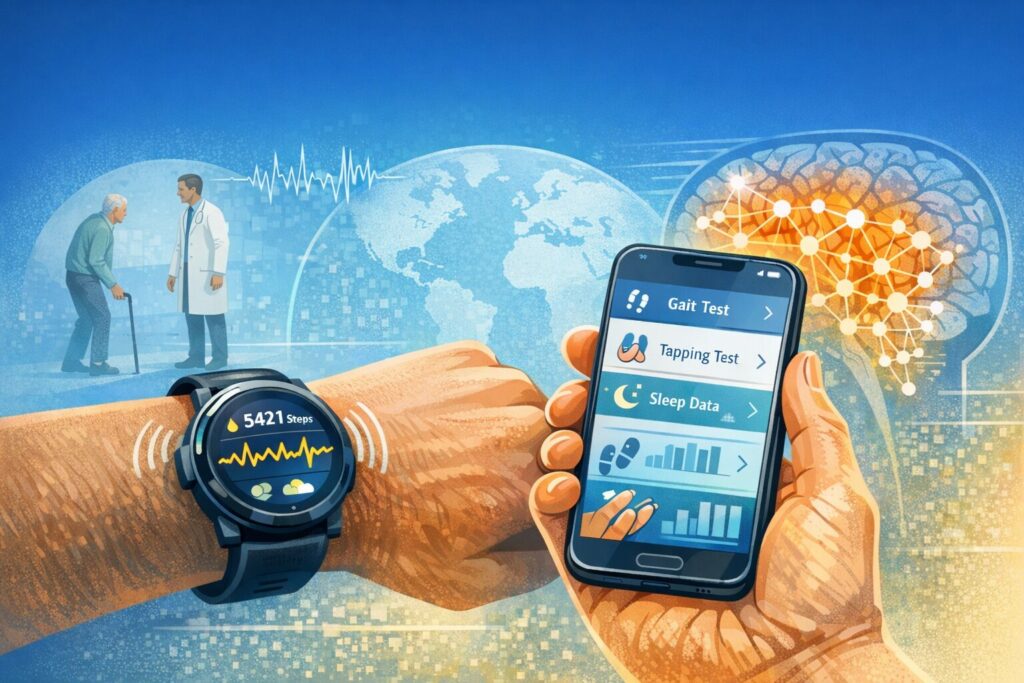
Over the past few years, a particular idea has circulated widely:
A smartwatch detected Parkinson’s years before diagnosis.
It appears in news articles, conference discussions, social media posts, and patient conversations. The phrasing varies, but the implication is usually the same — that wearable technology may have found a way to spot Parkinson’s disease early.
What makes this story travel so far is that it sounds both plausible and hopeful. Smartwatches already track movement. Parkinson’s disease affects movement. It feels like a natural connection.
But the real story is more nuanced. There is no single smartwatch study, and there is no device quietly diagnosing Parkinson’s in everyday life. What exists instead is a body of research that deserves careful explanation.
First, what this is not
It’s important to clear this up early.
There is no approved smartwatch that diagnoses Parkinson’s disease. There is no consumer device that can tell someone they will develop Parkinson’s years in advance. And there is no wearable currently used in routine care for early detection.
Some devices are often mentioned alongside these discussions. Cala Trio, for example, is designed to treat essential tremor, not Parkinson’s disease. Its purpose and evidence base are completely different.
The studies people refer to are research studies, not product announcements. They explore patterns, not diagnoses.
What researchers mean by “smartwatch data”
In research settings, “smartwatch data” usually means continuous wrist-based movement data, collected over days rather than minutes.
This data may come from:
- Research-grade wrist accelerometers
- Wearable devices similar in function to commercial smartwatches
- Watches worn during normal daily life
These devices capture how people move when they are not being observed in a clinic. That includes walking, resting, sleeping, and small habitual movements that rarely show up during medical exams.
Researchers are interested in:
- Movement consistency rather than visible tremor
- Rhythm and variability across the day
- Changes that develop gradually over time
This kind of data shifts Parkinson’s disease research away from snapshots and toward patterns.
The study most people are referring to
When people talk about “the smartwatch study,” they are usually referring to analyses based on large population datasets, particularly the UK Biobank.
In these studies:
- Hundreds of thousands of participants wore wrist accelerometers for several days
- Researchers later identified who went on to receive a Parkinson’s diagnosis
- Machine-learning models compared earlier movement data between groups
The findings did not involve visible tremor or obvious symptoms. Instead, researchers observed subtle differences in movement patterns, such as reduced consistency, altered activity rhythms, and small changes in daily motion.
In some analyses, these differences were detectable five to seven years before diagnosis, and occasionally earlier. Importantly, these were population-level findings, not predictions about specific individuals.
This is the work most often summarized — and oversimplified — in headlines.
Other wearable studies that support the idea
The smartwatch narrative does not rest on one dataset alone. It is supported by several related lines of research. Together, they explain why wearables are taken seriously in Parkinson’s research, even with clear limits.
1. WATCH-PD study
Journal: npj Parkinson’s Disease (Nature Portfolio), 2024
- A multicenter study using a smartwatch and smartphone together to assess movement, gait, tremor, and daily activity.
- Participants included people with early Parkinson’s and control subjects.
- Digital measures captured motor differences and symptom fluctuations that were not always visible during clinic visits.
- The study focused on monitoring and assessment, not early diagnosis or prediction.
2. Digital outcome measures from smartwatch data
Journal: npj Parkinson’s Disease (Nature Portfolio), 2024
- Analyzed activity and sleep data from wearable devices used in Parkinson’s research cohorts, including Verily- and PPMI-linked programs.
- Found that smartwatch-derived measures correlated with both motor and non-motor clinical features, such as sleep and daily activity patterns.
- Supported wearables as tools for tracking disease features over time, especially outside the clinic.
- Did not aim to detect Parkinson’s early or predict diagnosis.
3. Evaluation of wearable sensor devices in Parkinson’s disease
Journal: Parkinson’s disease (review; available via PubMed Central), 2020
- A comprehensive review of accelerometers, gyroscopes, and inertial sensors used in Parkinson’s research.
- Summarized evidence that wearables can reliably measure tremor, bradykinesia, gait abnormalities, and motor fluctuations.
- Emphasized that wearables are best suited for continuous monitoring, not diagnosis.
- Highlighted challenges related to data interpretation and real-world use.
4. Efficacy of wearable devices in monitoring Parkinson’s symptoms
Journal: IEEE Access (Systematic Review and Meta-Analysis), 2025
- Reviewed multiple studies using wearable devices to monitor Parkinson’s symptoms.
- Found consistent evidence that wearables sensitively track tremor severity, gait changes, and motor fluctuations.
- Reported strong agreement between wearable measures and established clinical rating scales.
- Clearly distinguished symptom monitoring from disease prediction or early detection.
5. Application of wearable sensors in Parkinson’s disease
Journal: Sens. Actuator Netw / MDPI, 2025
- Reviewed how wearable inertial sensors are applied in Parkinson’s research and clinical trials.
- Detailed how sensors capture movement patterns, balance, gait, and daily activity in real-world settings.
- Emphasized long-term monitoring for understanding disease progression.
- Did not propose wearables as standalone diagnostic or predictive tools.
What the smartwatch research actually shows
Taken together, these studies suggest a few important points:
- Parkinson’s disease affects movement long before diagnosis, but in ways too subtle to notice casually
- Continuous, real-world data captures information that short clinic exams miss
- Machine learning can identify patterns across large groups earlier than traditional observation
This is a meaningful shift in how Parkin is studied. It changes the questions researchers can ask and the timelines they can explore.
But it does not change what a smartwatch can do for an individual today.
What the smartwatch research does not prove
It does not prove that:
- A smartwatch can diagnose Parkinson’s diseas
- Wearable screening should be done in the general population
- Early detection automatically improves outcomes
Most findings are retrospective. Researchers look back after diagnosis and ask whether earlier signals were present. That is very different from predicting disease in real time.
False positives remain a major concern. Many movement changes overlap with aging, injury, stress, or other neurological conditions. This makes individual prediction unreliable.
Researchers are careful to state these limits, even when headlines are not.
Why this research still matters
Despite its limits, this work is important.
It helps researchers understand the long early phase of Parkinson’s. It improves the design of clinical trials. It allows treatments to be tested against real-life data rather than brief clinic visits.
Most importantly, it changes how Parkinson’s is observed. Instead of being measured occasionally, it can be studied continuously.
That shift may influence future care, even if no smartwatch ever becomes a diagnostic tool.
What this means for patients today
- There is no smartwatch that can diagnose Parkinson’s.
Current wearable research is used for study and monitoring, not diagnosis or prediction in daily care. - Wearables may help track symptoms, not detect disease.
Smartwatches can sometimes reflect changes in movement, activity, or sleep, but these signals are not specific to Parkinson’s. - Clinic visits still matter.
Wearable data may support conversations with clinicians, but it does not replace medical evaluation. - Future benefits are likely to be gradual.
The main value of wearables today is helping researchers and clinicians understand Parkinson’s over time, not providing early answers.
Conclusion
The Parkinson’s smartwatch study is often described as a breakthrough, but its real value lies in something quieter and more important.
These studies do not show that a smartwatch can diagnose Parkinson’s or predict it with certainty. What they show is that movement, activity, and sleep begin to change earlier than we once thought, and that continuous, real-world data can reveal patterns that short clinic visits miss.
Wearables have given researchers a new way to observe Parkinson’s as it unfolds in daily life, not just during scheduled exams. That shift is reshaping how the disease is studied, how clinical trials are designed, and how symptoms are monitored over time.
For patients today, this means better understanding rather than early answers. Smartwatches are tools for insight, not diagnosis. Their greatest impact is likely to come gradually, as part of broader research efforts rather than as standalone solutions.
The smartwatch study everyone is talking about did not uncover a hidden test for Parkinson’s.
It helped reveal how much there still is to learn — and how closely the body’s smallest changes can reflect larger stories unfolding over time.
Disclaimer: The information shared here should not be taken as medical advice. The opinions presented here are not intended to treat any health conditions. For your specific medical problem, consult with your healthcare provider.
We’re building a simple Parkinson’s tracking app
Free during early access. Designed for daily symptom tracking without complexity.