
Written by Dr. Akbar Zeb, PhD in Neurosciences
A new stem cell treatment for Parkinson’s disease in Japan is raising hope — and questions. AMCHEPRY, an iPS cell-based therapy, has received conditional approval after early research showed promising results. But how well did it work, what are the risks, and who can access it? Here’s what the evidence tells us so far.

Japan’s New Stem Cell Treatment for Parkinson’s: Key Facts
- Approval: Conditional and time-limited approval in Japan was granted on March 6, 2026, for seven years. Further evidence must be collected after approval.
- Treatment: AMCHEPRY (raguneprocel) is an allogeneic iPSC therapy made from donor cells and developed into dopamine neural progenitor cells.
- How it is given: The cells are transplanted into both sides of the putamen using stereotactic brain surgery. Tacrolimus is used to suppress the immune response to the donor cells.
- Approved use: To improve motor symptoms in adults with Parkinson’s disease whose symptoms are not adequately controlled by conventional medicines, including levodopa.
- Research and development: Sumitomo Pharma is the applicant and marketer. The treatment is based on research conducted at Kyoto University.
- Evidence so far: The published Phase I/II study included seven participants; six were included in the main motor-symptom assessment.
Japan has taken a major step toward using stem cells to treat Parkinson’s disease. In March 2026, it granted conditional and time-limited approval to AMCHEPRY, a treatment made from induced pluripotent stem cells, or iPS cells. The product’s generic name is raguneprocel.
This is not a cure, and it is not a treatment that every person with Parkinson’s disease can receive. The approval followed a small early clinical trial. Further studies must still confirm how well the treatment works and how safe it is over time.
There has also been a recent clinical milestone. Kyoto University Hospital reported that it began transplanting AMCHEPRY into patients in October 2026. As of its October 30 update, one patient had received the transplant and been discharged. This is an early step in clinical use, not evidence yet of how well the treatment works after approval. [4]
What changed in Japan?
The recent stem cell treatment for Parkinson’s disease in Japan has moved from clinical research into carefully monitored medical use. On March 6, 2026, Japan granted conditional and time-limited approval to AMCHEPRY, also known as raguneprocel. It is intended to improve motor symptoms in people with Parkinson’s disease whose symptoms are not adequately controlled by conventional medicines, including levodopa. [2, 3]
AMCHEPRY had received Japan’s SAKIGAKE designation in 2017. This program supports the development and priority review of innovative medical products. SAKIGAKE designation and conditional approval are separate steps: the designation came first, while the marketing approval was granted in 2026 under Japan’s conditional and time-limited approval pathway. That approval lasts seven years and requires continued assessment of the treatment’s safety and efficacy after it enters medical use. The PMDA noted that the available efficacy evidence was limited and should be confirmed after approval. [2, 8]
Access is being introduced under medical supervision. The treatment was listed under Japan’s National Health Insurance from May 20, 2026, at a listed price of ¥55,306,737 per treatment. The listed price is not necessarily what an eligible patient pays out of pocket. A post-marketing clinical study is also recruiting participants; its planned enrollment is 35, and it will assess motor symptoms 96 weeks after transplantation. [6, 7]
Kyoto University Hospital reported that it began transplant procedures in October 2026. In its October 30 update, the hospital said one patient had received a transplant and been discharged, with follow-up continuing. This is an early milestone. The treatment’s benefits and risks still need to be assessed in more patients over time. [4]
How does the iPS cell treatment work?
Parkinson’s disease involves the progressive loss of dopamine-producing nerve cells. Dopamine helps brain circuits control movement. As dopamine signaling is disrupted, people may develop symptoms such as slowness, stiffness, tremor, and difficulty with balance.
AMCHEPRY is an allogeneic iPSC therapy, meaning its cells come from a donor rather than from the patient receiving treatment. The donor’s blood cells are reprogrammed into induced pluripotent stem cells, then developed into dopaminergic neural progenitor cells. These cells are intended to mature into dopamine-producing neurons after transplantation. [2]
The target is the putamen, a brain region involved in movement. The cells are delivered to both sides of the putamen through stereotactic neurosurgery, which guides instruments to a specific brain location. This precise placement aims to provide a new source of dopamine in the movement circuits affected by Parkinson’s disease. [2]
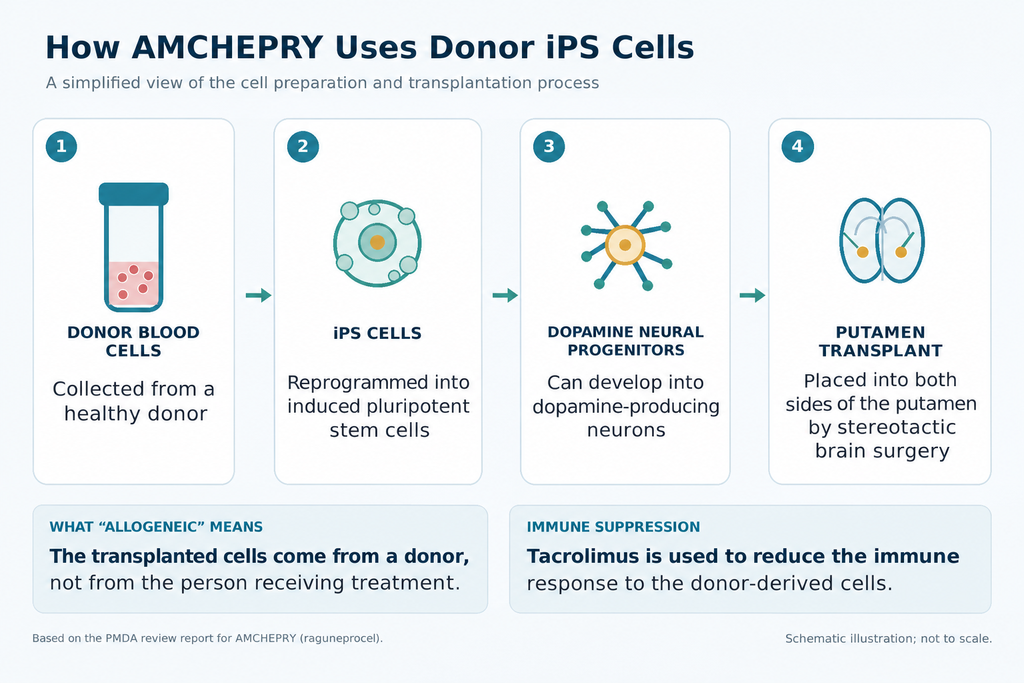
Because the transplanted cells are donor-derived, the treatment includes a tacrolimus immunosuppression protocol to reduce the risk of an immune response. The approved method calls for tacrolimus to begin on the day of transplantation, with blood levels monitored and the dose adjusted. It is generally tapered after about a year, though treatment may be extended when needed. [2]
Although news reports often call this “stem cell therapy,” patients are not given undifferentiated iPS cells. The cells are prepared and differentiated into neural progenitor cells before transplantation. This is an important distinction: the intended treatment is a specific, manufactured cell product delivered through brain surgery, not a general stem cell injection.
The goal is to improve motor symptoms by restoring some dopamine production in the putamen. It is not designed to replace every type of nerve cell affected by Parkinson’s disease or to address every symptom. Parkinson’s disease also affects other brain systems and can involve non-motor symptoms such as sleep problems, changes in mood, constipation, and cognitive difficulties. The treatment’s approval is specifically for motor symptoms. [2]
What did the clinical trial find?
The approval was based largely on a Phase I/II study conducted at Kyoto University Hospital. The study enrolled seven people with Parkinson’s disease, aged 50 to 69. Researchers transplanted the cells into the putamen and followed participants for 24 months. The main purpose was to evaluate safety; researchers also assessed motor symptoms and signs of dopamine production. [1, 5]
Brain scans showed increased dopamine activity in the putamen after transplantation. The average ¹⁸F-DOPA PET uptake rate increased by 44.7%. This is evidence that the transplanted cells were surviving and producing dopamine-related activity. It does not, on its own, prove that a treatment provides a meaningful or lasting improvement in daily life. [1]
Six of the seven participants were included in the study’s main motor-symptom efficacy assessment. Four of those six had an improved MDS-UPDRS Part III motor score when assessed in the OFF state, when medication benefits were reduced or had worn off. Five of six had an improved score in the ON state, when medication was working. Across the six participants, the average score change was a 9.5-point improvement in the OFF state and a 4.3-point improvement in the ON state. The researchers also reported improvement in Hoehn and Yahr stage in four participants. [1, 5]
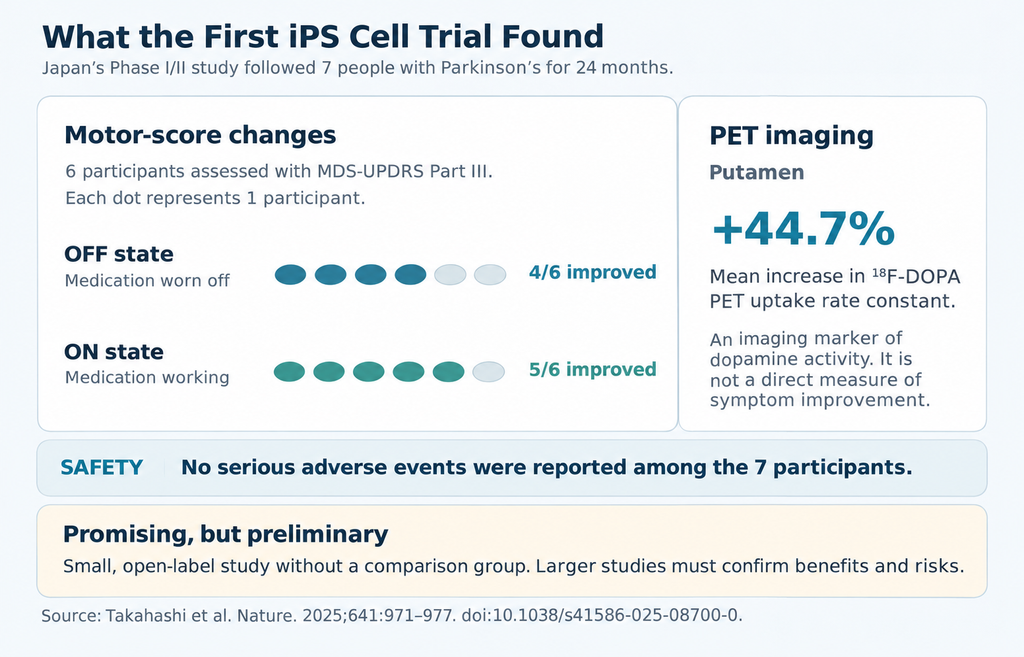
These results are promising, but they need careful interpretation. The study was small, open-label, and conducted at one centre. There was no comparison group receiving standard care or a sham operation. With so few participants, the results cannot tell us reliably how often people might benefit, how large the benefit would be for a typical patient, or how the treatment compares with other options.
The study’s motor results were also not uniform: some participants improved and some did not. The trial provides an early signal that the transplanted cells can survive and that motor scores may improve in some people. It cannot yet establish that AMCHEPRY reliably improves symptoms for the wider Parkinson’s population. [1, 2]
What risks and uncertainties remain?
No serious adverse events were reported during the 24-month trial. The seven participants experienced 73 adverse events: 72 were classified as mild and one as moderate. MRI scans did not show tumour-like overgrowth during the follow-up period. These findings are encouraging, but seven people followed for two years cannot rule out uncommon or delayed risks. Longer monitoring will matter. [1]
The treatment also has risks associated with brain surgery and immune suppression. In the trial, tacrolimus was used to reduce the chance that the immune system would attack the donor cells. The study team stopped tacrolimus after 15 months, but the medicine may have side effects, and patients need medical monitoring. [1, 2]
Dyskinesia is another important consideration. Six of the seven participants had a mild increase in dyskinesia scores during the study. The researchers noted that Parkinson’s medicines were generally kept at their existing doses, except when changes were needed. The trial design may have contributed to this finding, but it shows why motor symptoms and medication doses need to be monitored together after transplantation. [1]
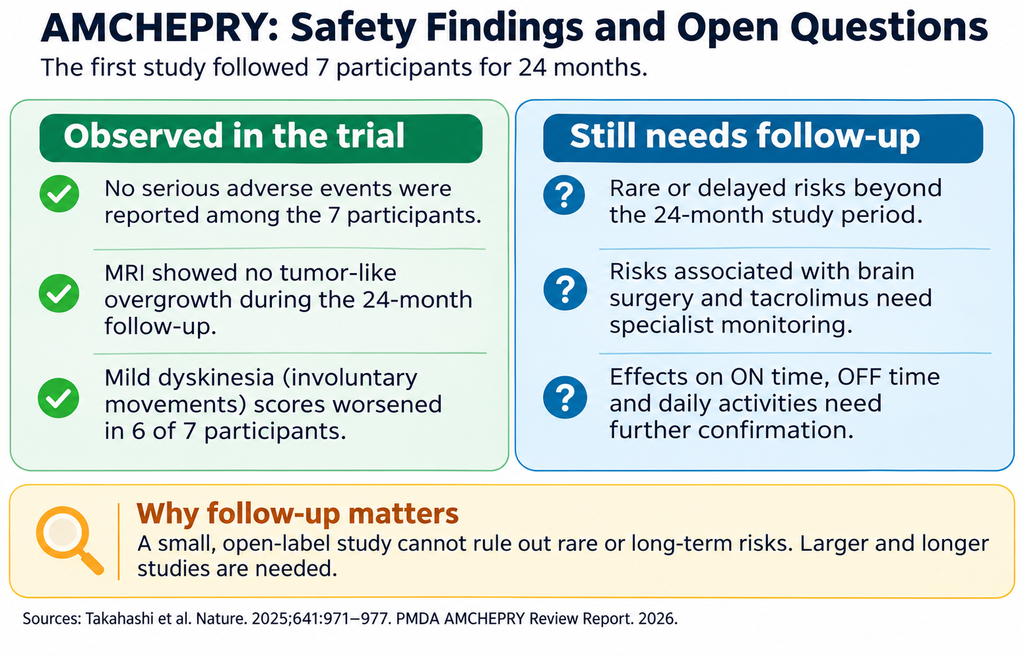
The Japanese regulator also pointed to limits in the efficacy evidence. In its review, PMDA concluded that the data were limited and that efficacy should continue to be evaluated after marketing. It noted that changes in everyday outcomes, including ON time, OFF time, and daily activities, still need to be confirmed. [2]
Who may be able to receive the treatment?
The approved indication is for people with Parkinson’s disease whose motor symptoms have not been adequately controlled by conventional medicines, including levodopa. That describes a particular clinical need, but it does not mean that everyone with fluctuating symptoms is suitable for transplantation.
AMCHEPRY requires brain surgery and immune-suppressing treatment. A specialist team needs to consider a person’s symptoms, overall health, response to medication, surgical fitness, and the balance of possible benefit and risk. The approval conditions require treatment by physicians experienced in Parkinson’s disease and stereotactic neurosurgery, in medical institutions equipped to manage the disease and the procedure. [2]
Additional evidence is being collected through a post-marketing clinical study. Japan’s trial registry listed the study as recruiting, with a planned total of 35 participants. Its main outcome is the change in OFF-state MDS-UPDRS Part III motor scores 96 weeks after transplantation. This study is intended to add evidence after conditional approval; the registry does not establish that every person who meets the broad indication can receive treatment. [6]
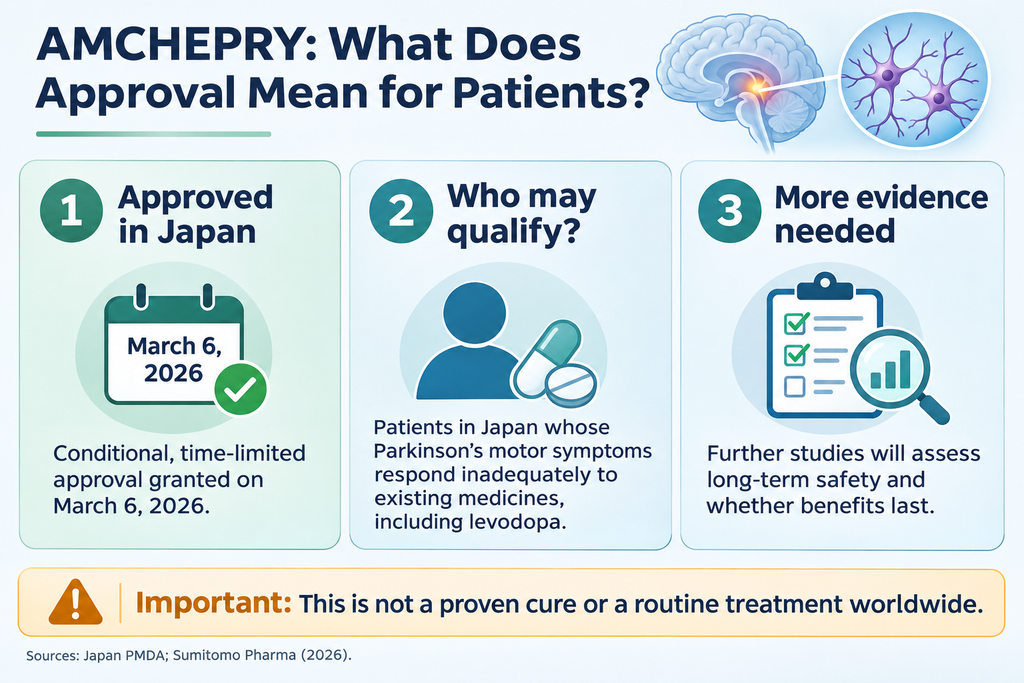
The current treatment pathway is in Japan. The product’s Japanese approval and insurance listing do not grant approval in other countries or guarantee access for people travelling to Japan. Anyone interested should speak with their movement-disorder specialist and contact the company through its official patient information channel for current eligibility and access details. Do not stop or change Parkinson’s medicines while exploring a new treatment.
Does this mean a cure is close?
AMCHEPRY is a significant development in cell-based research for Parkinson’s disease. The trial showed that donor-derived iPS cells can be developed into dopamine progenitor cells, transplanted into the brain, and followed by evidence of dopamine activity. Japan’s decision to allow conditional use means the treatment is moving from clinical research into carefully monitored medical use.
But it does not mean Parkinson’s disease can now be cured. The study did not show that the treatment stops the disease process or reverses all the changes caused by Parkinson’s disease. The proposed benefit is focused on motor symptoms that may be linked to loss of dopamine-producing neurons. The treatment’s effects on non-motor symptoms, long-term progression, and quality of life need further study.
The next several years of follow-up will help answer practical questions: how consistently patients improve, how long any benefit lasts, what side effects emerge with wider use, and which patients are most likely to benefit. For now, AMCHEPRY is best understood as a promising but still closely monitored treatment option for a limited group of patients in Japan—not a proven cure or a replacement for routine Parkinson’s care.
Frequently Asked Questions About Japan’s iPS Cell Treatment for Parkinson’s
Is Japan’s iPS cell treatment a cure for Parkinson’s?
No. AMCHEPRY is approved in Japan to improve motor symptoms in people whose symptoms are not adequately controlled by existing medicines. Current evidence does not show that it stops Parkinson’s or cures the disease.
Does the treatment use embryonic stem cells?
No. AMCHEPRY is made from induced pluripotent stem cells (iPS cells) derived from a donor’s blood cells. These cells are then developed into dopamine-producing neural progenitor cells before transplantation. Read the PMDA review report.
Can people outside Japan receive this treatment?
AMCHEPRY has received conditional approval in Japan. That approval does not authorize its use in other countries or guarantee access for people travelling to Japan. Availability and eligibility depend on local rules and specialist assessment.
How strong is the evidence so far?
The first published trial included seven people, with six included in the main assessment of motor symptoms. The results are promising but early. A post-marketing study is gathering further evidence about the treatment’s benefits and risks. Read the clinical trial published in Nature.
References
- Takahashi J, et al. Phase I/II trial of iPS-cell-derived dopaminergic cells for Parkinson’s disease. Nature. 2025;641:971–977. doi:10.1038/s41586-025-08700-0
- Pharmaceuticals and Medical Devices Agency (PMDA). Review Report: AMCHEPRY (raguneprocel). February 2026. English review report (PDF)
- Japan Agency for Medical Research and Development (AMED). Japan’s R&D and Application Practices toward the Realization of iPS Cell Therapy. Official page
- Kyoto University Hospital. Update on transplantation therapy using allogeneic iPS cell-derived dopaminergic neural progenitor cells for Parkinson’s disease. October 30, 2026. Official update (Japanese)
- Kyoto University Center for iPS Cell Research and Application (CiRA). Pioneering a cure for Parkinson’s disease: First allogeneic iPS cell-based therapy demonstrates safety and efficacy. April 17, 2025. Official study summary
- Japan Registry of Clinical Trials. A Confirmatory Study of Allogeneic iPSC-derived Dopaminergic Progenitor Cells (Raguneprocel) in Patients with Parkinson’s Disease (Post-marketing Clinical Study). Trial record: jRCT2053260117
- Ministry of Health, Labour and Welfare, Japan. Council on insurance coverage and pricing, May 13, 2026. Official meeting record (Japanese)
- Pharmaceuticals and Medical Devices Agency (PMDA). Overview of SAKIGAKE Designation. https://www.pmda.go.jp/english/review-services/reviews/0012.html
Medical disclaimer: This article is for educational and informational purposes only. It does not provide medical advice, diagnosis, or treatment recommendations. Information about AMCHEPRY (raguneprocel) reflects currently available research and regulatory information; evidence about its long-term benefits and risks is still developing. Its conditional, time-limited approval applies in Japan and does not mean the treatment is suitable or available for everyone. Talk with a qualified neurologist about your individual care. Do not start, stop, or change Parkinson’s medication, or pursue a procedure, based solely on this article.
Related Parkinson’s Treatment Articles
Explore more about Parkinson’s treatments, including current medicines and other cell-therapy research.
-
A Promising Step in Parkinson’s Research: Stem-Cell Therapy Enters Human Trials
A look at a separate stem-cell treatment studied in clinical trials—not AMCHEPRY (raguneprocel). -
Parkinson’s Medications: Types, Benefits and Side Effects
Learn how established medicines help manage Parkinson’s symptoms and what their limitations may be. -
Parkinson’s Medication Not Working as Well? What to Do
Read about treatment options clinicians may consider when symptoms become harder to control.
Get Your Free Parkinson’s Medication Management Diary
Download your free printable diary to easily track your medications, symptoms, and doses.