
Written by
PhD in Neurosciences
Key Takeaways
- An experimental daily capsule. Australian biotech company Syntara is studying SNT-4728, a once-daily oral drug designed to reduce inflammation in the brain.
- Who took part. The Phase 2 trial enrolled 41 people with isolated REM sleep behaviour disorder (iRBD), a condition in which people may act out their dreams. People with iRBD have a higher risk of developing Parkinson’s or a related condition.
- What the trial found. Syntara reported that a PET marker linked to inflammation decreased on one side of the putamen, a brain region involved in movement. At week 24, 12 weeks after treatment ended, clinician-rated motor scores also favoured SNT-4728 over placebo.
- What comes next. SNT-4728 remains investigational. Larger, longer studies are needed to find out whether it can delay the onset of Parkinson’s or slow its progression.

If you have followed health news out of Australia recently, you have likely seen headlines celebrating a “simple daily pill that could stop Parkinson’s before it starts.” For families living with Parkinson’s disease—or anyone experiencing early warning signs—news like this naturally sparks both hope and urgent questions.
When sensational headlines circulate, it is essential to look past the buzzwords and examine the actual clinical evidence. Behind the media excitement is SNT-4728, an experimental oral medication developed in Australia that reported Phase 2 clinical trial results in October 2026. While it is not a cure available at your local pharmacy today, the science behind it marks an important shift in how researchers are trying to intercept Parkinson’s disease at its earliest stages.
What is SNT-4728 and how does it work?
SNT-4728 is an investigational, once-daily oral capsule developed by Syntara Limited (formerly Pharmaxis), a clinical-stage biotechnology company based in Sydney, Australia.
Unlike standard Parkinson’s medications such as levodopa—which replace lost dopamine to temporarily ease tremors and stiffness—SNT-4728 is engineered to target one of the underlying biological drivers of neurodegeneration: chronic brain inflammation.
Scientifically, SNT-4728 is a first-in-class dual inhibitor of two enzymes in the brain:
- SSAO (Semicarbazide-Sensitive Amine Oxidase): An enzyme involved in vascular and neuroinflammatory pathways. When overactive in the brain, SSAO contributes to inflammatory signaling and generates toxic aldehyde byproducts that stress vulnerable nerve cells.
- MAO-B (Monoamine Oxidase-B): An enzyme responsible for breaking down dopamine and producing oxidative stress.
By blocking both SSAO and MAO-B simultaneously, SNT-4728 aims to cool down localized neuroinflammation and protect dopamine-producing neurons before widespread, irreversible cell loss occurs.
Why the trial focused on REM sleep behaviour disorder (iRBD)
One of the biggest challenges in Parkinson’s research is timing. By the time a person notices a resting tremor or slowness of movement and receives a formal diagnosis, roughly 50% of the dopamine-producing neurons in the brain’s movement center have already been lost. Intervening earlier requires identifying people during the prodromal phase—years before standard motor symptoms appear.
To achieve this, researchers focused on isolated REM Sleep Behaviour Disorder (iRBD). During normal REM (dream) sleep, the brain temporarily paralyzes the body’s muscles so we stay still while dreaming. In people with iRBD, that safety switch malfunctions, causing them to kick, punch, shout, or thrash in bed while acting out vivid dreams.
Epidemiological studies show that approximately 70% (7 out of 10) of people diagnosed with iRBD will go on to develop Parkinson’s disease or a closely related alpha-synuclein disorder within 15 years. Because iRBD is the single strongest clinical predictor of future Parkinson’s, testing a neuroprotective therapy in this group gives scientists a rare window to see whether calming brain inflammation can alter the disease trajectory early on.
Inside the phase 2 trial: key numbers and findings
The Phase 2 trial of SNT-4728 was a randomized, double-blind, placebo-controlled study conducted across two academic centers: Macquarie University in Sydney (led by Principal Investigator Professor Simon Lewis) and the University of Oxford in the UK (led by Professor Michele Hu), with funding from Parkinson’s Research Ventures in collaboration with Parkinson’s UK.
A total of 41 participants with iRBD were enrolled and randomized in a 3:1 ratio—30 received a once-daily oral dose of SNT-4728, while 11 received a matching placebo. Participants took the capsule daily for 12 weeks, followed by an additional 12-week off-treatment follow-up period (24 weeks total) to observe what happened after stopping the drug.
The trial data—unveiled across July and October 2026 and presented at the International Congress of Parkinson’s Disease and Movement Disorders in Seoul—highlighted several notable findings:
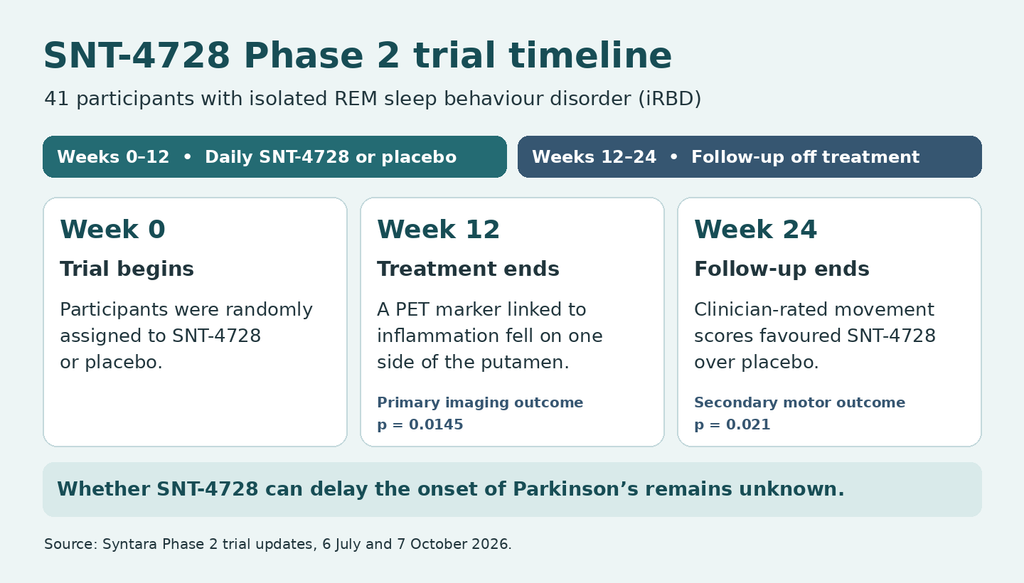
The most compelling detail for neurologists was the Week 24 motor outcome. Even though participants stopped taking SNT-4728 at Week 12, their clinician-assessed motor scores continued to hold steady or improve three months later, whereas the placebo group showed expected gradual deterioration. That lingering benefit suggests the capsule may be doing more than temporarily masking symptoms.
Separating hope from hype: limitations and what happens next
While these findings provide encouraging proof of biological activity in the human brain, it is important to keep the results in realistic clinical perspective:
- Small sample size: With 41 total participants (and only 11 on placebo), this was an exploratory Phase 2 study. Small trials are designed to detect biological signals and confirm safety, not to prove definitive clinical efficacy.
- Short observation window: Parkinson’s disease develops over decades. A 12-week treatment period cannot prove whether SNT-4728 prevents someone with iRBD from developing Parkinson’s five or ten years down the road.
- The path to approval: In clinical drug development, promising Phase 2 candidates still have to pass rigorous Phase 3 trials involving hundreds of participants tracked over multiple years. Until a Phase 3 study confirms long-term protection, regulatory agencies like Australia’s TGA or the U.S. FDA will not approve the medication for public prescription.
Frequently Asked Questions
Can I get a prescription for SNT-4728 right now?
SNT-4728 is still being studied and is unavailable as an approved prescription treatment for Parkinson’s or isolated REM sleep behaviour disorder.
Could SNT-4728 help people already diagnosed with Parkinson’s?
That remains unknown. The Phase 2 trial enrolled people with isolated REM sleep behaviour disorder. Syntara has identified people with early diagnosed Parkinson’s as a group to study in future trials.
How is SNT-4728 different from levodopa?
The brain converts levodopa into dopamine, which helps manage movement symptoms. SNT-4728 blocks two enzymes called SSAO and MAO-B. Researchers are studying whether it can reduce brain inflammation and whether that could slow disease progression.
Related Reading
-
Best Sleep Positions for Parkinson’s Patients
Includes a section on dream enactment and bedroom safety for people with REM sleep behaviour disorder. -
AI Drug Discovery for Parkinson’s Disease
Explores another research effort targeting brain inflammation. -
Can a Diabetes Drug Improve Parkinson’s Symptoms?
Explains what the exenatide trial found when researchers tested whether the drug could slow Parkinson’s progression. -
Parkinson’s Medications: Types, Benefits and Side Effects
A guide to levodopa and other medicines used to manage Parkinson’s symptoms.