
Written by Dr. Akbar Zaib, PhD in Neurosciences
Knowing how to prepare for a Parkinson’s appointment can help you explain important changes clearly, ask the right questions, and make better use of the limited time with your healthcare professional.

A Parkinson’s appointment may last only a short time, yet you may need to explain symptoms and changes that have developed over several weeks or months. When the clinician asks, “How have you been?”, it is not always easy to know where to begin.
You may remember the tremor but forget to mention dizziness, constipation, sleep problems, anxiety, or a recent near-fall. Medication may work well at certain times but wear off before the next dose. You might also have a good day during the appointment, making it difficult for the clinician to see the problems you regularly experience at home.
Learning how to prepare for a Parkinson’s appointment can make these conversations easier and more productive. It does not mean recording every small detail. The aim is to identify the changes that matter most, describe how they affect daily life, and prepare the questions you want answered.
This guide will show you what to track, what to bring, and how to communicate your concerns clearly. You can also download the free four-page Parkinson’s Appointment Preparation Pack to organize your symptoms, medication observations, questions, and next steps before your visit.
Why Parkinson’s appointments can feel difficult
Parkinson’s symptoms can change from one day—or even one hour—to the next. You may experience stiffness in the morning, better movement after medication, and fatigue or wearing-off later in the day. However, if you happen to feel well during the appointment, your clinician may not see what a typical difficult day looks like.
Parkinson’s disease also involves more than visible movement symptoms. Problems such as pain, constipation, poor sleep, dizziness, anxiety, changes in thinking, and difficulty swallowing may be easy to overlook or may not seem connected to Parkinson’s disease.
It can also be difficult to recall exactly when a symptom started, how often it occurs, or whether it appears before or after medication. A caregiver may remember some details, but they may notice different concerns from the person living with Parkinson’s disease.
Preparing a few notes beforehand reduces this pressure. It helps you focus on the changes that affect your daily life most, rather than trying to remember everything during a short appointment.
Key takeaway: Your clinician only sees a brief moment of your life. Preparing a few clear notes can help them understand what has been happening between appointments.
Decide what matters most before the appointment
Before your appointment, take a few minutes to decide which changes or concerns matter most to you. Trying to discuss every symptom at once can make the conversation feel rushed and may leave too little time for your biggest concerns.
Start by writing down the three most important things you want to discuss. These might include a new symptom, more frequent OFF periods, medication side effects, a recent fall, difficulty swallowing, or a change affecting your independence.
It can also help to consider four simple questions:
- What is the biggest change since my last appointment?
- What has become more difficult in daily life?
- Is there anything new that worries me?
- What has improved or is going well?
Improvements are worth mentioning too. If a medication adjustment, exercise programme, therapy, or change in routine has helped, your clinician needs to know. This can provide useful information when planning the next stage of your care.
If you attend with a caregiver, compare notes beforehand. Their observations may help, but your own priorities should remain central to the appointment.
Key takeaway: Choose your three most important concerns before the visit and discuss them first. Do not wait until the final few minutes to mention the issue affecting you most.
Describe how symptoms affect your daily life
Simply naming a symptom may not give your clinician enough information to understand its impact. Whenever possible, explain when it happens, how often it occurs, and what it prevents you from doing.

For example, instead of saying:
“My balance has become worse.”
You could say:
“I have nearly fallen twice while turning in the kitchen, and I now avoid walking outside alone.”
Instead of saying:
“My medication is not working as well.”
You might explain:
“About 30 minutes before my next dose, my right leg becomes stiff and it becomes difficult to stand up or walk.”
Remember to mention both movement and non-movement symptoms. Tremor, stiffness, slowness, freezing, and balance problems are important, but so are fatigue, pain, constipation, poor sleep, dizziness, anxiety, low mood, speech changes, swallowing difficulties, and changes in memory or thinking.
Be honest about symptoms that may feel uncomfortable to discuss, including falls, hallucinations, bladder problems, sexual difficulties, or changes in mood. These details may be relevant to your care, and your healthcare professional cannot help with a problem they do not know about.
Key takeaway: Do not only name the symptom. Explain when it happens and how it affects walking, eating, sleeping, speaking, working, or other parts of daily life.
Look for symptom and medication patterns
A single symptom can be difficult to interpret without knowing when it happens. Before your appointment, look for patterns across the day and consider whether changes may be connected to medication timing, meals, activity, stress, or sleep.
Useful details to record include:
- When you take each medication and the dose
- How long it takes before you notice an effect
- Whether symptoms return before the next scheduled dose
- When you feel most mobile or least mobile
- How long OFF periods appear to last
- Any possible side effects or difficulty taking medication
- Missed or delayed doses and what happened afterward

For example, “My stiffness is getting worse” provides limited information. A more helpful description might be: “My stiffness usually returns around 30 minutes before my afternoon dose and improves after I take it.”
You do not need to track every detail for months. Even a short record covering several typical days may help reveal patterns that are difficult to remember later. f symptoms regularly return before the next dose or medication takes longer to work, read our guide on what to do when Parkinson’s medication is not working as well.
Bring an updated medication list to the appointment, including any non-prescription medicines or supplements you use.
Do not change the dose, timing, or type of medication based on your observations alone. Use your notes to support a discussion with your healthcare professional.
Key takeaway: The timing of a symptom can be as important as the symptom itself. Record when changes occur and how they relate to medication, meals, sleep, and daily activities.
Prepare your most important questions
It is common to remember an important question only after the appointment has ended. Writing your questions down beforehand can prevent this and help keep the conversation focused.
Put your most important question first, especially if the appointment may be short. Try to make each question specific to a symptom, treatment concern, or daily difficulty. For example:
- Could this new symptom be related to Parkinson’s or my medication?
- Could these changes mean that my medication is wearing off?
- What should I do if this symptom becomes worse?
- Could physiotherapy, speech therapy, or occupational therapy help?
- Are there any side effects I should watch for?
- Which symptoms should prompt me to contact the clinic?
- What should I track before my next appointment?
If you have many questions, select your top three and keep the others as a backup. You can also ask whether there is another member of the healthcare team who can help with questions that cannot be covered during the visit.
Leave space beside each question to record the answer. If the explanation is unclear, ask the clinician to repeat it in simpler words or write down the main instruction.
Key takeaway: Write down your questions in order of importance and ask the most important one early in the appointment. Do not rely on memory alone.
Make the most of the appointment
At the beginning of the appointment, briefly explain what you most want to discuss. You could say, “I have three concerns today, but the most important is that I have started falling.” This helps your clinician understand your priorities from the start.
Use short, real-life examples when describing changes. If you have symptom notes, a medication list, or a diary report, keep them easy to access. You do not need to read every entry aloud. Use them to show important patterns or answer questions more accurately.
A caregiver or family member can help by sharing changes they have noticed, reminding you of important details, or taking notes. However, whenever possible, the person living with Parkinson’s disease should remain at the centre of the conversation.

Before leaving, make sure you understand:
- Whether any medication or treatment changes were recommended
- When and how those changes should be made
- Whether you need tests, referrals, or follow-up appointments
- Which symptoms require earlier contact with the healthcare team
- What you should monitor before your next visit
If an instruction is unclear, ask for it to be explained again or written down. It can also help to repeat the plan in your own words to confirm that you understood it correctly.
Key takeaway: Begin with your main concern, use clear examples, and do not leave until you understand the agreed next steps.
Use the free Parkinson’s appointment preparation pack
To make this process easier, I have created a free four-page Parkinson’s Appointment Preparation Pack. It brings the most important information into one place, so you do not have to depend on memory during your visit.
The printable pack includes:
- My appointment snapshot
Write down your three main concerns, the biggest change since your last visit, something that has become harder, and anything that has improved.
- Symptoms and daily changes
Mark the symptoms you want to discuss and record when they occur, which one affects you most, and whether you have noticed ON/OFF periods or wearing-off.
- Medication and treatment notes
List your medication or treatment, dose and timing, possible side effects, and any concerns you want to raise.
- Questions for my appointment
Prioritise your three main questions, take notes during the visit, and record the next steps you need to remember.
You do not need to complete every box. Focus on the parts that are most relevant to you, and bring the completed pack to your appointment. A caregiver can help fill it in, but the answers should reflect the priorities and experiences of the person living with Parkinson’s disease.
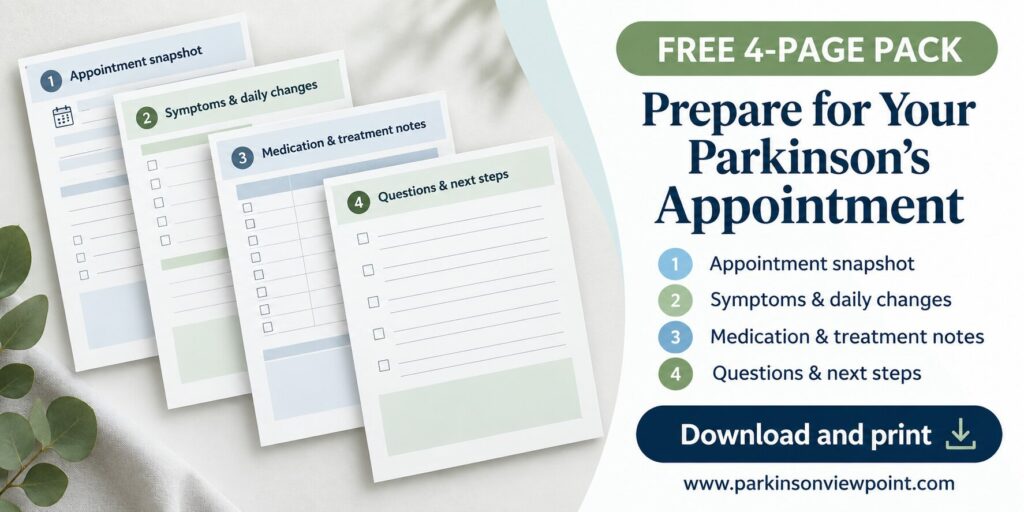
📄 Download the Free 4-Page Parkinson’s Appointment Preparation Pack
Key takeaway: Use the preparation pack to organise your concerns before the visit and record important answers and next steps during the appointment.
Keep tracking between appointments
After the appointment, review your notes while the conversation is still fresh. Record any agreed next steps, such as medication instructions, tests, referrals, therapy appointments, or symptoms your healthcare professional wants you to monitor.
Do not wait until the next appointment is approaching to think about what has changed. A brief daily record can help you notice patterns that may otherwise be missed. You might record your main symptoms, medication response, ON/OFF periods, falls or near-falls, sleep, and a short note about anything unusual.
This does not need to become a complicated task. The goal is to capture enough information to answer questions such as:
- When did the change begin?
- How often does it happen?
- Is it becoming more frequent?
- Does it occur before or after medication?
- How does it affect daily activities?
The free Parkinson’s Daily Diary app allows you to record symptoms, medication status, ON/OFF periods, and important notes in about one minute a day. It can also create reports that help present changes more clearly at a future appointment.

Daily tracking should support—not replace—communication with your healthcare team. Contact them earlier if you develop a concerning new symptom or if they have advised you not to wait until your next scheduled visit.
Key takeaway: A one-minute daily record can provide a clearer picture than trying to remember several weeks of symptoms shortly before your next appointment.
Final thoughts
Knowing how to prepare for a Parkinson’s appointment can help you feel more confident and make the limited time with your healthcare professional more useful. You do not need to record every symptom or prepare a perfect medical history. Focus on the changes that matter most, how they affect daily life, and the questions you want answered.
Bring clear examples, an updated medication list, and notes about any patterns you have noticed. During the visit, begin with your main concern and write down the agreed next steps before you leave.
The free Parkinson’s Appointment Preparation Pack can help you organise this information in one place. Between visits, brief daily tracking can make it easier to notice changes and describe them accurately at your next appointment.
Good preparation cannot guarantee that every issue will be resolved in one visit, but it can help ensure that your most important concerns are heard.
Important medical note
This article and the Parkinson’s Appointment Preparation Pack are provided for educational and organisational purposes only. They are intended to help you record your own experiences, prepare questions, and communicate more clearly with your healthcare team.
They do not provide medical advice, diagnosis, or treatment recommendations. Do not start, stop, or change the dose or timing of Parkinson’s medication without speaking with a qualified healthcare professional. If you develop a new, severe, or rapidly worsening symptom, contact your healthcare team rather than waiting for your next scheduled appointment.