
Neuroscientist • Parkinson’s Researcher
Many people with Parkinson’s disease notice that their medication works extremely well at first—but after a few years, its effects seem to fade more quickly. If you’ve ever wondered how Parkinson’s medication works and why it doesn’t last as long as it once did, you’re not alone. In this article, we’ll explain the science in simple language and show why the medication usually hasn’t failed—it’s your brain that has changed over time.

When many people first start taking Parkinson’s medication, the results can feel almost miraculous. Walking becomes easier, stiffness improves, and movements that once felt slow and difficult suddenly seem much smoother.
But after a few years, many people begin asking the same worrying question:
“Why doesn’t my medication work like it used to?”
Perhaps it wears off sooner, symptoms return before the next dose, or some days it seems less predictable than before. This can be frustrating and sometimes even frightening.
The good news is that, in most cases, the medication itself has not stopped working. Instead, the way your brain responds to it changes as Parkinson’s disease progresses.
Understanding this process can help explain why doctors often adjust medication schedules over time and why taking your tablets at the right time becomes increasingly important.
In this article, we’ll explore how Parkinson’s medication works, why it is so effective in the early stages of the disease, and why its effects often become shorter and less predictable over time.
Disclaimer: The information shared here should not be taken as medical advice. The opinions presented here are not intended to treat any health conditions. For your specific medical problem, consult with your healthcare provider.
Think of Your Brain Like a Rechargeable Battery
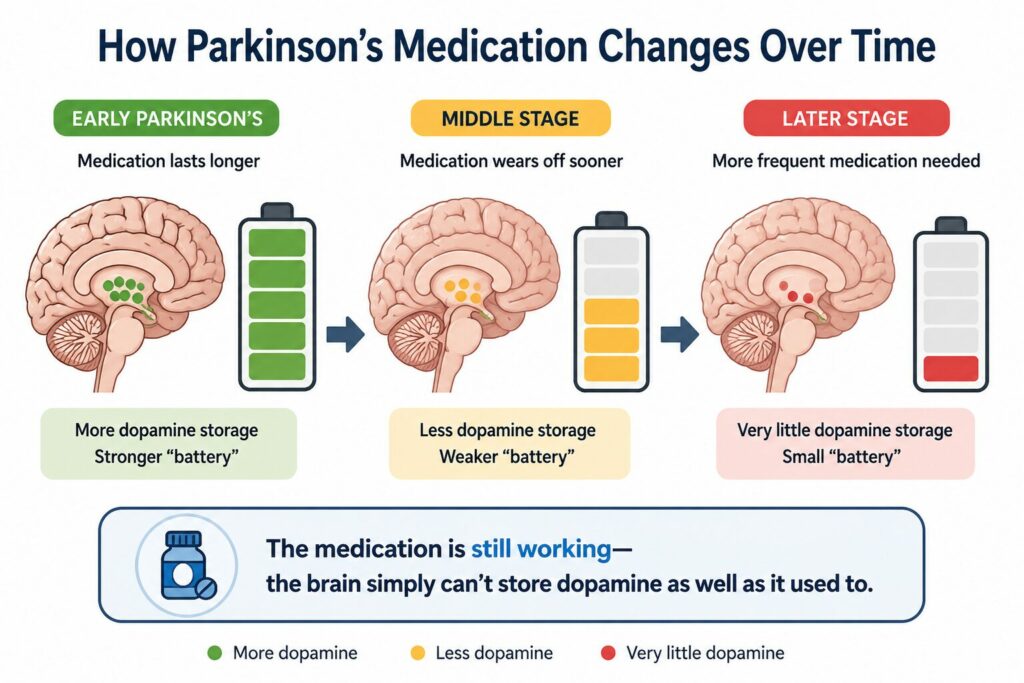
To understand why Parkinson’s medication changes over time, it helps to imagine that the movement centers of your brain work like a rechargeable battery.
In a healthy brain, special nerve cells produce a chemical messenger called dopamine. Dopamine helps different parts of the brain communicate smoothly, allowing you to walk, write, smile, and perform everyday movements without thinking about them.
You can think of dopamine as the energy that keeps the battery charged. As long as enough dopamine is available, the brain can send movement signals efficiently.
In Parkinson’s disease, these dopamine-producing cells gradually die. As more cells are lost, the brain’s “battery” slowly loses its ability to hold a full charge. This is why symptoms such as slowness, stiffness, tremor, and balance problems begin to appear and gradually worsen over time.
Parkinson’s medications, especially levodopa, act like a temporary charger. They help restore dopamine levels and recharge the system, allowing movement to improve again.
During the early stages of Parkinson’s disease, the remaining healthy brain cells can still store some of this newly produced dopamine and release it gradually throughout the day. This is one of the main reasons why medication often provides long-lasting symptom relief in the beginning.
However, as the disease progresses and more dopamine-producing cells are lost, the brain gradually loses its ability to store dopamine. The “battery” becomes smaller and weaker, meaning each dose of medication lasts for a shorter period before symptoms return.
This simple change explains why many people find that Parkinson’s medication works extremely well at first but becomes less predictable years later.
How Parkinson’s Medication Actually Works
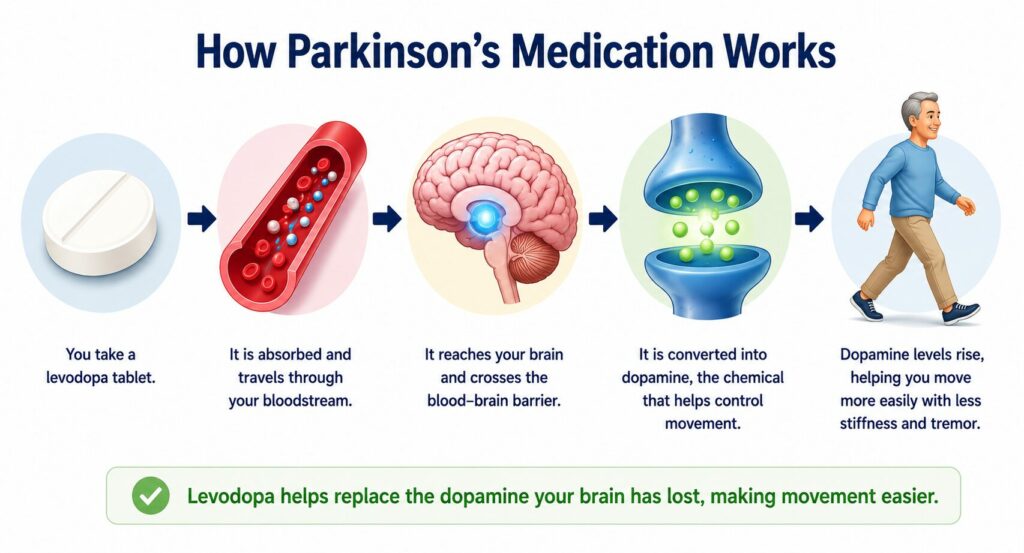
The most commonly prescribed medication for Parkinson’s disease is levodopa. It has been used for decades and remains the most effective treatment for improving movement symptoms such as slowness, stiffness, and tremor.
But levodopa does not cure Parkinson’s disease or stop the condition from progressing.
Instead, it works by replacing the dopamine that the brain can no longer produce in sufficient amounts.
After you swallow a levodopa tablet, it is absorbed into your bloodstream and travels to the brain. Once there, it is converted into dopamine, helping nerve cells communicate more effectively and allowing movement to become smoother and easier.
This is why many people notice that walking improves, stiffness decreases, and everyday activities become easier within 30 to 60 minutes after taking their medication.
In the early years of Parkinson’s disease, the remaining healthy dopamine-producing cells can still store and release some of this newly produced dopamine throughout the day. Think of these cells as small rechargeable batteries that hold onto the energy and release it when your body needs it.
Because of this natural storage system, a single dose of medication may continue working for several hours, providing relatively stable symptom control.
However, this storage ability does not last forever. As Parkinson’s disease progresses and more dopamine-producing cells are lost, the brain gradually loses its ability to hold onto dopamine. Instead, it becomes increasingly dependent on each individual dose of medication.
This is the key reason why Parkinson’s medication often seems to work differently after several years, even though the medication itself has not changed.
Get Your Free Parkinson’s Medication Management Diary
Download your free printable diary to easily track your medications, symptoms, and doses.
Why Parkinson’s Medication Doesn’t Last as Long Over Time
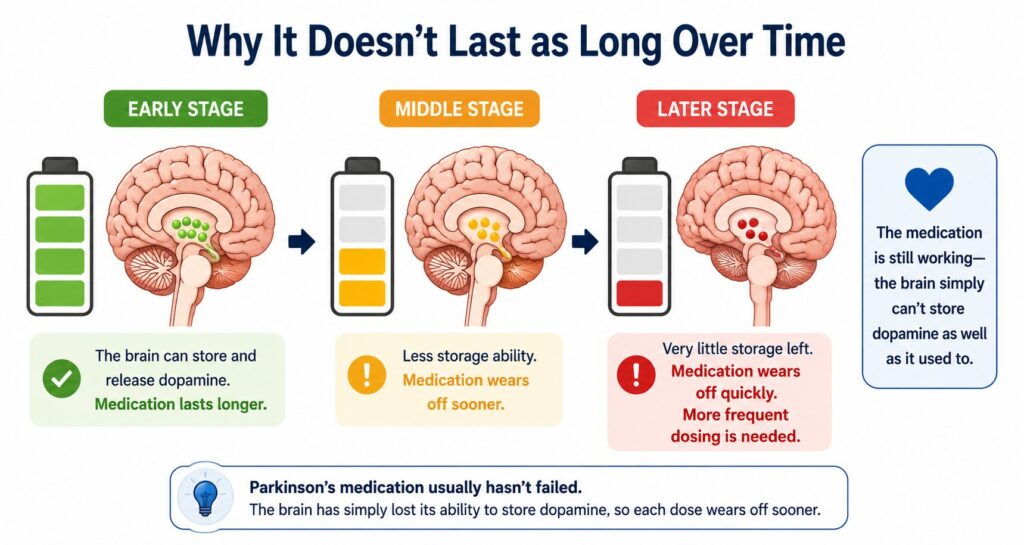
When Parkinson’s medication starts wearing off sooner than it used to, many people assume that their body has become “immune” to the medicine or that the medication has stopped working.
In reality, that’s usually not what is happening.
The medication is still producing dopamine, just as it did when you first started taking it. The difference is that your brain has gradually lost more of the dopamine-producing cells that once helped store and release that dopamine throughout the day.
Think back to the battery analogy.
In the early stages of Parkinson’s disease, the brain still has enough healthy cells to act like a rechargeable battery. After taking levodopa, those cells can store some of the dopamine and release it slowly, allowing one dose to keep working for several hours.
As Parkinson’s progresses, however, that battery becomes smaller.
The brain can no longer hold onto dopamine for very long. Instead, it depends almost entirely on the dopamine produced by each individual tablet. As soon as the medication level begins to fall, symptoms such as slowness, stiffness, tremor, or difficulty walking may return.
This is known as “wearing-off.”
For many people, it means that medication which once lasted four or five hours may eventually last only two or three hours. Doctors often respond by adjusting the timing of doses rather than simply increasing the amount of medication.
The important message to remember is this:
Parkinson’s medication usually hasn’t failed. The brain has simply lost more of its natural ability to store dopamine, making each dose wear off more quickly than before.
Can Parkinson’s Medication Still Help in the Later Stages?
The short answer is yes.
Many people believe that Parkinson’s medication eventually “stops working,” but this is a common misconception.
Even in the later stages of Parkinson’s disease, levodopa remains the most effective treatment for improving movement symptoms in most people. The medication can still reduce stiffness, improve walking, and make daily activities easier.
The challenge is that its effects often become shorter and less predictable because the brain has lost much of its ability to store dopamine.
For this reason, neurologists often adjust treatment over time. Instead of stopping the medication, they may recommend taking smaller doses more frequently, adding another medication to help levodopa last longer, or using extended-release formulations or advanced therapies for suitable patients.
Every person’s Parkinson’s journey is different, so treatment plans should always be individualized.
The most important thing to remember is that changes in how your medication feels do not necessarily mean it has stopped working. In many cases, it simply means that your treatment plan needs to evolve alongside the progression of the disease.
With regular follow-up and the right adjustments, many people continue to benefit from Parkinson’s medication for many years after diagnosis.
Key Takeaway
Parkinson’s medication usually doesn’t stop working. As Parkinson’s disease progresses, the brain gradually loses its ability to store dopamine, causing each dose to wear off sooner. Understanding this can help you work with your neurologist to adjust your treatment and continue getting the best possible symptom control.
What This Means for Your Daily Life
Understanding how Parkinson’s medication works can help you make better decisions about your daily routine.
If your medication seems to wear off sooner than it used to, don’t assume that it has stopped working. In many cases, it simply means that your brain can no longer store dopamine as efficiently as before.
This is one reason why taking your medication at the same time every day becomes increasingly important as Parkinson’s disease progresses.
Keeping a simple diary of when you take your medication and when your symptoms improve or return can also help your neurologist adjust your treatment more effectively.
Most importantly, never change your medication dose or schedule on your own. Even small adjustments should always be discussed with your healthcare team.
Remember, Parkinson’s treatment often needs to evolve over time. Changes in medication timing or dosage are a normal part of managing the condition and do not necessarily mean that your disease is progressing rapidly.
With the right treatment plan and regular follow-up, many people continue to achieve good symptom control and maintain their quality of life for many years.
Common Question
Does this mean my medication has stopped working?
Usually, no. It often means your brain can no longer store dopamine as well as before, so each dose wears off sooner.
Can I become resistant to levodopa?
Most people do not become “resistant” in the usual sense. The medication can still help, but its effect may become shorter and less predictable over time.
Should I increase my dose if it wears off too soon?
No, not by yourself. Wearing-off can often be managed, but dose timing and medication changes should always be discussed with your neurologist.
The key message is simple: Parkinson’s medication usually doesn’t stop working—the brain gradually loses its ability to store dopamine. Understanding this can help you feel more confident when treatment changes are needed and encourage you to work closely with your neurologist to find the approach that works best for you.
Track your Parkinson’s day in less than a minute
The Parkinson’s Daily Diary App lets you record symptoms, medications, daily notes and doctor ready report in under a minute.



My medicine is wearing off sometimes before next dose. I think anxiety is the reason why.us that possibility