
Neuroscientist • Parkinson’s Researcher
Falls and injuries are a major concern for people living with Parkinson’s disease, and many of them happen at home. Making simple home adjustments to improve safety in Parkinson’s disease can significantly reduce fall risk, increase confidence, and support independence. These adjustments can happen often without expensive equipment or major renovations. Small, thoughtful changes to everyday spaces can make daily movement safer and less stressful.
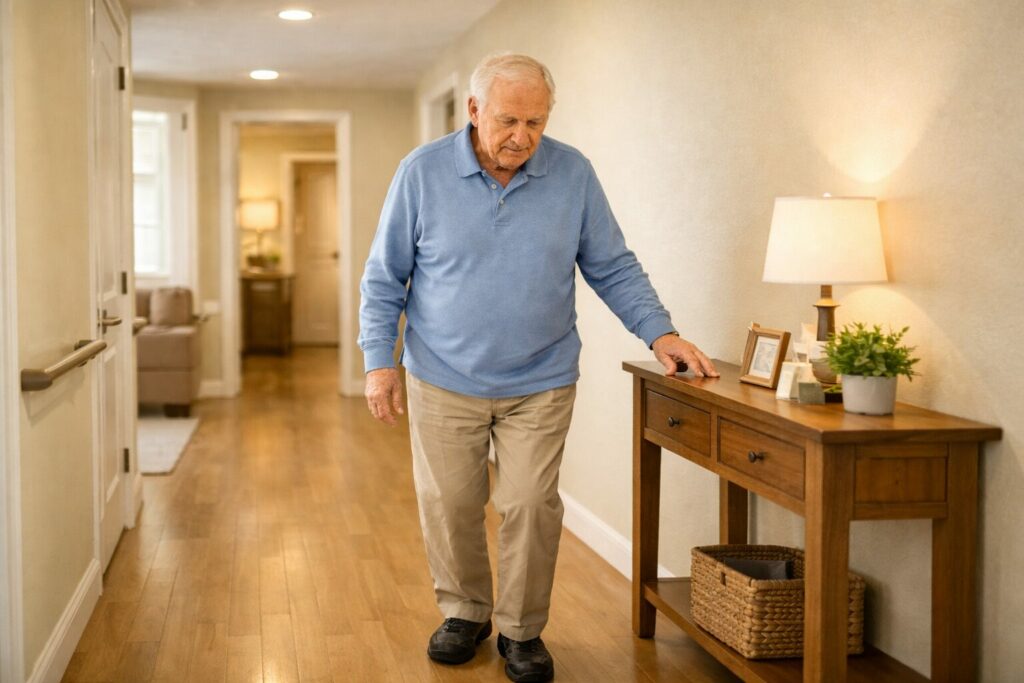
For people living with Parkinson’s disease, everyday movement at home can gradually become more difficult. Changes in balance, walking, and reaction time mean that spaces once considered safe may now carry hidden risks. For caregivers, it can be hard to know what changes truly help and which ones add unnecessary complexity. Many safety improvements are simple, affordable, and immediately effective.
This article focuses on simple home adjustments to improve safety in Parkinson’s disease, with practical recommendations that can be applied room by room.
In this guide, you’ll learn:
- Why safety risks increase at home for people with Parkinson’s disease
- Core principles that make living spaces safer and easier to navigate
- Simple, low-cost adjustments for common areas, bedrooms, bathrooms, and kitchens
- Home adjustments that help with freezing of gait
- How to reduce fall risk related to freezing of gait and poor lighting
- Tips that caregivers can implement quickly and confidently
The goal is to create a home environment that supports confidence, independence, and safety for Parkinson’s patients and their caregivers.
Why home safety matters more in Parkinson’s disease
For people living with Parkinson’s disease, the home is where most daily movement happens — and where most falls occur. Unlike outdoor environments, home spaces are often navigated automatically, without much conscious attention. Parkinson’s changes how automatic movement works, which is why familiar surroundings can become unexpectedly risky.
Several Parkinson’s-related symptoms contribute to this increased risk. Balance reactions may be slower, steps may become shorter or shuffling, and turning or navigating narrow spaces can trigger freezing of gait. Reaction time is often reduced, making it harder to recover from a small slip. Even mild symptoms can combine to increase fall risk, especially during multitasking or fatigue.
Another key factor is predictability. Homes tend to accumulate furniture, rugs, cords, and personal items over time. For Parkinson’s patients, visual clutter and tight pathways increase cognitive load and make movement planning harder. What feels like a minor obstacle to others can become a serious hazard.
Nighttime movement adds additional risk. Getting up to use the bathroom in low light, standing quickly after lying down, or walking while still drowsy can significantly increase the chance of falls. This is why lighting, clear paths, and stable support points matter so much in Parkinson’s-safe homes.
Importantly, improving home safety is not about restricting movement or independence. It’s about supporting how the Parkinson’s brain moves today, not how it moved in the past. Small, thoughtful adjustments can reduce risk, increase confidence, and allow both patients and caregivers to focus less on preventing accidents and more on living comfortably at home.
In the next section, we’ll look at the core principles of a Parkinson’s-safe home — simple ideas that guide all effective safety adjustments, regardless of room or budget.
Core principles of a Parkinson’s-safe home
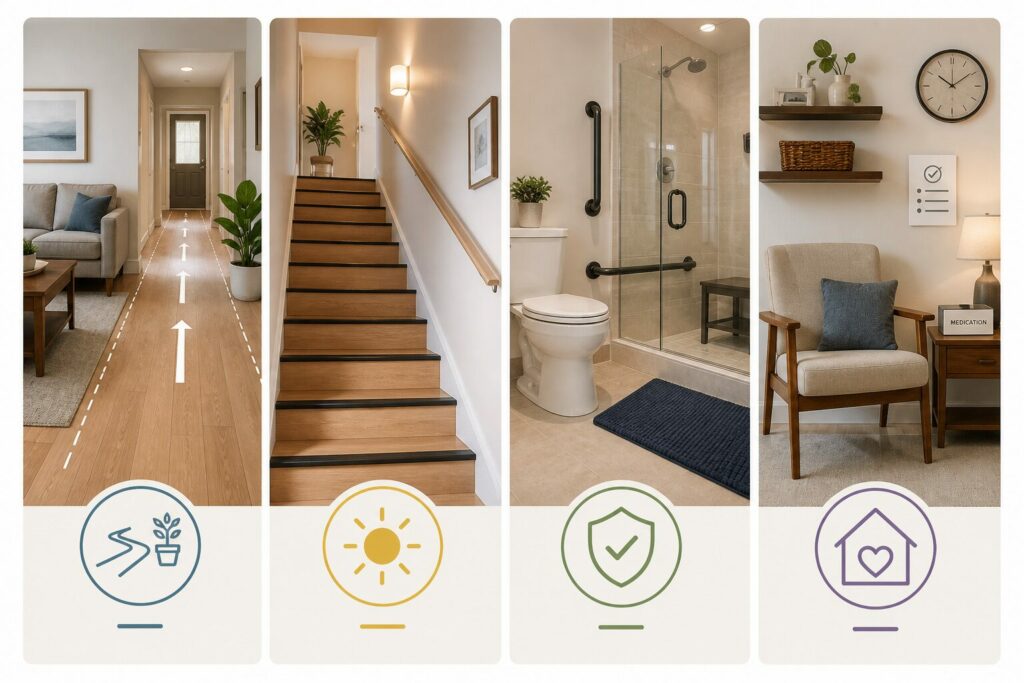
Creating a safer home for someone living with Parkinson’s disease does not require turning the house into a medical space. The most effective changes follow a few simple principles that support how movement works in Parkinson’s disease.
One key principle is reducing visual and physical clutter. The Parkinson’s brain works harder to process complex environments. Crowded floors, tight furniture spacing, and busy visual patterns increase cognitive load and make walking less automatic. Clear, predictable pathways allow the body to move with less hesitation and reduce the risk of freezing or missteps.
Another important principle is improving lighting and contrast. Dim or uneven lighting makes it harder to judge depth, steps, and edges. Good lighting supports balance and confidence, especially during transitions such as standing up or turning. Consistent lighting is particularly important in hallways, stairs, and bathrooms.
A Parkinson’s-safe home also prioritizes stability over speed. Furniture that shifts, lightweight chairs without armrests, or slippery surfaces increase fall risk. Stable seating, firm handholds, and non-slip surfaces provide reliable support during everyday movements like sitting, standing, and reaching.
Finally, consistency matters. Rearranging furniture too often or adding too many cues can be confusing. Keeping frequently used items in predictable places helps reduce hesitation and anxiety. Safety improves most when the environment supports familiar routines rather than constantly changing them.
In the next section, we’ll put them into practice with simple safety adjustments for common living areas, starting with living rooms and shared spaces.
Simple safety adjustments by area
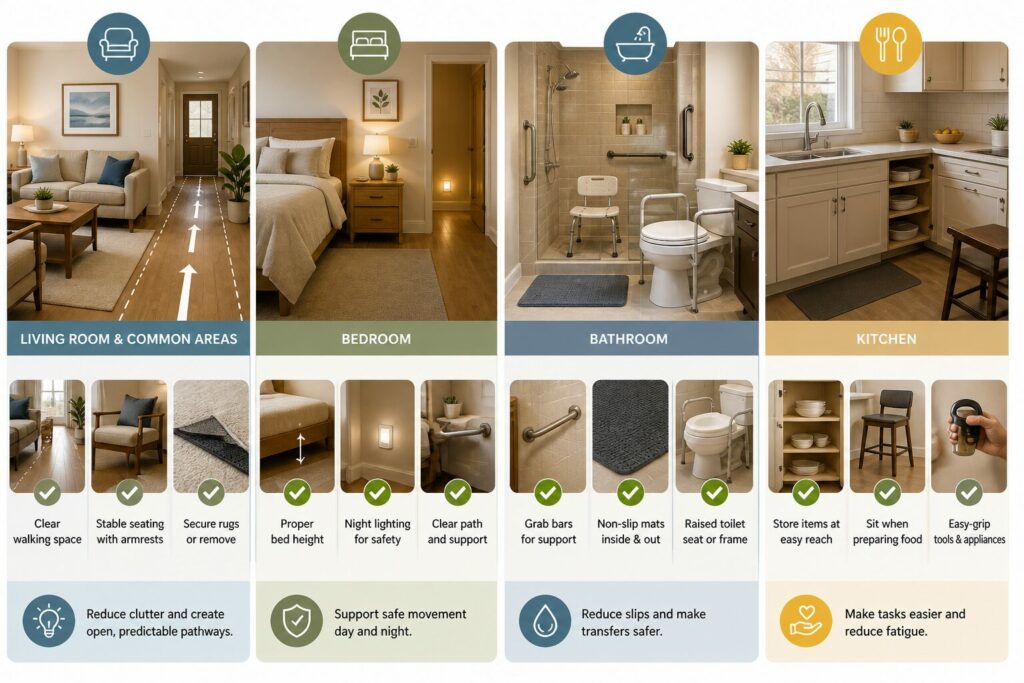
Applying safety principles room by room makes changes easier to plan and more effective. The goal is not to redesign the home, but to support everyday movement for people living with Parkinson’s disease and make caregiving safer and less stressful.
Living room and common areas
Living rooms are often the most used spaces and also where clutter quietly accumulates. Furniture arrangement plays a major role in safety.
Ensure there is a clear walking space between frequently used areas, such as from the couch to the doorway. Avoid tight turns around coffee tables or decorative furniture that may catch the feet. If possible, remove low or unstable items that are easy to trip over.
Seating should be stable and supportive. Chairs and sofas with armrests make sitting down and standing up much safer. Very soft or low seating increases effort and fall risk. If a favorite chair is low, adding a firm cushion can improve safety without replacing the furniture.
Rugs deserve special attention. Loose rugs or curled edges are a common cause of falls. If rugs are kept, secure them with non-slip backing or remove them from high-traffic areas altogether.
Bedroom
The bedroom is a high-risk area, especially during the night or early morning when stiffness and balance problems are worse.
Bed height matters. The bed should allow the feet to rest flat on the floor when sitting at the edge. Beds that are too low or too high make standing more difficult and increase fall risk. Simple risers or mattress adjustments can help.
Keep the path from bed to bathroom clear and well-lit. Remove clutter, cords, or furniture that narrows the walking path. A stable bedside table or wall-mounted grab point can provide support during nighttime standing.
Night lighting is essential. Soft night lights or motion-activated lights reduce the risk of falls without disrupting sleep.
Bathroom
Bathrooms are one of the most dangerous areas in the home due to wet surfaces and tight spaces.
Installing grab bars near the toilet and in the shower or bathtub provides reliable support during transfers. Towel racks are not a safe substitute, as they are not designed to bear weight.
Non-slip mats inside and outside the shower are essential. If stepping over a bathtub wall is difficult, a shower chair or walk-in shower can significantly improve safety.
Raised toilet seats or toilet frames can reduce the effort needed to stand, which is especially helpful during morning stiffness or medication OFF periods.
Kitchen
Kitchens require frequent reaching, turning, and multitasking — all of which can increase fall risk. Store commonly used items at waist to chest height to avoid excessive bending or overhead reaching. Keep floors dry and free of loose mats.
When preparing food, encourage sitting on a stable chair or stool rather than standing for long periods. This reduces fatigue and improves balance.
Appliances and tools should be easy to grip and operate without force. Stability at work surfaces is more important than speed or efficiency.
These room-by-room changes address the most common safety challenges without major renovations.
In the next section, we’ll focus specifically on adjustments that help with freezing of gait, especially in doorways, hallways, and narrow spaces.
Get Your Free Parkinson’s Medication Management Diary
Download your free printable diary to easily track your medications, symptoms, and doses.
Home adjustments that help with freezing of gait
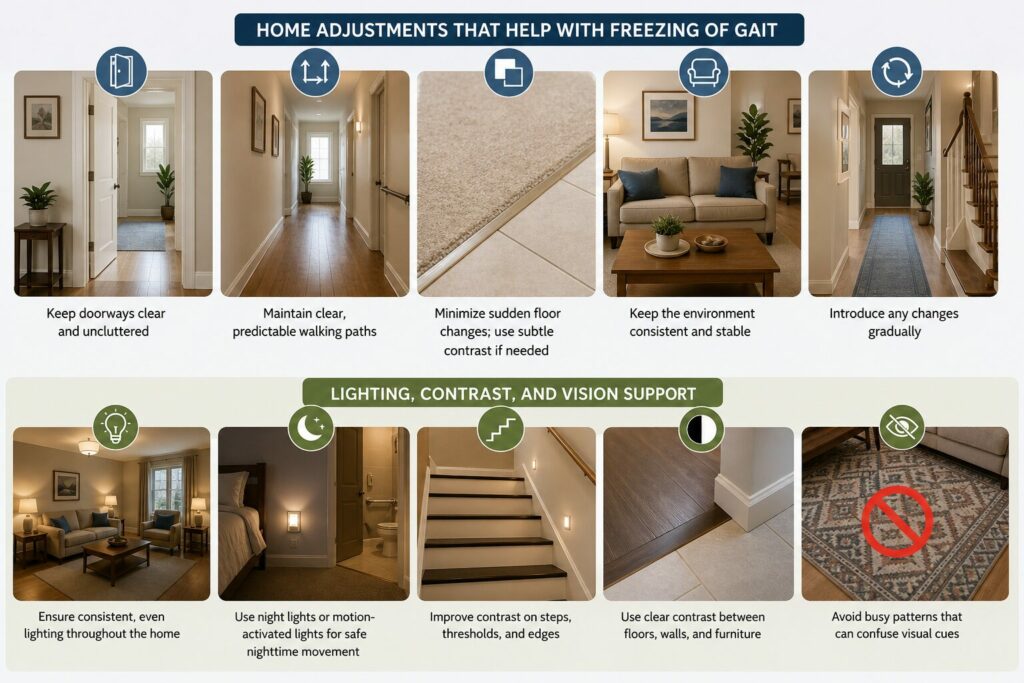
Freezing of gait is a common and challenging symptom in Parkinson’s disease, and it frequently occurs at home — especially in tight or visually complex spaces. Simple environmental adjustments can significantly reduce how often freezing happens and how disruptive it becomes.
Doorways and narrow passages are some of the most common freezing triggers. Reducing visual clutter around doorframes helps the brain process the space more easily. Keep floors clear, remove unnecessary objects near entrances, and avoid busy patterns or strong contrasts right at the doorway that can confuse movement planning.
Clear, predictable walking paths are especially important. Hallways should be free of furniture, shoe racks, or decorative items that narrow the space. Even small obstacles can increase hesitation and trigger freezing. Wider, unobstructed paths allow for smoother, more confident walking.
Floor surfaces also matter. Sudden changes in flooring — such as transitions from carpet to tile — can trigger freezing in some people. Where possible, minimize abrupt visual changes or clearly mark transitions with subtle contrast that is easy to interpret rather than distracting.
Consistency is key. Frequently rearranging furniture or adding multiple visual cues can increase cognitive load and worsen freezing. A stable, familiar environment supports more automatic movement. When changes are needed, introduce them gradually so the brain has time to adapt.
These adjustments do not eliminate freezing, but they reduce the environmental triggers that make it worse. In the next section, we’ll look at how lighting and contrast can further improve safety and confidence throughout the home.
Lighting, contrast, and vision support
Good lighting is one of the most effective — and often overlooked — ways to improve safety for people living with Parkinson’s disease. Parkinson’s can affect visual processing, depth perception, and contrast sensitivity, making dim or uneven lighting especially risky.
Start by ensuring consistent, even lighting throughout the home. Sudden changes from bright to dim areas force the brain to constantly readjust, which can increase hesitation and missteps. Hallways, entryways, and stair areas should be well lit at all times, not just during the day.
Nighttime lighting deserves special attention. Soft night lights or motion-activated lights in bedrooms, bathrooms, and along common walking paths reduce fall risk during nighttime and early-morning movement. These lights should illuminate the floor and pathway without creating glare or harsh shadows.
Contrast can also improve safety. Clearly distinguishing edges — such as steps, thresholds, or furniture — helps the brain judge space more accurately. Simple contrast, like darker flooring against lighter walls or visible edges on steps, can support smoother movement. Avoid overly busy patterns, which may confuse visual cues and worsen freezing.
By improving lighting and contrast, the home becomes easier to navigate with less effort and less anxiety.
In the final section, we’ll highlight practical tips caregivers can implement quickly and confidently to improve safety at home without overwhelming changes.
Practical safety tips caregivers can implement quickly and confidently
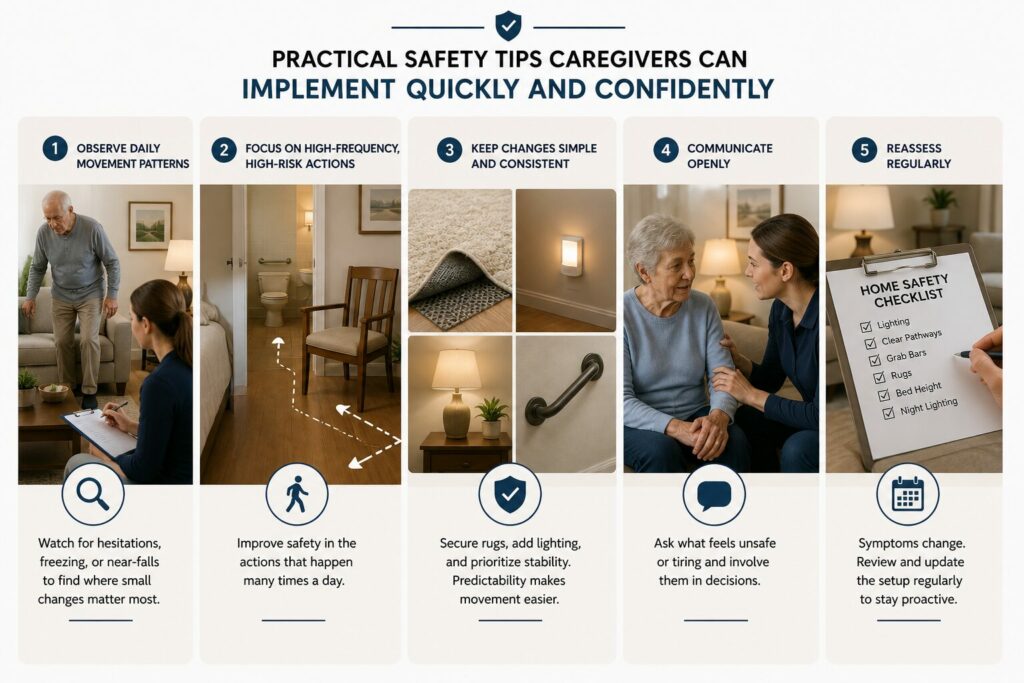
Caregivers play a crucial role in creating a safer home for someone living with Parkinson’s disease. The most effective changes are often small, fast to implement, and based on observation rather than major renovations.
Start by watching daily movement patterns. Notice where hesitations, freezing, or near-falls occur — getting up from a favorite chair, turning into the bathroom, or walking at night. These moments reveal where a simple adjustment will have the greatest impact.
Focus next on high-frequency, high-risk actions. Improving safety where movement happens many times a day (bed to bathroom, chair to table, hallway turns) reduces overall fall risk more than making changes in rarely used spaces.
Keep changes simple and consistent. Secure rugs instead of replacing floors. Add lighting instead of rearranging rooms. Choose stability over aesthetics. When the environment stays predictable, movement becomes easier and less stressful.
Communicate openly. Ask what feels unsafe or tiring rather than assuming. Involving the person with Parkinson’s in decisions preserves independence and increases acceptance of changes.
Finally, reassess regularly. Parkinson’s symptoms evolve, and a setup that worked six months ago may need small updates. Viewing home safety as an ongoing process — not a one-time task — helps caregivers stay proactive without becoming overwhelmed.
Conclusion
Creating a safer home in Parkinson’s disease is not about making dramatic changes — it’s about making the right changes.
As you’ve seen throughout this guide, many of the biggest safety improvements come from simple adjustments: clearer pathways, better lighting, stable support, and more consistent routines. These changes work because they align with how movement, balance, and perception are affected in Parkinson’s — not because they add complexity.
What matters most is awareness. Noticing where movement becomes difficult, where hesitation occurs, or where risk increases allows you to focus on changes that truly make a difference. When the environment supports the person, rather than challenges them, everyday activities become more manageable and less stressful.
For both people living with Parkinson’s and caregivers, home safety is not a one-time task. It’s an ongoing process of small refinements that evolve with changing needs. With the right approach, these adjustments can reduce fall risk, improve confidence, and support independence — all within the comfort of home.
Disclaimer: The information shared here should not be taken as medical advice. The opinions presented here are not intended to treat any health conditions. For your specific medical problem, consult with your healthcare provider.
Track your Parkinson’s day in less than a minute
The Parkinson’s Daily Diary App lets you record symptoms, medications, daily notes and doctor ready report in under a minute.