
Can AI reverse neuron damage in Parkinson’s disease is a question that reflects both hope and confusion. As AI becomes more visible in medical research, claims about neuron repair and brain regeneration have grown louder. This article looks carefully at what current Parkinson’s research actually shows — separating real scientific progress from language that overstates what AI can do today.
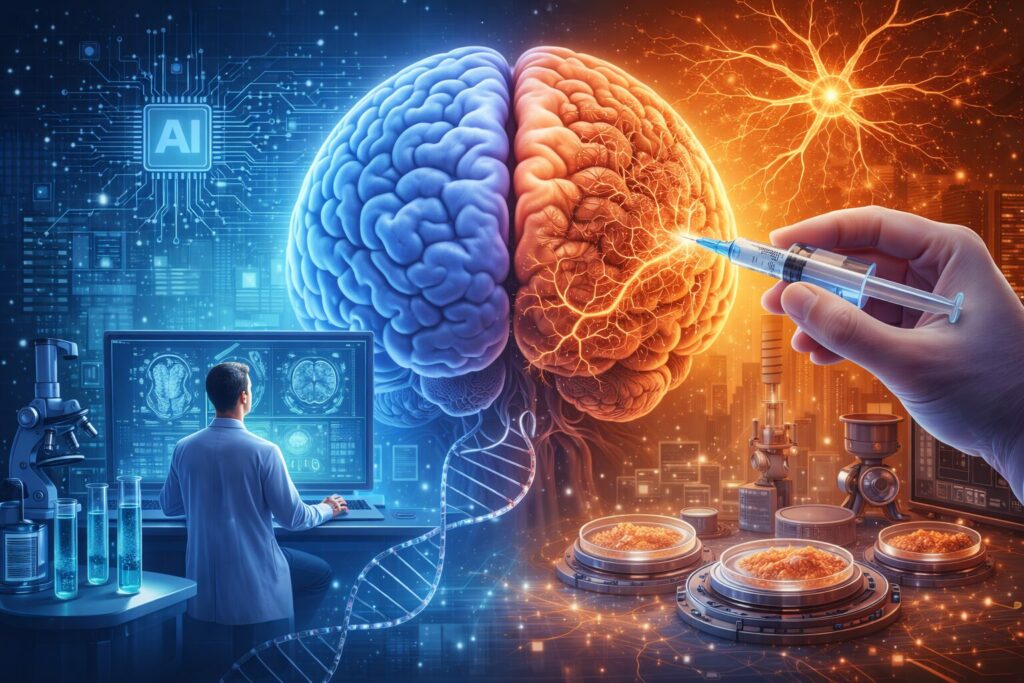
For people living with Parkinson’s disease, few questions are more powerful than this one: Can damaged neurons be restored? Headlines about artificial intelligence (AI), stem cells, and gene therapy often suggest that reversal may be close. The language is hopeful, but it is also frequently imprecise.
In Parkinson’s disease, the core biological problem is the progressive loss of dopamine-producing neurons in the brain. Once those neurons die, they do not naturally regenerate. This biological reality makes claims of “reversal” especially sensitive — and especially easy to misunderstand.
This article takes a careful, Parkinson’s-specific look at what current research actually shows. It separates what AI is helping science do faster from what biology can realistically achieve today.
What this article covers
This article explains what neuron damage means specifically in Parkinson’s disease, what “reversal” would require at a biological level, and where AI genuinely contributes to Parkinson’s research. It reviews recent Parkinson’s-focused studies and clarifies what patients can reasonably expect — and what remains beyond current science.
What neuron damage means in Parkinson’s disease
Parkinson’s disease is defined by the gradual loss of dopaminergic neurons in the substantia nigra, a region of the brain essential for smooth and coordinated movement. By the time symptoms such as tremor or slowness appear, a significant proportion of these neurons have already been lost.
Importantly, not all Parkinson’s-related dysfunction comes from dead neurons. Some neurons remain alive but function poorly due to disrupted signaling, protein accumulation (such as alpha-synuclein), or metabolic stress. These surviving neurons may still respond to treatment. The brain also adapts. Neural circuits compensate for loss through plasticity, which explains why symptoms can improve with medication or stimulation even as neuron loss continues.
This distinction — neuron death versus dysfunction — is central to understanding what “reversal” could mean.
What “reversing neuron damage” would mean in Parkinson’s
True reversal in Parkinson’s disease would require more than symptom improvement. It would mean replacing lost dopaminergic neurons, integrating them correctly into existing brain circuits, and restoring dopamine release with normal timing and regulation.
This is extraordinarily difficult. Neurons must survive, connect precisely, and function in a complex, aging brain environment that originally contributed to their loss. Even small errors can lead to abnormal signaling or side effects.
Media coverage often conflates three very different outcomes: slowing further neuron loss, improving function in damaged circuits, and replacing neurons entirely. Only the last of these represents true reversal — and it remains the hardest goal in neuroscience.
Where AI fits in Parkinson’s biology — and where it does not
AI does not regenerate neurons. It does not repair damaged brain tissue or restore dopamine production on its own. AI is not a treatment.
Where AI excels is in accelerating Parkinson’s research. AI models analyze vast datasets to identify molecular targets, predict drug–protein interactions, optimize gene therapy vectors, and interpret complex imaging and biomarker data. These capabilities help researchers decide what to test next — faster and more efficiently.
In short, AI amplifies scientific discovery. The biological intervention — a drug, gene therapy, or cell therapy — still has to do the work inside the brain.
Three Parkinson’s pathways are often mistaken for “reversal”
In Parkinson’s research, progress is often described using language that sounds like reversal but reflects different biological goals.
- Neuroprotection: slowing or stopping further loss of dopaminergic neurons
- Neurorestoration: improving function in damaged but surviving neural circuits
- Neuron replacement: introducing new dopamine-producing cells
Neuroprotection has the strongest human evidence so far, though no therapy has conclusively stopped progression. Neurorestoration — improving circuit function — is already part of clinical care through medication and deep-brain stimulation. Neuron replacement is biologically plausible and actively studied, but still experimental.
Clear language matters. Confusing these pathways can create false expectations for patients.ate Parkinson’s disease, progression, or treatment response on its own.
What the latest research shows
To understand whether AI could reverse neuron damage in Parkinson’s disease, it is essential to separate what AI contributes from what the underlying therapies achieve biologically. Recent Parkinson’s-focused research does not show neuron regeneration driven by AI. Instead, it shows how AI accelerates discovery, improves prediction, and supports therapies that aim to protect neurons or restore function in surviving circuits.
The studies below represent the strongest and most precise evidence currently available.
Study 1: AI accelerates Parkinson’s drug discovery, not neuron repair
Journal: Neurotherapeutics (2023)
Paper: Artificial intelligence in drug discovery for neurological diseases
Link: https://www.sciencedirect.com/science/article/pii/S1878747925001023
This high-impact review examines how AI is used in drug discovery across neurological diseases, including Parkinson’s disease. AI methods are shown to improve target identification, molecular screening, and optimization of compounds related to alpha-synuclein aggregation, mitochondrial dysfunction, and neuroinflammation. Importantly, the authors are explicit that AI does not alter disease biology directly. Its role is to make the discovery process faster and more efficient, particularly for neuroprotective strategies. The review does not report or imply neuron regeneration or reversal of dopaminergic neuron loss in humans.
Study 2: Machine learning predicts Parkinson’s disease progression using DAT-SPECT and MRI
Journal: Journal of Nuclear Medicine (2024, Supplement)
Paper: Machine learning model for prediction of Parkinson’s disease progression using multimodal imaging
Link: https://jnm.snmjournals.org/content/65/supplement_2/242322
This study developed a machine-learning model to predict motor progression in Parkinson’s disease using baseline dopamine transporter SPECT (DAT-SPECT), MRI, and clinical data. Researchers used data from the Parkinson’s Progression Markers Initiative (PPMI), an international, multi-center observational cohort, and classified patients into slow- and fast-progression groups based on longitudinal MDS-UPDRS motor scores. Radiomic features were extracted from key regions of the nigrostriatal system, including the caudate, putamen, ventral striatum, and midbrain, and multiple machine-learning algorithms were trained and validated.
Study 3: What AI can and cannot do in Parkinson’s disease — clarified by 2025 evidence
Journal: npj Parkinson’s Disease (2025)
Paper: Machine learning for Parkinson’s disease: a comprehensive review of datasets, algorithms, and challenges
Link: https://www.nature.com/articles/s41531-025-01025-9
This comprehensive 2025 review examined how machine learning has been applied across Parkinson’s disease research, including diagnosis support, symptom assessment, progression modeling, and treatment-response prediction. The authors systematically reviewed available datasets, algorithmic approaches, and validation strategies, highlighting where AI performs well and where it consistently falls short. A central finding of the review is that most machine-learning models in Parkinson’s disease focus on interpreting clinical, imaging, or sensor data, rather than modifying disease biology.
Importantly, the paper explicitly addresses common sources of overinterpretation, including small datasets, inconsistent outcome definitions, and limited external validation. The authors emphasize that while AI can improve research efficiency and clinical insight, it does not constitute a therapeutic intervention and does not provide evidence for reversing dopaminergic neuron loss. In the context of this article, the review serves as a critical guardrail against inflated claims, reinforcing that AI’s current role in Parkinson’s disease is analytical and supportive — not regenerative.
The final ensemble model, combining clinical information with DAT-SPECT and MRI features, achieved strong predictive performance, with an area under the curve (AUC) of up to 0.90 in internal testing and maintained performance in an external validation cohort. Importantly, this study demonstrates AI’s ability to predict disease trajectory at baseline, which has clear implications for patient stratification, trial design, and earlier intervention planning. However, the model does not claim to alter disease biology or reverse neuron loss. Its contribution lies in forecasting progression, not repairing dopaminergic neurons.
Study 4: Gene-based strategies support dopaminergic function but do not reverse neuron loss
Journal: Parkinsonism & Related Disorders (2025)
Paper: Gene therapy approaches for Parkinson’s disease: current status and future directions
Link: https://www.sciencedirect.com/science/article/pii/S1525001625002047
This 2025 review examines the current landscape of gene therapy approaches for Parkinson’s disease, including therapies targeting dopamine synthesis, neurotrophic support, and modulation of disease-related pathways. The paper reviews human and late-stage clinical studies involving strategies such as AADC gene delivery, GDNF-related approaches, and viral vector–mediated interventions aimed at improving dopaminergic circuit function. Across these approaches, the central goal is to enhance or stabilize function in surviving neurons, not to regenerate neurons that have already been lost.
Importantly, the authors clearly distinguish between functional improvement and biological reversal. While several gene therapy strategies have demonstrated improvements in motor symptoms, reduced medication requirements, or biochemical markers of dopamine activity, none have shown evidence of restoring the original substantia nigra neuron population. The review emphasizes that gene therapy in Parkinson’s disease should be understood as a means of supporting existing neural circuitry and potentially slowing further decline, rather than reversing established neurodegeneration.
Study 5: Advanced computational models improve Parkinson’s data interpretation — not neuron repair
Journal: Scientific Reports (2025)
Paper: Decoding dynamic brain networks in Parkinson’s disease with temporal attention
Link: https://www.nature.com/articles/s41598-025-01106-y
This study applied advanced computational and machine-learning techniques to analyze Parkinson’s disease–related data, focusing on improving classification, pattern recognition, or disease modeling accuracy. The work demonstrates how modern AI approaches can extract more structured information from complex datasets, potentially supporting research efficiency and hypothesis generation. However, the study is explicitly analytical in nature and does not involve biological intervention, treatment, or clinical outcome modification.
In the context of Parkinson’s disease, the paper reinforces an important boundary: even highly sophisticated AI models operate at the level of data interpretation, not biological repair. While such models may help researchers understand disease heterogeneity or progression patterns more clearly, they do not alter neuron survival, regeneration, or function directly. Including this study helps clarify why AI should be understood as a research and decision-support tool — not a mechanism for reversing neuron damage.
What AI cannot currently do in Parkinson’s disease
AI cannot regenerate lost dopaminergic neurons in humans. There is no validated biomarker that proves neuron replacement in living patients, and no AI system can overcome these biological constraints.
AI also cannot eliminate safety risks associated with regenerative therapies, such as immune reactions, abnormal growth, or off-target effects. These risks must be addressed through long-term clinical trials.
These limitations are not technical failures. They reflect the fundamental complexity of human neurobiology.
What improvement can look like without reversal
Many Parkinson’s treatments improve quality of life without reversing neuron loss. Medications restore dopamine signaling temporarily. Deep brain stimulation modulates circuit activity. Rehabilitation strengthens compensatory pathways.
AI-supported monitoring may further optimize these interventions by identifying patterns and adjusting care earlier. Patients may function better, longer — even as neuron loss continues.
Understanding this distinction helps align hope with reality.
Where Parkinson’s treatment is realistically heading
Over the next three to five years, AI is expected to accelerate target discovery, trial design, and patient stratification in Parkinson’s research. This may lead to faster identification of effective therapies — and quicker abandonment of ineffective ones.
Cell and gene therapies will continue to evolve, focusing on safety, durability, and functional benefit rather than claims of reversal. Progress will be incremental, not sudden.
The future of Parkinson’s care is hybrid: better biology supported by better data.
What this means for patients today
No AI-based therapy can currently reverse neuron damage in Parkinson’s disease. AI is helping researchers move faster and design smarter studies. Real progress today focuses on slowing loss and improving function — not rebuilding the brain.
Precision matters more than promises
AI does not reverse neuron damage in Parkinson’s disease. What it does is help science identify realistic paths toward protecting neurons and restoring function where possible.
Progress is real, but it is careful and constrained by biology. The most important advance may be learning how to ask better questions — faster — without promising what science cannot yet deliver.
Disclaimer: The information shared here should not be taken as medical advice. The opinions presented here are not intended to treat any health conditions. For your specific medical problem, consult with your healthcare provider.
We’re building a simple Parkinson’s tracking app
Free during early access. Designed for daily symptom tracking without complexity.