
Neuroscientist • Parkinson’s Researcher
Last updated: August 2026
How to relieve muscle tightness and rigidity in Parkinson’s disease is a question many Parkinson’s patients ask after diagnosis. While there isn’t a single solution that works for everyone, research shows that simple daily habits can help reduce stiffness and improve mobility. In this article, you’ll discover five practical, evidence-based strategies you can start using today.

Living with muscle tightness and rigidity in Parkinson’s disease can make even simple daily activities feel more challenging. While there is no single solution that works for everyone, research shows that several practical strategies can help reduce stiffness, improve movement, and make everyday life more comfortable.
In this article, we’ll explore five evidence-based strategies that many people with Parkinson’s find helpful. Rather than quick fixes, these are approaches supported by clinical research and commonly recommended by Parkinson’s specialists around the world.
Disclaimer: The information shared here should not be taken as medical advice. The opinions presented here are not intended to treat any health conditions. For your specific medical problem, consult with your healthcare provider.
What does Parkinson’s rigidity feel like?
Parkinson’s rigidity occurs when muscles remain tense even when they should be relaxed. It does not usually mean that the muscles themselves are damaged; rather, changes in the brain’s movement-control signals make it harder for them to relax and contract smoothly.
People may describe rigidity as stiffness, tightness, heaviness or resistance to movement. It commonly affects the shoulders, neck, arms, back, hips and legs, and it may begin on one side of the body. Everyday activities such as dressing, turning in bed, standing from a chair and walking can consequently require more effort.
Rigidity may become more noticeable in the morning, during stress or fatigue, after remaining still, or when Parkinson’s medication is wearing off. Because other conditions can also cause stiffness and pain, new, sudden or unusual symptoms should be discussed with a healthcare professional.
Strategy 1: Keep moving — movement is one of the best ways to reduce rigidity
When you stay in the same position for a long time, muscles naturally become tighter. In Parkinson’s disease, this effect is often much more noticeable because the brain already has difficulty sending smooth movement signals to the muscles. Gentle movement helps reduce muscle tightness, improves joint flexibility, and often makes walking and other daily activities feel easier.
Many people notice that although taking the first few steps may feel difficult, stiffness gradually improves once they begin moving. This is one reason why regular movement throughout the day is so important.
Research highlight
International Parkinson’s guidelines consistently recommend regular exercise as a core part of Parkinson’s treatment. Research has shown that regular physical activity can improve mobility, reduce rigidity, maintain independence, and enhance overall quality of life. While exercise does not cure Parkinson’s disease, it remains one of the most effective non-drug strategies for managing symptoms.
Try this today
- Stand up every 30–60 minutes if you’ve been sitting for a while.
- Take a 5–10 minute walk, even if it’s just around your home or garden.
- Before standing up, gently roll your shoulders and stretch your legs.
Small, frequent movements throughout the day are often more helpful than remaining inactive for long periods.

What doesn’t help?
❌ Sitting in the same chair for several hours.
❌ Waiting for stiffness to disappear on its own.
❌ Avoiding movement because you feel stiff.
Although it may seem easier to rest, prolonged inactivity often makes rigidity worse.
Quick summary
- Gentle movement helps loosen stiff muscles.
- Walking regularly may improve comfort and mobility.
- Try to avoid sitting still for long periods.
- Small movements throughout the day can make a meaningful difference.
Strategy 2: Stretch daily to maintain flexibility and reduce stiffness
In Parkinson’s disease, muscles tend to stay tighter than normal, making it harder to move joints through their full range of motion. Over time, this can contribute to reduced flexibility, poorer posture, discomfort, and difficulty performing everyday activities.
Gentle stretching helps lengthen tight muscles, improve flexibility, and maintain joint mobility. While stretching won’t eliminate rigidity, doing it regularly can make movements feel smoother and more comfortable.
Many people also find that stretching first thing in the morning or after a warm shower helps reduce stiffness at the start of the day.
Research highlight
Research has shown that regular stretching and flexibility exercises can improve range of motion, posture, and mobility in people with Parkinson’s disease, particularly when combined with aerobic exercise and strength training. Clinical guidelines also recommend flexibility exercises as part of a comprehensive Parkinson’s exercise program.
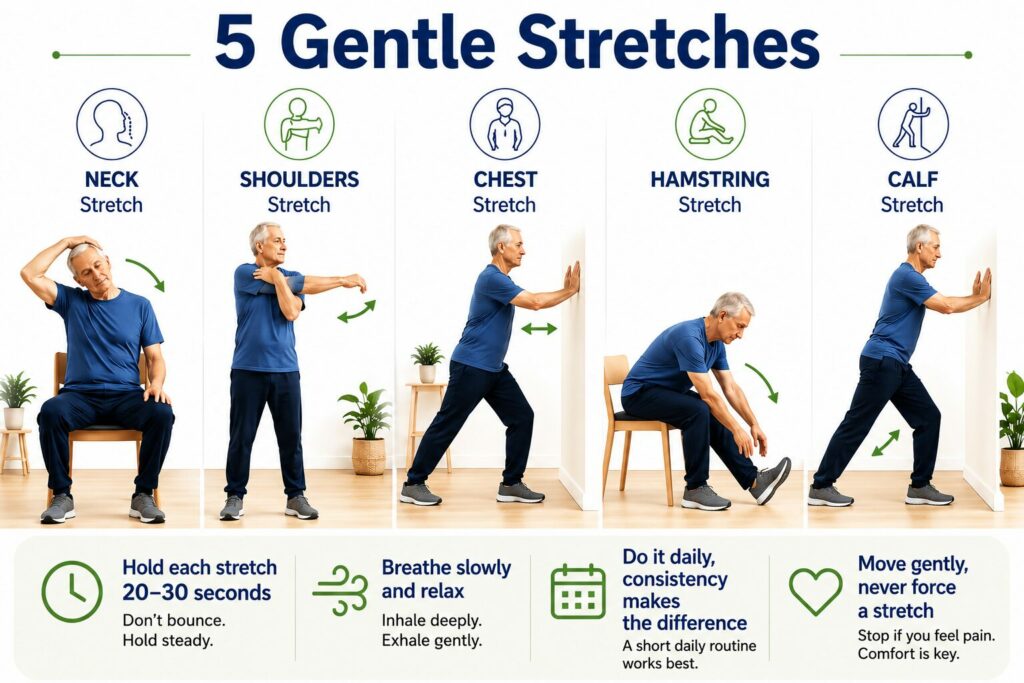
What to stretch
Focus on the muscles that commonly become tight in Parkinson’s disease:
- Neck – to improve turning and reduce stiffness.
- Shoulders and chest – to maintain arm movement and posture.
- Lower back – to improve comfort and standing posture.
- Hips – to make walking and getting out of chairs easier.
- Calves and hamstrings – to improve stride length and walking.
You don’t need an intense routine. Gentle, controlled stretches performed consistently are usually more beneficial than occasional long sessions.
Try this today
- Stretch for 5–10 minutes every morning.
- Hold each stretch for 20–30 seconds without bouncing.
- Breathe slowly and avoid forcing the movement.
- If possible, stretch after a warm shower or short walk when your muscles are more relaxed.
What doesn’t help?
❌ Stretching only once a week.
❌ Forcing painful stretches.
❌ Holding your breath while stretching.
❌ Skipping stretching because you feel stiff.
Gentle, regular stretching is far more effective than occasional intense sessions.
Quick summary
- Stretching helps maintain flexibility and joint mobility.
- Focus on the neck, shoulders, back, hips, and legs.
- A short daily routine is better than occasional long sessions.
- Stretching after movement or a warm shower may feel easier.
Practical Tip
If you feel especially stiff in the morning, try this simple sequence:
- Take a warm shower.
- Stretch for 5–10 minutes.
- Take a short walk around your home or outside.
Many people find this combination more effective than relying on medication alone to get moving comfortably.
Strategy 3: Get the most from your Parkinson’s medication
For many people with Parkinson’s disease, medication is the most effective way to reduce muscle rigidity. However, how you take your medication can be almost as important as which medication you take.
As Parkinson’s progresses, stiffness may begin returning before the next dose is due—a phenomenon known as wearing OFF. Missing doses, taking medication at inconsistent times, or not recognizing symptom patterns can all make rigidity feel worse.
Understanding when your stiffness improves and when it returns can help you and your neurologist make more informed treatment decisions.
Research highlight
Levodopa remains the gold-standard treatment for Parkinsonian rigidity. Research has consistently shown that it significantly improves stiffness, slowness of movement, and overall mobility. However, over time, many people experience motor fluctuations, where the benefit of each dose becomes shorter. Tracking these patterns is an important part of optimizing treatment.
Practical tips
- Take your medication at the same time each day whenever possible.
- Don’t wait until you feel very stiff before taking your next scheduled dose.
- Keep a simple record of when medication starts working and when symptoms return.
- If stiffness is becoming less predictable, discuss it with your neurologist rather than changing your medication on your own.
Try this today
For the next three days, write down:
- What time you take your medication.
- When you start feeling better.
- When stiffness begins to return.
You may notice a pattern you hadn’t recognized before.
What doesn’t help?
❌ Skipping doses because you feel well.
❌ Taking medication at very different times each day.
❌ Adjusting your dose without speaking to your doctor.
❌ Trying to remember symptom patterns from memory alone.
Quick summary
- Take medication consistently.
- Notice when stiffness improves and returns.
- Track your symptoms over several days.
- Share these patterns with your healthcare team.
Helpful tool
Track Your Medication and Symptoms in Less Than a Minute
Knowing when your medication starts working and when stiffness returns can help you better understand your symptoms and have more productive discussions with your neurologist.
The Parkinson’s Daily Diary app makes it easy to record medication, symptoms, and daily changes in under a minute.
Try the free Parkinson’s Daily Diary app here
Strategy 4: Reduce stress and improve sleep
Many people with Parkinson’s notice that their muscles feel tighter during stressful situations or after a poor night’s sleep. While stress and sleep problems do not cause Parkinson’s disease, they can temporarily make symptoms such as rigidity, slowness, and tremor feel more noticeable.
Stress causes muscles throughout the body to tense, while poor sleep can leave you feeling stiffer and less mobile the next morning. Learning simple ways to relax and improving your sleep routine may help you start the day feeling more comfortable.
Research highlight
Research has shown that psychological stress can temporarily worsen motor symptoms in Parkinson’s disease, including rigidity and bradykinesia. Studies have also found that poor sleep quality is associated with greater daytime motor impairment, reduced mobility, and lower quality of life.
Although stress management and good sleep cannot replace medication, they can complement medical treatment and improve day-to-day symptom control.
Practical tips
- Keep a regular bedtime and wake-up time.
- Try a warm shower or bath before bed to relax tight muscles.
- Practice deep breathing or gentle mindfulness for 5–10 minutes each day.
- Limit caffeine and large meals close to bedtime if they interfere with your sleep.
Try this tonight
Before going to bed:
- Take a warm shower or bath.
- Spend five minutes doing slow, deep breathing.
- Avoid screens for the last 30–60 minutes before sleep.
Many people find that these simple habits help them wake up feeling less stiff.
What doesn’t help?
❌ Staying awake late every night.
❌ Ignoring stress because “it’s just part of Parkinson’s.”
❌ Spending long periods in bed during the day if it disrupts nighttime sleep.
❌ Using your phone or tablet right before trying to sleep.
Quick summary
- Stress can temporarily increase muscle rigidity.
- Better sleep often leads to easier movement the next morning.
- Relaxation techniques can complement medication.
- Small bedtime habits can make a meaningful difference over time.
Reality check
There will still be days when stress or poor sleep make your symptoms feel worse—and that’s okay. The goal isn’t perfect days; it’s building habits that help you recover more quickly and feel your best more often.
Strategy 5: Know when it’s time to ask for more help
Although daily habits such as movement, stretching, good sleep, and taking medication on time can make a meaningful difference, muscle rigidity sometimes becomes more difficult to control as Parkinson’s disease progresses.
If stiffness continues to interfere with your daily activities, it doesn’t necessarily mean you have to simply live with it. Many people benefit from adjustments to their treatment plan or additional support from healthcare professionals.
The important thing is not to wait until stiffness becomes overwhelming before asking for help.
Research highlight
Research consistently shows that multidisciplinary care — including neurologists, Parkinson’s nurses, physiotherapists, and occupational therapists—can improve mobility, daily function, and quality of life compared with relying on medication alone.
Regular review of symptoms also allows treatment to be adjusted as Parkinson’s changes over time.
When should you ask for more help?
Speak with your healthcare team if:
- Stiffness is getting worse.
- Your medication no longer lasts as long.
- Pain is affecting your daily activities.
- Walking or balance is becoming more difficult.
- You have experienced a fall or near fall.
Remember, these changes don’t mean you have failed—they simply mean your treatment plan may need to be updated.
Try this before your next appointment
Instead of simply saying,
“I’m getting stiffer,”
- try bringing specific information:
- When stiffness is worst.
- When you take your medication.
- Which daily activities are becoming harder.
- What seems to help.
This gives your healthcare team a much clearer picture and can lead to more effective treatment decisions.
What doesn’t help?
❌ Assuming nothing can be done.
❌ Waiting months before mentioning new symptoms.
❌ Changing medication on your own.
❌ Ignoring falls or increasing pain.
Quick summary
- Parkinson’s symptoms change over time.
- Treatment plans sometimes need adjusting.
- The more information you can provide, the better your healthcare team can help.
- Asking for help early may prevent symptoms from becoming more disruptive.
Reality check
Parkinson’s disease changes over time, and your treatment should change with it. Asking for help isn’t a sign that you’re getting worse—it’s part of managing Parkinson’s well.
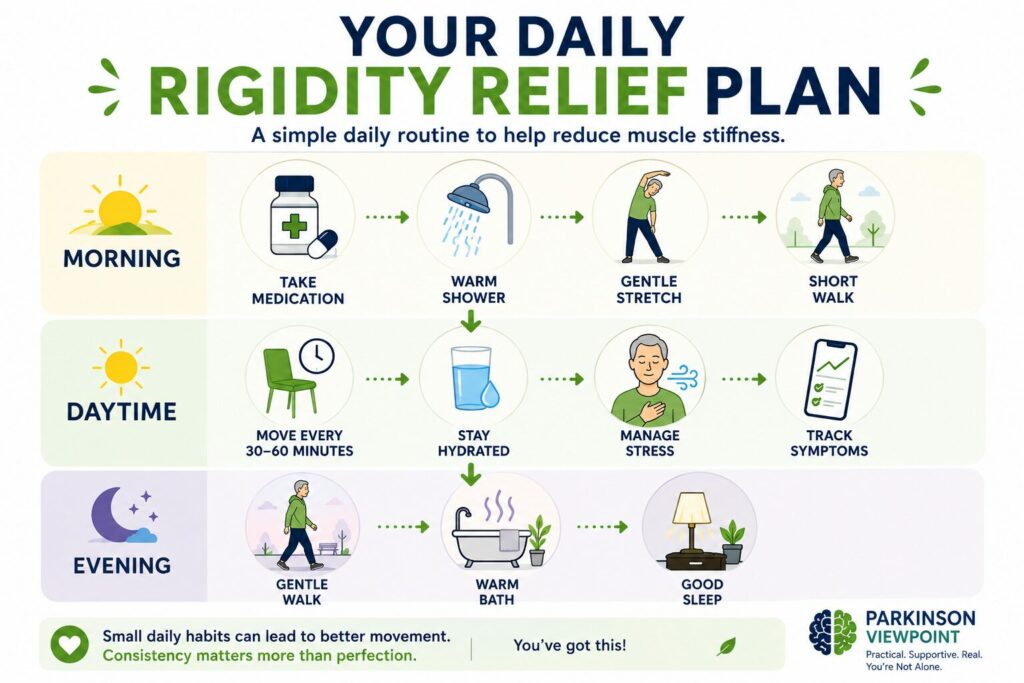
Your daily action plan for reducing muscle tightness and rigidity
Living with Parkinson’s disease can be unpredictable, and no single strategy works for everyone. However, building a few simple habits into your daily routine can help reduce stiffness, improve movement, and make everyday activities feel more manageable.
Here’s a simple action plan to get started.
Morning
- Take your medication as prescribed.
- Take a warm shower if morning stiffness is a problem.
- Spend 5–10 minutes doing gentle stretches.
- Take a short walk to help loosen tight muscles.
During the day
- Avoid sitting for long periods. Stand up and move every 30–60 minutes.
- Stay hydrated throughout the day.
- Take a few minutes to relax or practice deep breathing if you feel stressed.
- Keep track of your medication and symptoms to identify patterns.
Evening
- Take a gentle walk or stretch if your body feels stiff.
- Use a warm shower or bath to relax tight muscles before bed.
- Keep a regular bedtime to support better sleep.
Quick reminder
You don’t have to do everything perfectly.
Small, consistent habits often make a bigger difference than occasional big efforts.
If your stiffness is getting worse or beginning to interfere with your daily life, speak with your healthcare team. Parkinson’s treatment can often be adjusted, and you don’t have to manage these changes alone.
Final thoughts
Muscle tightness and rigidity are a common part of Parkinson’s disease, but they do not have to define your day. By combining regular movement, stretching, good medication habits, better sleep, and timely support from your healthcare team, many people find they can move more comfortably and stay active for longer.
Remember, progress doesn’t come from one perfect day—it comes from the small choices you make every day. Even a short walk, a few minutes of stretching, or taking your medication on time can add up to meaningful improvements over time.
Get Your Free Parkinson’s Medication Management Diary
Download your free printable diary to easily track your medications, symptoms, and doses.