
Freezing of gait is one of the most distressing and disabling symptoms of Parkinson’s disease. For many people, freezing of gait in Parkinson’s disease interferes with walking, turning, navigating doorways, and moving confidently in public — often in ways that medication alone does not fully control.
By 2026, freezing of gait is no longer viewed as an untreatable complication. Research now shows that targeted strategies, cues, and movement techniques can reduce freezing episodes, improve walking safety, and restore confidence in daily life. This article explores new solutions for freezing of gait in Parkinson’s disease, backed by current research and clinical practice.
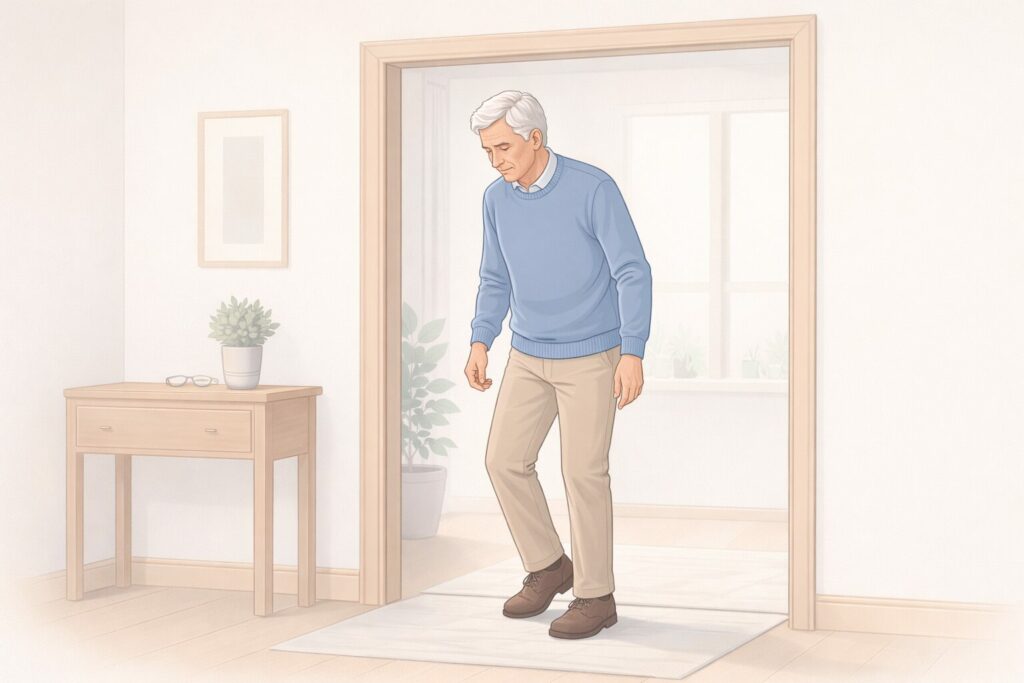
Freezing of gait is not a problem of weak legs. Most people who experience freezing are physically capable of walking — until suddenly, they are not. This apparent contradiction is one of the reasons freezing is so confusing and frustrating.
By 2026, freezing of gait is understood as a failure of automatic movement control. In Parkinson’s disease, walking normally relies on automatic brain circuits that allow movement to flow without conscious effort. When these circuits are disrupted, the brain struggles to smoothly initiate or continue stepping, especially in complex or demanding situations.
What this article covers
This article explains freezing of gait in Parkinson’s disease in practical, real-world terms, with a focus on solutions supported by current research rather than theory alone.
You’ll learn:
- Why freezing of gait happens and why it can appear suddenly
- What recent studies (2024–2025) reveal about cueing, attention, and movement strategies
- Which approaches are shown to help — and which commonly recommended ones do not
- How to apply research-backed strategies to daily situations like turning, doorways, crowds, and stress
- How to build simple routines that reduce freezing risk and improve walking confidence
Rather than promising a cure, this article focuses on understanding, preparation, and control — helping people with Parkinson’s disease manage freezing of gait more safely and confidently in everyday life.
What causes freezing of gait
Research shows that freezing occurs when multiple systems become overloaded at the same time. Key contributing factors include:
- Impaired communication within the basal ganglia, which normally help regulate smooth, automatic movement
- Reduced ability to internally generate rhythm and step timing
- Increased reliance on conscious control for tasks that should be automatic
When these systems are stressed — for example, during turning, approaching a doorway, or walking in a crowded space — the brain may briefly “stall,” resulting in freezing.
Importantly, this means freezing is not a sign of laziness, fear, or poor effort. It is a neurological response to overload.
Why freezing happens suddenly
One of the most unsettling aspects of freezing of gait is its unpredictability. People often walk normally for minutes, then freeze abruptly.
This happens because freezing is often triggered by:
- Sudden changes in movement demands (turning, stopping, starting)
- Narrow or visually complex environments
- Divided attention (talking while walking, carrying items)
- Emotional pressure, stress, or feeling rushed
Medication timing also plays a role. Freezing can occur during medication “OFF” periods, but many people also experience ON-state freezing, where dopamine levels are adequate but movement control still breaks down.
By 2026, clinicians recognize that freezing reflects a mismatch between intention and execution, rather than simply low dopamine.
Why strength alone does not fix freezing
A critical insight from recent research is that freezing of gait does not improve reliably with strength training alone. While strength and fitness are important for overall health, freezing is primarily a coordination and strategy problem, not a power problem.
This explains why people with Parkinson’s may be able to:
- Step over an object when cued
- Walk better to music or a metronome
- Freeze less when focusing consciously on each step
These observations form the foundation for modern, research-backed solutions.
In the next section, we will look into what recent studies reveal about cueing, attention, and movement strategies for dealing with freezing of gait in Parkinson’s disease.
What the latest research shows
Several recent studies have examined how cueing, attention-based strategies, and technology-assisted interventions can help reduce freezing of gait in Parkinson’s disease. Rather than relying on continuous cues, this newer research focuses on on-demand and context-specific approaches, testing how targeted cues delivered at the moment of freezing affect gait initiation, step length, and overall freezing severity in real-world walking situations.
1. On-demand cueing for freezing of gait (DeFOG trial)
Journal: Movement Disorders (2024)
Study Title: On-Demand Cueing for Freezing of Gait in Parkinson’s Disease: A Randomized Controlled Trial
🔗 https://pubmed.ncbi.nlm.nih.gov/38486430/
One of the most practical recent trials is the DeFOG on-demand cueing randomized controlled trial (Movement Disorders, 2024). In this study, 63 people with Parkinson’s disease and daily FOG were randomized to a device that provided personalized auditory cues triggered when freezing was detected, versus an active control that used the same device for step-count feedback only. The key outcome was video-rated FOG severity during a home-based, freezing-provoking walking protocol.
The results were very clinically relevant: DeFOG reduced FOG when worn (both OFF and ON medication), but 4 weeks of daily-life use did not “train away” freezing when participants did the protocol without the system. In plain terms: cueing can be strongly effective, but it behaves like a walking aid — it helps during use, not necessarily after you take it off.
2. Augmented reality cueing reduces freezing of gait
Journal: Clinical Parkinsonism and related disorders (2025)
Study Title: Effects of Augmented Reality Cueing Strategies on Freezing of Gait in Parkinson’s Disease
🔗 https://pubmed.ncbi.nlm.nih.gov/40417228/
A 2025 study on augmented reality (AR) cueing reported reductions in FOG incidence and duration, suggesting AR cues may help some people reduce freezing during challenging gait situations. Importantly, the paper notes that response likely depends on individual factors such as cue preference and personal gait patterns, reinforcing the 2026 shift toward personalized cueing rather than one-size-fits-all approaches.
What this means for your blog: the “new solution” isn’t just cueing—it’s on-demand + personalized cueing, delivered only when needed, in a format the individual responds to.
3. Cueing interventions improve gait and balance (meta-analysis)
Journal: Applied Sciences (2024)
Study Title: Cueing Interventions for Gait and Balance in Parkinson’s Disease
🔗 https://www.mdpi.com/2076-3417/14/24/11781
The review, published in Applied Sciences, examined the effectiveness of cueing interventions—using external auditory, visual, or somatosensory cues—on gait, balance, and quality of life in people with Parkinson’s disease. The authors analyzed six studies, assessing methodological quality and risk of bias. Across the studies, cueing interventions consistently improved gait performance, particularly step length, with most studies reporting significant gains. Results for walking speed were mixed, with some studies showing improvement and others finding no significant change.
Balance outcomes were more favorable for dynamic balance than static balance, suggesting cueing is especially helpful during movement rather than quiet standing. Two studies reported lasting benefits at follow-up when interventions were structured and supervised. Evidence for improvements in quality of life was limited, as only one study assessed this outcome and found no significant effect.
Overall, the review concludes that cueing—especially auditory cueing—can enhance gait and dynamic balance in Parkinson’s disease, while highlighting the need for further research on long-term effects and quality-of-life outcomes.
4. Neural network abnormalities linked to freezing of gait
Journal: Frontiers in Neuroscience (2025)
Study Title: Gait Dynamics and Brain Function Abnormalities in Parkinson’s Disease with Freezing of Gait: A Resting-State fMRI Study
🔗https://www.frontiersin.org/journals/neuroscience/articles/10.3389/fnins.2025.1560333/full
Using resting-state functional MRI and wearable sensors, this 2025 study mapped brain networks associated with freezing episodes. It revealed that people with Parkinson’s-related FOG show distinct brain activity patterns, especially in areas involved in motor planning and coordination. These insights help explain why freezing doesn’t respond well to strength training alone and supports the idea that interventions should target neural coordination, attention, and sensory processing rather than just muscle power.
5. Experimental VR and neural sensing in FOG
Journal: Sensors (2025)
Study Title: An Experimental Approach for Investigating Freezing of Gait Using Virtual Reality and Neural Sensing
🔗 https://www.mdpi.com/1424-8220/25/13/4036
This pilot study combined virtual reality environments and neural sensing technology to provoke and analyze freezing in controlled settings. Results highlighted how contextual and sensory factors influence gait and freezing episodes, and how VR setups can help researchers study FOG mechanisms in laboratory conditions that resemble real life. Findings support the idea that interventions must consider environment and perception, not only motor commands.
This supports why 2026 solutions focus on “in-the-moment support” rather than promising a full fix: detection + cueing is improving, but real-life deployment is still the frontier.
In the next section, we will explore new movement-based solutions backed by research, focusing on how cueing, conscious movement strategies, and weight-shifting techniques can help reduce freezing of gait in Parkinson’s disease.
Get Your Free Parkinson’s Medication Management Diary
Download your free printable diary to easily track your medications, symptoms, and doses.
New movement-based solutions backed by research
1. Cueing strategies: using the environment to restart movement
One of the strongest research-supported approaches to freezing of gait is external cueing. Studies such as the DeFOG randomized controlled trial show that cues help precisely because they bypass impaired automatic walking circuits and shift control to more intact conscious pathways.
Cueing works best when it is:
- External (something you see or hear, not something you “will” yourself to do)
- Simple and rhythmic
- Used at the moment freezing begins, not after panic sets in
Common cue types include visual cues (lines on the floor), auditory cues (metronomes, rhythmic sounds), and tactile cues. Research also shows that cue effectiveness varies between individuals, which is why personalization matters. A cue that helps one person may distract another.
Key takeaway from research:
Cueing reduces freezing during use. It functions like a walking aid — powerful when applied, not a permanent fix when removed.
2. Attention-based strategies: turning walking back into a conscious task
Multiple studies now confirm that freezing of gait is strongly linked to attentional overload. When attention is divided — navigating space, turning, thinking, or talking — freezing becomes more likely.
Attention-based strategies work by deliberately slowing down and refocusing the brain before movement.
Examples include:
- Mentally preparing a step before moving
- Counting steps aloud or silently
- Thinking “shift weight, then step” rather than “just walk”
Research shows that these strategies are especially effective during:
- Turning
- Doorway approaches
- Starting to walk from standing
This explains a common experience reported by patients: freezing often resolves when they stop, reset, and intentionally restart movement.
Key takeaway from research:
Freezing improves when walking becomes deliberate instead of automatic.
3. Weight-shifting and pre-step training
Recent biomechanical and neuroimaging studies show that freezing often occurs before the step, not during it. The brain fails to generate a clean weight shift, which prevents the foot from lifting.
Training the pre-step phase helps address this exact failure point.
Effective strategies include:
- Gentle side-to-side weight shifting before stepping
- Rocking slightly forward and backward to “unlock” movement
- Pausing to feel both feet grounded before initiating a step
These techniques reduce the pressure to move quickly and give the nervous system time to organize the step.
Key takeaway from research:
Preparing the body for movement is often more important than the step itself.
4. Turning and narrow-space strategies
Turning is one of the strongest freezing triggers identified in both laboratory and real-world studies. The combination of balance demands, directional change, and spatial judgment overwhelms automatic gait control.
Research-backed turning strategies include:
- Breaking turns into smaller segments instead of pivoting
- Using wide, arc-shaped turns rather than tight rotations
- Pausing briefly before turning to reset posture and attention
Similarly, when approaching doorways or narrow spaces, slowing down and consciously preparing the first step reduces freezing risk.
Key takeaway from research:
Freezing decreases when complex movements are simplified and segmented.
5. Technology-assisted strategies
Newer technologies — including wearable sensors, smartphone apps, and cue-triggering devices — are based on solid research foundations. Studies show they can:
- Detect freezing patterns
- Deliver cues at the right moment
- Improve walking while in use
However, research also clearly shows that technology is a tool, not a cure. Some devices help some people and not others. In certain cases, poorly matched cues may even worsen gait.
Key takeaway from research:
Technology works best when it supports known strategies like cueing and attention, not when it replaces them.
In the next section, we will look at what does not work for freezing of gait — and why, highlighting common approaches that may seem logical but often fail to address the underlying mechanisms of freezing in Parkinson’s disease.
Related article: Walking Changes in Parkinson’s Disease: Why They Happen
What does not work for freezing of gait — and why
One of the most important advances in understanding freezing of gait in Parkinson’s disease is recognizing that some well-intended approaches are simply not effective, and in some cases may even increase fall risk.
Knowing what doesn’t work is just as important as knowing what does.
1. Trying to “push through” the freeze
A very common response to freezing is to try harder — forcing the legs to move, leaning forward, or rushing to break through the block. Research and clinical experience show that this often makes freezing worse.
When someone pushes through a freeze:
- Balance is compromised
- Posture deteriorates
- The nervous system becomes more overloaded
This increases the risk of falls and reinforces fear, which itself is a strong freezing trigger.
Why it doesn’t work:
Freezing is a coordination and planning problem, not a strength problem. Forcing movement adds pressure to already overloaded neural circuits.
2. Strength training alone
Strength training is valuable for overall health in Parkinson’s disease, but studies consistently show that strength alone does not reliably reduce freezing of gait.
People with freezing often have sufficient leg strength to:
- Stand from a chair
- Step over obstacles when cued
- Walk normally under certain conditions
Yet freezing still occurs.
Why it doesn’t work:
Freezing happens before muscle activation — at the level of movement planning and initiation. Strength does not address this failure point.
3. Generic exercise programs without strategy
Many general Parkinson’s exercise programs focus on fitness, repetition, or endurance. While beneficial for cardiovascular health and mobility, these programs may not reduce freezing if they lack cueing, attention, and preparatory components.
Research shows that freezing is context-specific. Practicing walking in open, predictable spaces does not automatically translate to better performance in:
- Doorways
- Turns
- Crowded environments
Why it doesn’t work:
Freezing requires task-specific strategy training, not just repetition of normal walking.
4. Relying on medication adjustments alone
Medication timing and optimization are essential, but freezing often persists even when dopamine levels are adequate. Many people experience ON-state freezing, which does not respond well to medication changes.
Why it doesn’t work:
Freezing involves non-dopaminergic networks, including attention, executive function, and sensory processing. Medication cannot fully address these systems.
5. One-size-fits-all technology
Laser shoes, metronomes, and wearable devices are often marketed as universal solutions. However, research shows mixed results, with some devices helping certain individuals while offering no benefit — or even worsening gait — in others.
Why it doesn’t work:
Cue effectiveness depends on personal gait patterns, cognitive load, and environmental context. Technology must be matched to the individual, not applied universally.
Freezing of gait does not improve by force, speed, or repetition alone.
It improves when movement becomes simpler, slower, and more intentional.
Understanding these limitations helps people with Parkinson’s disease avoid blame, frustration, and unsafe advice — and prepares them for the final sections, which focus on daily strategies and practical application.
In the next section, we will outline a sample daily freezing-of-gait strategy plan, showing how movement strategies can be applied at different times of day to reduce freezing and improve confidence in everyday situations.
Sample daily freezing-of-gait strategy plan
Managing freezing of gait works best when strategies are built into daily routines, rather than saved only for moments of crisis. Research shows that preparation, consistency, and context-specific practice reduce freezing more effectively than reacting once a freeze has already occurred.
This sample plan illustrates how freezing strategies can be integrated throughout a typical day.
1. Morning: setting the tone for movement
Mornings are often a high-risk time for freezing due to stiffness, medication transitions, and time pressure.
Start with:
- A brief pause before walking, focusing on posture and balance
- One or two deliberate weight shifts before the first step
- A conscious cue such as counting or mentally stepping
Taking an extra 10–20 seconds to prepare movement in the morning can reduce freezing throughout the day by lowering early nervous system overload.
2. Walking indoors: doorways and turns
Doorways, narrow hallways, and tight turns are among the most common freezing triggers.
Helpful strategies include:
- Slowing down before reaching the doorway
- Pausing briefly to reset posture and attention
- Using segmented or arc turns instead of pivoting
Rather than trying to “walk normally,” research supports walking strategically in these high-risk zones.
3. Walking outdoors: streets and public spaces
Outdoor walking adds visual complexity, noise, and unpredictable movement — all of which increase cognitive load.
Before stepping off:
- Pause and prepare the first step
- Use an external cue if helpful (rhythm, counting, visual target)
- Avoid multitasking during the first few steps
If freezing occurs, stopping fully, resetting attention, and restarting deliberately is safer than pushing forward.
4. During the day: managing fatigue and stress
Freezing becomes more likely when the brain is tired or overstimulated.
Throughout the day:
- Take short movement breaks rather than pushing through fatigue
- Reduce dual-tasking when walking (e.g., talking, carrying items)
- Use calm breathing if stress or frustration rises
Research consistently shows that emotional and cognitive load directly influence freezing frequency.
5. High-risk situations: crowds, rushing, and pressure
Freezing often worsens when people feel watched, rushed, or pressured.
In these situations:
- Give yourself permission to slow down
- Use clear, simple cues rather than multiple strategies at once
- Step aside if needed to reset without embarrassment
Planning ahead for known triggers reduces fear and improves confidence.
6. Evening: reflect and reinforce
At the end of the day, briefly reflecting on what worked can reinforce learning.
Consider:
- Which strategies helped most today
- Which situations triggered freezing
- Whether fatigue or stress played a role
This awareness supports personalization — a key theme in modern freezing-of-gait management.
Freezing of gait improves when strategies are practiced before freezing occurs, not only when it is already happening.
In the next section, we’ll translate all of this into what it means for patients today, focusing on reassurance, empowerment, and realistic expectations.
What this means for Parkinson’s patients today
Freezing of gait can feel frightening and unpredictable, but modern research offers an important message: freezing is not a personal failure, and it is not simply a sign that Parkinson’s disease is “getting worse.”
By 2026, freezing of gait is understood as a problem of how the brain organizes movement under pressure, not a lack of strength, effort, or motivation. This understanding alone can reduce fear and frustration — two factors that strongly worsen freezing.
The most effective approaches today do not focus on forcing movement. Instead, they emphasize:
- preparation before stepping
- slowing down rather than rushing
- using cues and attention deliberately
- adapting movement to the environment
Many Parkinson’s patients notice meaningful improvements when they stop trying to “walk normally” and start walking strategically.
It is also important to know that freezing often fluctuates. Good days and difficult days can occur even when medication and routines remain the same. This variability reflects how sensitive freezing is to stress, fatigue, and context — not a failure of treatment.
Perhaps most importantly, research supports that skills can be learned. Freezing may not disappear completely, but its frequency, severity, and impact on daily life can often be reduced with consistent strategy use.
Freezing of gait is a brain–movement mismatch, not a loss of ability.
With the right strategies, many patients regain confidence and control.
Disclaimer: The information shared here should not be taken as medical advice. The opinions presented here are not intended to treat any health conditions. For your specific medical problem, consult with your healthcare provider.
Track your Parkinson’s day in less than a minute
The Parkinson’s Daily Diary App lets you record symptoms, medications, and daily notes in under a minute.