
AI-based tremor detection apps are increasingly used by people who want to track shaking in their hands or arms, often with the hope of gaining clarity about neurological health. These tools can measure movement objectively using smartphone sensors and artificial intelligence, but their clinical value depends on how — and why — they are used. Understanding what these apps can and cannot do is essential before relying on their results.
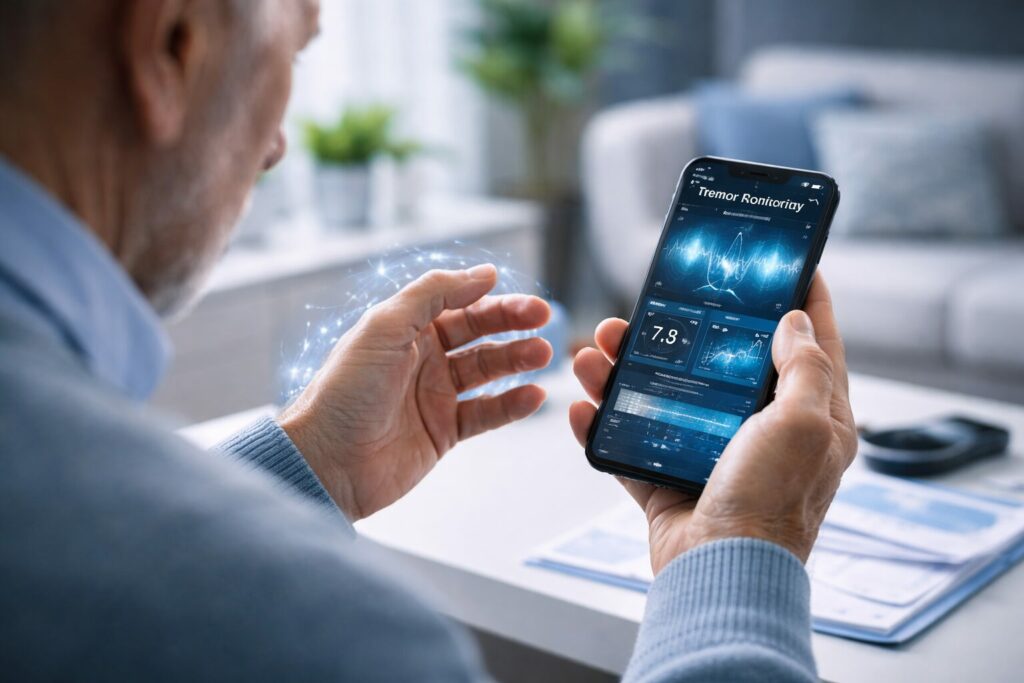
Over the past few years, smartphone apps that claim to detect or measure tremor have multiplied rapidly. Many promise objective tracking, early warning signs, or even hints about neurological conditions such as Parkinson’s disease. For patients, these tools are attractive: they are accessible, inexpensive, and available at any moment.
At the same time, tremor is one of the most visible and anxiety-provoking symptoms people notice. A shaking hand can trigger immediate concern, especially when paired with app-generated graphs or scores that appear precise and authoritative. This combination has pushed tremor detection apps into widespread, largely unsupervised use.
The key question is not whether these apps can measure movement — many can — but whether that measurement is clinically meaningful. Do AI-based tremor detection apps actually work in a way that helps patients and clinicians, or do they risk creating confusion and false reassurance?
What this article covers
This article explains what AI-based tremor detection apps are designed to do, how they work in the context of Parkinson’s disease, and what recent research shows about their accuracy and limitations. It also clarifies what these apps cannot do and how patients should interpret their results responsibly.
What tremor really means in Parkinson’s disease
Tremor is often associated with Parkinson’s disease, but it is only one possible symptom. Some people with Parkinson’s disease have prominent tremor, while others have little or none. In many cases, tremor appears intermittently or changes with stress, posture, or medication timing.
Clinically, Parkinson’s tremor is usually a rest tremor, meaning it occurs when the limb is relaxed and supported. This is different from action tremor, which occurs during movement, and postural tremor, which appears when holding a position. Many non-Parkinson’s conditions — including essential tremor, anxiety, medication effects, and aging — can cause action or postural tremor.
Because of this overlap, tremor alone is a weak diagnostic signal. Neurologists interpret tremor in the context of other findings such as rigidity, slowness of movement, asymmetry, and progression over time. Any tool that measures tremor without this context must be used carefully.
What AI-based tremor detection apps actually do
Most tremor detection apps rely on sensors already built into smartphones, primarily accelerometers and gyroscopes. Some apps also use touchscreen interaction tasks, asking users to hold the phone steady, trace shapes, or tap repeatedly. These raw signals are then processed by algorithms to estimate tremor frequency, amplitude, and variability.
AI or machine-learning models are used to recognize patterns in this sensor data. Over repeated measurements, the models can detect changes or trends that may not be obvious from a single test. In this sense, the apps provide quantitative movement data, not interpretations or diagnoses.
It is crucial to understand the boundary: these apps measure movement, not disease. Even when AI is involved, the output reflects how the phone moved in a specific situation, influenced by posture, grip, fatigue, and environment. Interpretation requires caution.
Where tremor apps perform well
AI-based tremor apps can be useful in certain, clearly defined ways when their limits are understood.
They perform best in:
- Objective quantification of tremor amplitude and frequency
- Repeated measurements over time
- Home-based monitoring outside the clinic
- Visualizing trends rather than single readings
Because smartphones are ubiquitous, these tools allow people to capture data during everyday life. This can reduce reliance on memory or subjective descriptions when discussing symptoms with clinicians. Over weeks or months, trends may emerge that are more informative than isolated clinic observations.
However, this usefulness depends on consistency and context. Without guidance, raw numbers can be misinterpreted or overvalued.
Where tremor apps fall short
Despite their appeal, tremor detection apps have significant limitations that are often undercommunicated.
Key limitations include:
- Poor specificity between tremor types
- Sensitivity to posture, grip, and phone position
- High variability between users and devices
- Difficulty distinguishing pathological tremor from normal movement
AI models trained in controlled settings often perform worse in real-world use. A slight change in how a phone is held can alter results dramatically. Environmental vibration, muscle fatigue, and anxiety can all influence readings.
Most importantly, tremor apps cannot determine the cause. A measured tremor signal does not indicate Parkinson’s disease, progression, or treatment response on its own.
Get Your Free Parkinson’s Medication Management Diary
Download your free printable diary to easily track your medications, symptoms, and doses.
What the latest research shows (2023–2025)
Over the last few years, research into AI-based tremor detection has shifted from experimental algorithms toward software-based tools that resemble real-world apps, often running on smartphones or smartwatches. Importantly, most of this work evaluates measurement reliability and monitoring, not diagnosis. The studies below clarify where tremor apps and app-like systems are useful — and where their limits are clear.
Study 1: Mobile apps can measure resting tremor — but validation is uneven
Journal: Journal of Clinical Medicine (2023)
Paper: Mobile Applications for Resting Tremor Assessment in Parkinson’s Disease: A Systematic Review
Link: https://pmc.ncbi.nlm.nih.gov/articles/PMC10057335/
This systematic review examined mobile applications designed to assess resting tremor in Parkinson’s disease. The authors identified research-grade smartphone apps that use accelerometers and gyroscopes to quantify tremor amplitude and frequency. While several apps demonstrated reasonable agreement with clinical tremor scales under controlled conditions, the review highlighted major variability in study quality, validation methods, and usability. Crucially, most apps were tested in small cohorts and research settings rather than real-world, unsupervised use. The authors concluded that mobile tremor apps show promise for measurement, but cannot yet be considered reliable clinical tools without further validation.
Study 2: Smartphone and smartwatch apps can capture tremor-related signals in early Parkinson’s
Journal: npj Parkinson’s Disease (2023)
Paper: Using a smartwatch and smartphone to assess early Parkinson’s disease in the WATCH-PD study
Link: https://pubmed.ncbi.nlm.nih.gov/37069193/
The WATCH-PD study evaluated a combined smartphone and smartwatch app system in individuals with early Parkinson’s disease. Participants completed structured motor tasks using a smartphone app while wearing a smartwatch that continuously collected movement data, including tremor-related features. The study demonstrated that digital tools could capture tremor characteristics and other motor signals consistently over time. However, tremor was only one component of a broader motor assessment, and the authors emphasized that the system was designed for research monitoring, not diagnosis. This study supports the idea that app-based systems can measure tremor as part of longitudinal tracking, but not as a standalone clinical decision tool.
Study 3: Machine learning on smartwatch app data enables tremor-related motor analysis
Journal: npj Parkinson’s Disease (2023)
Paper: Machine learning in the Parkinson’s disease smartwatch (PADS) dataset
Link: https://www.nature.com/articles/s41531-023-00625-7
This study introduced a large smartwatch dataset collected through app-based motor assessments, including tasks sensitive to tremor and fine motor control. Machine-learning models were trained to analyze these signals across individuals with Parkinson’s disease. While the work focused on benchmarking algorithms rather than validating a consumer app, it demonstrated that tremor-related signals captured through app-driven smartwatch tasks are suitable for AI analysis. The authors clearly noted that algorithm performance depends heavily on standardized task execution and data quality. The study reinforces that AI can analyze tremor data effectively, but only within carefully designed frameworks.
Study 4: At-home digital tremor monitoring is reliable for longitudinal tracking
Journal: npj Parkinson’s Disease (2025)
Paper: Added value of a wrist-worn device for assessing tremor in Parkinson’s disease: reliability and validity of tremor evaluation at home
Link: https://pmc.ncbi.nlm.nih.gov/articles/PMC12635349/
This study evaluated a wrist-worn digital system used by patients at home to monitor tremor over extended periods. Although the device was wearable-based rather than a phone-only app, data were collected and processed through app-like software pipelines similar to consumer tools. Researchers found good reliability for tremor duration and intensity measures when compared across repeated sessions. Importantly, at-home monitoring captured fluctuations that clinic visits often missed. The authors concluded that digital tremor monitoring is best suited for tracking trends over time, not for diagnostic classification.
Study 5: Most movement-disorder apps lack clinical validation
Journal: Parkinsonism & Related Disorders (2024)
Paper: Smartphone applications for movement disorders: Towards collaboration and re-use
Link: https://www.prd-journal.com/article/S1353-8020(23)01067-2
This systematic review examined smartphone applications used across movement disorders, including tremor-focused tools. The authors found that while many apps claim clinical relevance, only a small fraction have undergone rigorous validation. Most studies were limited to feasibility testing or algorithm development. The review emphasized the need for standardized evaluation frameworks and closer collaboration between clinicians and developers. This paper strongly supports a cautious stance: most tremor apps measure movement, but few are clinically proven.
Can tremor apps help with early Parkinson’s detection?
At present, evidence does not support tremor apps as tools for early diagnosis of Parkinson’s disease. Tremor may appear late, early, or not at all in Parkinson’s, and its characteristics overlap with many other conditions.
What tremor apps can do is support signal tracking. If a person already has a diagnosis, consistent tremor measurements may help document fluctuations or treatment effects. Even then, interpretation should involve a clinician.
Using tremor apps to self-diagnose Parkinson’s carries real risk. False alarms can cause anxiety, while false reassurance can delay proper evaluation.
What AI tremor apps cannot replace
AI-based tremor apps cannot replace neurological examination. Differentiating tremor types requires observation, palpation, and assessment of associated signs such as rigidity and bradykinesia.
They also cannot replace clinical reasoning. Neurologists weigh multiple signals over time, including progression, response to medication, and non-motor symptoms. No app currently integrates this complexity reliably.
Finally, tremor apps cannot assume ethical responsibility. Diagnosis, reassurance, and treatment decisions must remain human-led.
Where this technology is realistically heading
The most likely future role for tremor detection apps is as adjunct monitoring tools. With better validation, they may integrate into clinical follow-up, helping clinicians review longitudinal data between visits.
Algorithms will improve, but limitations will remain. Tremor is only one piece of Parkinson’s disease, and its measurement will never be sufficient alone.
Regulatory oversight and clearer guidance will be essential to ensure responsible use.
What this means for patients today
Tremor detection apps can measure movement, but they do not diagnose Parkinson’s disease. They may help track changes over time, especially after diagnosis. Any concerning results should be discussed with a healthcare professional, not interpreted alone.
Disclaimer: The information shared here should not be taken as medical advice. The opinions presented here are not intended to treat any health conditions. For your specific medical problem, consult with your healthcare provider.
We’re building a simple Parkinson’s tracking app
Free during early access. Designed for daily symptom tracking without complexity.