
When people talk about the future of Parkinson’s disease, they often imagine a single breakthrough that changes everything at once. In reality, progress tends to arrive quietly, through small shifts in understanding, timing, and care. The future of Parkinson’s disease and AI is less about replacing today’s treatments and more about how prediction and decision-making gradually begin to work together.
This article explores how AI predictions and current treatments coexist—and why that balance matters more than dramatic promises.
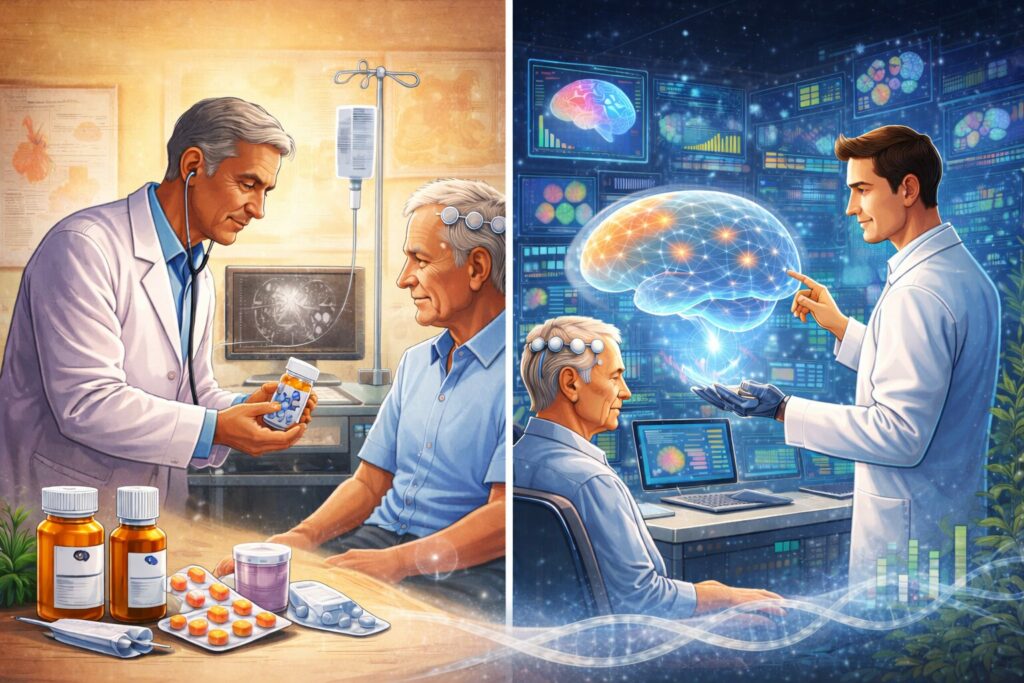
When people hear “the future of Parkinson’s disease,” they often imagine something dramatic. A breakthrough. A cure. A moment when everything changes at once.
That is rarely how the future actually arrives. For most people living with Parkinson’s disease, change happens quietly and unevenly. A medication adjustment. A new symptom that needs attention. A conversation that feels slightly different than it did before.
The future does not replace the present. It slowly blends into it. Most progress shows up in small shifts rather than clear milestones.
This gap between expectation and reality is where confusion often begins. AI predictions look forward. Treatment decisions happen now. Understanding how those two coexist matters more than imagining what might come next.
What AI is really being asked to do
AI is not being asked to cure Parkinson’s disease. It is not searching for a single answer or solution.
Instead, it is being asked practical questions. How do symptoms usually change over time? Which treatments tend to help which people? When do adjustments commonly become necessary? What patterns appear before changes are obvious?
These are questions about timing, not destiny. AI works by looking at many lives at once. Movement data. Sleep patterns. Medication responses. Daily activity. Information that already exists but is often scattered.
AI does not understand individuals better than people do.
It understands patterns across many people. That makes prediction possible, but only in probabilities. Not promises.
What today’s treatments are built to do
Most Parkinson’s disease treatments are not designed for prediction. They are designed for response.
Medications help manage symptoms that are already present. When they work, daily life often improves in noticeable ways. When they stop working as well, they are adjusted. This cycle is familiar to most people living with Parkinson’s disease.
Deep Brain Stimulation works in a similar way. It does not stop the disease. It helps control specific symptoms when medication alone is no longer enough. Newer systems, such as adaptive DBS, adjust stimulation in real time, but the goal remains the same.
Therapies, exercise, and lifestyle changes also focus on the present. They support function and independence now. Today’s treatments meet Parkinson’s disease where it is, not where it might be years from now.
Where AI predictions and treatment start to meet
The real change begins when prediction supports decisions rather than replaces them.
AI does not tell someone what treatment to take. It helps reveal patterns that guide timing and choice. Who often responds well to certain medications. When changes are commonly needed. Which symptoms tend to appear together.
This can reduce trial and error. Care becomes more prepared and less reactive. Decisions feel more informed, even when uncertainty remains.
The treatments themselves do not suddenly change.
What changes is how confidently and thoughtfully they are used.
Get Your Free Parkinson’s Medication Management Diary
Download your free printable diary to easily track your medications, symptoms, and doses.
Where prediction still has limits
AI cannot tell someone exactly how their Parkinson’s disease will progress. It cannot predict how a person will feel about those changes or how they will adapt.
Data reflects averages. Real lives rarely do. Personal priorities, resilience, environment, and daily context all shape experience in ways data cannot fully capture.
There is also an emotional side to prediction. Some people want to know as much as possible as early as possible. Others prefer to focus on what is manageable now. Prediction only helps when it leaves room for choice and personal control.
What the near future will likely feel like
For most people, the future of Parkinson’s disease will not feel dramatic or revolutionary.
- It will feel more flexible.
- More personal.
- Less rushed.
Appointments may involve more listening and fewer fixed timelines. Conversations may start earlier, even if interventions do not. Care plans may change more gradually, guided by trends rather than sudden declines.
AI will mostly stay in the background. Supporting decisions quietly rather than leading them.
A future that is already here
The future of Parkinson’s disease is not waiting for a headline moment or a single discovery.
It is already shaping care. Slowly. Unevenly. Quietly. In how treatment is timed, how symptoms are discussed, and how uncertainty is handled.
AI adds perspective, not certainty. Treatments remain grounded in reality. Progress shows up in how well care fits the person living with the disease.
For most people with Parkinson’s disease, that kind of progress matters more than any bold promise.
AI Predictions vs Today’s Treatments
AI looks ahead
- Identifies patterns across many people
- Estimates likely changes over time
- Supports timing and planning
- Works in probabilities, not promises
Today’s treatments respond now
- Manage symptoms that are present
- Adjust as needs change
- Focus on daily function and quality of life
- Grounded in what helps today
Disclaimer: The information shared here should not be taken as medical advice. The opinions presented here are not intended to treat any health conditions. For your specific medical problem, consult with your healthcare provider.
We’re building a simple Parkinson’s tracking app
Free during early access. Designed for daily symptom tracking without complexity.