
Brain imaging has long supported Parkinson’s diagnosis, but interpreting scans, especially in early cases, remains challenging. Recent advances in AI brain imaging for Parkinson’s disease show that artificial intelligence can help identify subtle patterns in DaTscan and MRI images that are difficult to detect through visual assessment alone.
This article examines what the latest research reveals, how AI is being used responsibly alongside clinicians, and what this could mean for earlier and more confident diagnosis.
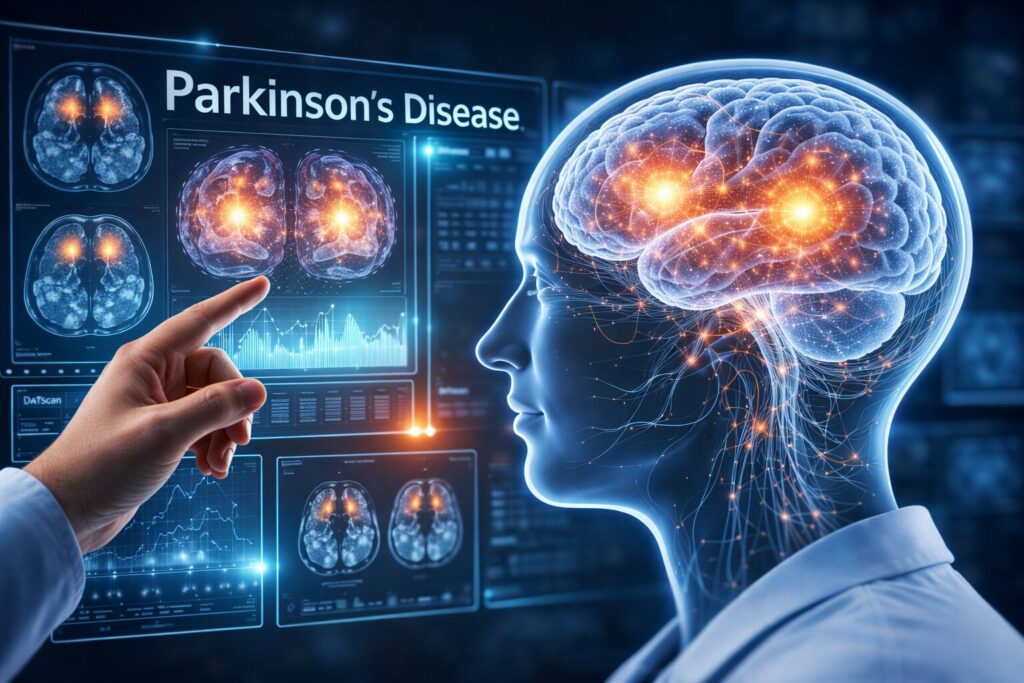
Parkinson’s disease is primarily a clinical diagnosis, based on symptoms and neurological examination. However, imaging often plays a supporting role, particularly when symptoms are mild, atypical, or overlap with other conditions.
Two imaging approaches are commonly discussed in Parkinson’s care:
- DaTscan, which visualizes dopamine transporter activity in the brain
- MRI, which captures structural and functional brain features
While these tools are valuable, they have limitations. Early-stage Parkinson’s disease may produce changes that are subtle, asymmetric, or difficult to interpret consistently. Visual readings can vary between clinicians, and borderline cases can remain uncertain.
This is where artificial intelligence is beginning to contribute.
The challenge: interpreting brain scans isn’t always straightforward
Even experienced specialists can face difficulties when reading brain images related to Parkinson’s disease:
- Early dopamine loss may be mild or uneven
- Normal aging can resemble disease-related changes
- Visual interpretation is subjective
- Small differences can be missed in busy clinical settings
Traditional imaging relies heavily on human judgment. AI offers a complementary approach, one that evaluates images quantitatively and consistently across large datasets.
The DaTscan + AI study at the center of this breakthrough
One of the most influential studies in this area was published in the European Journal of Nuclear Medicine and Molecular Imaging. Researchers investigated whether deep learning could improve the classification of Parkinson’s disease using DaTscan imaging.
Their goal was not to replace clinicians, but to determine whether AI could support interpretation by identifying patterns that may be difficult to recognize visually.
How the study was conducted
The researchers used dopamine transporter (DAT) PET brain scans from a large group of participants, including healthy controls and people with different forms of Parkinsonism, such as idiopathic Parkinson’s disease (IPD), multiple system atrophy (MSA), and progressive supranuclear palsy (PSP).
Instead of relying only on visual interpretation, the team trained a 3D deep convolutional neural network to learn to distinguish DAT patterns directly from the scans. The model learned to recognize differences in signal distribution and spatial patterns that can help separate these conditions.
Importantly, the approach analyzes the scan in a comprehensive way (learning features from the image itself), rather than depending on a single pre-defined measurement alone.
What the AI was able to detect
The deep-learning system showed strong performance for the differential diagnosis of Parkinsonism based on DAT PET imaging. In practical terms, the study supports that AI can:
- learn disease-relevant DAT patterns from imaging data
- identify spatial signal differences that may be subtle on visual review
- support more consistent classification when distinguishing between parkinsonian syndromes
These findings suggest that AI can act as a reliable analytical layer—supporting clinicians by highlighting patterns that may otherwise be overlooked.
Why this matters clinically
The significance of this research lies not in replacing existing diagnostic methods, but in strengthening them.
1. Greater confidence in early or uncertain cases
In early-stage Parkinson’s disease or atypical presentations, imaging results may appear borderline or difficult to interpret with certainty. AI-based analysis can provide additional quantitative support when clinical findings are inconclusive. By comparing an individual scan against large reference datasets, AI can help highlight patterns that align more closely with Parkinson’s-related changes. This additional layer of analysis may support clinicians when deciding whether further monitoring, follow-up imaging, or additional assessments are warranted.
2. More consistent interpretation across settings
AI evaluates brain images using the same criteria every time, helping reduce variability between readers and institutions. This consistency is particularly valuable in settings where access to specialized imaging expertise may vary. By applying standardized analysis across scans, AI can help ensure that similar imaging patterns are interpreted in a more uniform way. This may improve comparability of results across clinics, hospitals, and research studies.
3. Decision support, not automation
The study emphasizes AI as a tool for assisting clinicians—not making diagnoses independently. Final decisions remain firmly in human hands. AI outputs are intended to be interpreted alongside clinical examination, patient history, and other diagnostic information. Used in this way, AI can support more informed decision-making while preserving the central role of clinical judgment.
Get Your Free Parkinson’s Medication Management Diary
Download your free printable diary to easily track your medications, symptoms, and doses.
Where MRI-based AI fits into the picture
While DaTscan focuses on dopamine transporter function, MRI provides complementary information about brain structure and, in some studies, brain connectivity.
Research published in Frontiers in Neurology has shown that machine-learning models applied to MRI data can identify patterns associated with Parkinson’s disease that may not be apparent through visual inspection alone. These patterns are typically identified by analyzing subtle, distributed changes across the brain rather than a single visible abnormality.
Examples of MRI features explored in this and related studies include:
- structural differences in specific brain regions
- alterations in brain tissue characteristics measured across multiple areas
- complex imaging patterns that are difficult to detect through routine visual review
MRI-based AI does not replace DaTscan or clinical evaluation, but it expands the imaging toolkit available to clinicians and researchers. Together, these approaches support a multimodal imaging strategy, where AI helps integrate information from multiple sources to support Parkinson’s disease assessment.
Research Snapshot
AI brain imaging for Parkinson’s disease using dopamine transporter imaging, supported by MRI-based machine learning research.
Whole-brain imaging data examined by deep-learning models to identify subtle spatial patterns linked to Parkinson’s disease.
AI detects imaging patterns and asymmetries that may be difficult to assess consistently through visual interpretation alone.
AI-supported imaging analysis can improve consistency and confidence when interpreting brain scans, particularly in early or uncertain cases.
AI acts as decision support for clinicians and does not replace neurological evaluation or diagnosis.
Not a standalone diagnostic tool and not a replacement for clinical judgment.
What AI sees that humans may miss
AI systems differ from human readers in a key way: they analyze thousands of images simultaneously and learn from population-level patterns.
This allows AI to:
- Compare a single scan against large reference datasets
- Identify subtle statistical differences
- Recognize complex spatial relationships
- Maintain consistency across repeated evaluations
These strengths make AI particularly useful in conditions like Parkinson’s disease, where early changes are often gradual and heterogeneous.
Limitations and caution are still essential
Despite promising results, AI-based brain imaging has clear limitations:
- Imaging alone cannot diagnose Parkinson’s disease
- AI models depend on the quality and diversity of training data
- Results must be interpreted within full clinical context
- Further validation is required across broader populations
Researchers consistently emphasize that AI should complement, not replace, neurological expertise.
What this research points to next
These studies suggest that AI brain imaging for Parkinson’s disease is moving toward a practical role in clinical decision support. As imaging datasets expand and models improve, AI-assisted interpretation may become more integrated into routine care, particularly for early diagnosis and complex cases.
Rather than relying on a single test, the future of Parkinson’s disease diagnosis is likely to involve multimodal assessment, combining clinical evaluation, movement data, imaging, and AI-driven analysis.
Takeaway
AI-assisted analysis of DaTscan and MRI images can help clinicians interpret subtle brain changes more consistently, supporting earlier and more confident Parkinson’s disease diagnosis when used alongside clinical judgment.
Disclaimer: The information shared here should not be taken as medical advice. The opinions presented here are not intended to treat any health conditions. For your specific medical problem, consult with your healthcare provider.
Track your Parkinson’s day in less than a minute
The Parkinson’s Daily Diary App lets you record symptoms, medications, daily notes and doctor ready report in under a minute.